354 8-bit RISC CPU
354 : 8-bit RISC CPU
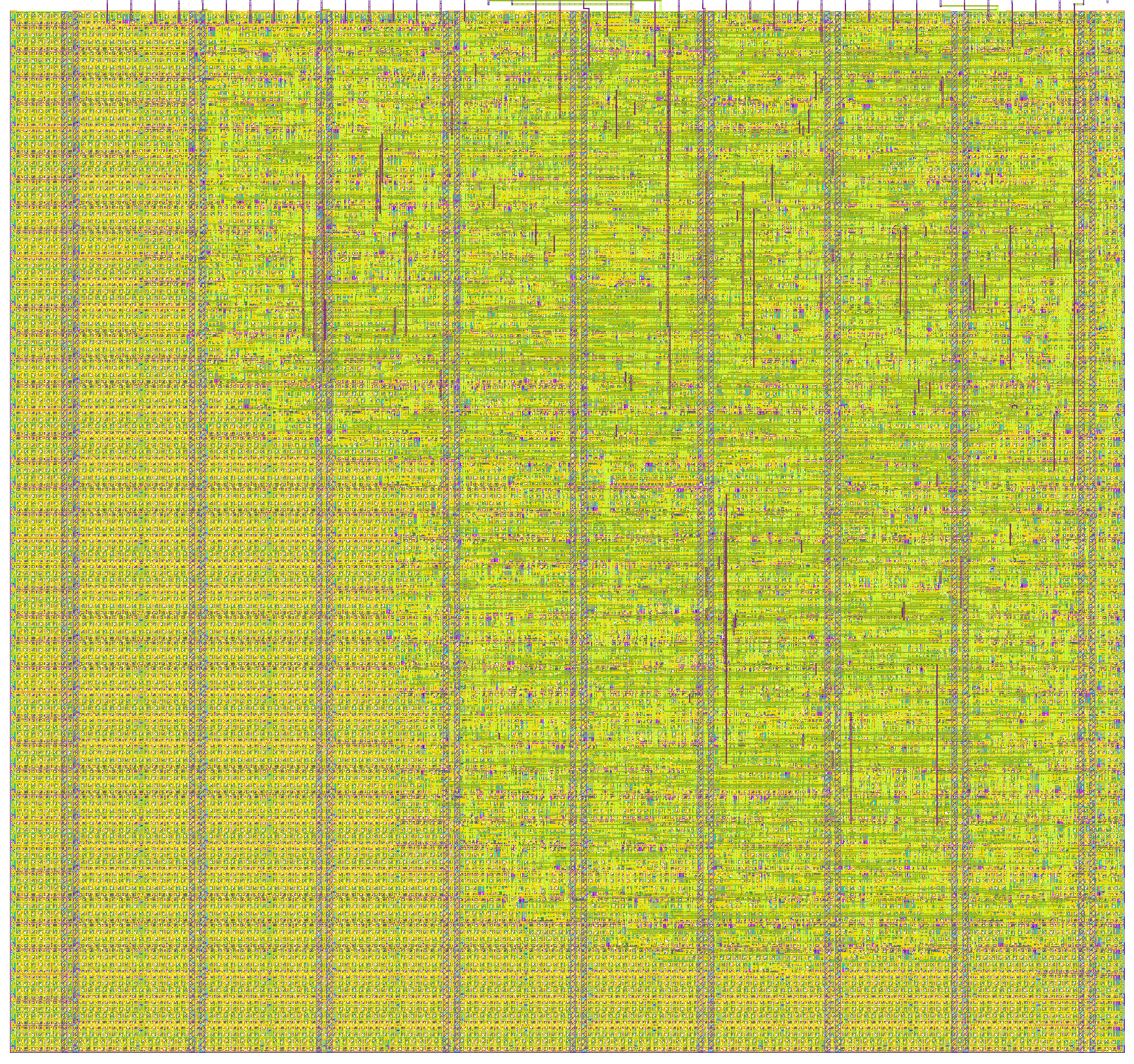
- Author: Jan Kozina
- Description: 8-bit RISC CPU with ALU, registers, data memory and external 16-bit instructions
- GitHub repository
- Open in 3D viewer
- Open in Tiny Tapeout Explorer
- Clock: 5000000 Hz
Overview
This project is an 8-bit RISC CPU written in Verilog for Tiny Tapeout GF. The CPU is intentionally small and simple: it has no internal program ROM, so an external controller provides one 16-bit instruction at a time through the Tiny Tapeout input pins.
The design executes the instruction and returns either the instruction result or the current program counter on the 8-bit output bus.
Main building blocks:
- 8-bit program counter
- 8 x 8-bit register file
- 8-bit ALU
- immediate generator
- branch-control logic
- 16-byte data memory
The target clock configured for this project is 5 MHz.
Pin Interface
The instruction bus is 16 bits wide and is split across ui_in and uio_in.
The bidirectional uio pins are used only as inputs.
| Tiny Tapeout signal | Direction | CPU signal |
|---|---|---|
ui_in[7:0] |
input | instruction[15:8] |
uio_in[7:0] |
input | instruction[7:0] |
uo_out[7:0] |
output | CPU result / PC output |
uio_out[7:0] |
output | Always 0 |
uio_oe[7:0] |
output | Always 0 |
clk |
input | system clock |
rst_n |
input | active-low reset |
ena |
input | Tiny Tapeout enable, unused internally |
To drive an instruction:
ui_in  = instruction[15:8]
uio_in = instruction[7:0]
For example, instruction 0x1843 is driven as:
ui_in  = 0x18
uio_in = 0x43
This means ui_in[0] carries instruction[8], and uio_in[0] carries
instruction[0].
Execution Timing
The CPU alternates between two internal phases:
- NOP / PC phase
- execute phase
For normal use, keep each instruction stable for two clock cycles.
During the execute phase, uo_out shows the instruction result. On the next
clock edge, register, memory, and PC updates are committed. During the following
NOP / PC phase, uo_out shows the current program counter.
One instruction slot looks like this:
| Moment | External action / observation |
|---|---|
| Before clock edge 1 | Drive the 16-bit instruction and keep it stable |
| After clock edge 1 | uo_out shows the instruction result |
| Clock edge 2 | The register file, data memory, and PC update |
| After clock edge 2 | uo_out shows the updated PC |
Typical external-controller sequence:
- Drive
rst_n = 0for reset. - Release reset with
rst_n = 1. - Put a 16-bit instruction on
{ui_in, uio_in}. - Hold the instruction stable for two clock cycles.
- Read the result from
uo_out. - Change to the next instruction and repeat.
Architecture Details
Register File
There are eight 8-bit general-purpose registers, r0 through r7.
After reset:
| Register | Value |
|---|---|
r0 |
0 |
r1 |
0 |
r2 |
0 |
r3 |
0 |
r4 |
0 |
r5 |
0 |
r6 |
0 |
r7 |
0 |
Data Memory
The data memory contains 16 bytes. Address calculations are 8-bit, but only the lower 4 address bits select the memory entry. In other words, data-memory addresses wrap modulo 16.
Example:
0x08, 0x18, and 0xF8 all access memory index 8
Program Counter
The program counter is 8 bits wide. Normal instructions increment the PC by 1. Taken branches update the PC using:
next_pc = pc + imm6
PC arithmetic wraps modulo 256.
Instruction Encoding
This is a compact custom ISA for this Tiny Tapeout design, not a standard RISC-V-compatible encoding.
The opcode is always stored in instruction[15:12].
R-Type Format
R-type instructions use two source registers, one destination register, and a 3-bit ALU function field.
| Bits | Field |
|---|---|
[15:12] |
opcode, always 0000 |
[11:9] |
destination register rd |
[8:6] |
source register rs1 |
[5:3] |
source register rs2 |
[2:0] |
ALU function funct3 |
Encoding formula:
instruction = (rd << 9) | (rs1 << 6) | (rs2 << 3) | funct3
Immediate Format
Most non-R-type instructions use a source/base register and a 6-bit immediate.
| Bits | Field |
|---|---|
[15:12] |
opcode |
[11:9] |
destination register rd, or unused depending on instruction |
[8:6] |
source/base register rs1 |
[5:0] |
immediate imm6 |
Encoding formula:
instruction = (opcode << 12) | (rd << 9) | (rs1 << 6) | (imm6 & 0x3F)
The imm6 value is sign-extended to 8 bits before ALU use. For example,
imm6 = 0x3F represents -1, which becomes 0xFF in the 8-bit datapath.
The LI instruction is a special case:
instruction = (0x2 << 12) | (rd << 9) | imm8
Store And Branch Format
Store and branch instructions use a split 6-bit immediate so that rs2 can be
encoded independently.
| Bits | Field |
|---|---|
[15:12] |
opcode |
[11:9] |
immediate imm6[5:3] |
[8:6] |
source/base register rs1 |
[5:3] |
source register rs2 |
[2:0] |
immediate imm6[2:0] |
Encoding formula:
instruction = (opcode << 12)
            | (((imm6 >> 3) & 0x7) << 9)
            | (rs1 << 6)
            | (rs2 << 3)
            | (imm6 & 0x7)
For SW, rs2 selects the register whose value is written to data memory. For
branch instructions, rs1 and rs2 are compared, while imm6 is used as the
signed PC offset when the branch is taken.
Instruction Set
| Opcode | Mnemonic | Operation |
|---|---|---|
0000 |
R-type | ALU operation selected by funct3 |
0001 |
ADDI | rd = rs1 + imm6 |
0010 |
LI | rd = imm8 |
0011 |
LW | rd = memory[rs1 + imm6] |
0100 |
SW | memory[rs1 + imm6] = rs2 |
0101 |
BEQ | branch when rs1 == rs2 |
0110 |
BNE | branch when rs1 != rs2 |
0111 |
BLT | branch when rs1 < rs2 |
1000 |
ANDI | rd = rs1 & imm6 |
1001 |
ORI | <code>rd = rs1 | imm6</code> |
1010 |
XORI | rd = rs1 ^ imm6 |
1011 |
SLLI | rd = rs1 << imm6 |
1100 |
SRLI | rd = rs1 >> imm6 |
1111 |
NOP | no operation |
NOP and unsupported opcodes leave the PC, registers, and data memory unchanged.
ALU Functions
R-type instructions use funct3.
funct3 |
Operation |
|---|---|
000 |
ADD |
001 |
SUB |
010 |
AND |
011 |
OR |
100 |
XOR |
101 |
Shift left |
110 |
Shift right |
111 |
Defaults to ADD |
Shift operations use the lower three bits of the second ALU operand as the shift amount, giving a range from 0 to 7 positions.
The branch instructions use the SUB path internally to compare rs1 and rs2
and generate comparison flags. The less-than comparison is signed, so both
operands are interpreted as 8-bit two's-complement values.
Worked Examples
Example 1: Basic Register And ALU Sequence
| Step | Instruction | Encoding | Result on uo_out |
|---|---|---|---|
| 1 | LI r1, 4 |
0x2204 |
4 |
| 2 | ADDI r4, r1, 3 |
0x1843 |
7 |
| 3 | ADDI r5, r4, 2 |
0x1B02 |
9 |
| 4 | ADD r6, r4, r5 |
0x0D28 |
16 |
Explanation:
r1 = 4
r4 = 4 + 3 = 7
r5 = 7 + 2 = 9
r6 = 7 + 9 = 16
Example 2: Load Immediate And Negative Immediate
| Instruction | Encoding | Result |
|---|---|---|
LI r6, 42 |
0x2C2A |
r6 = 42 |
ADDI r7, r6, -1 |
0x1FBF |
r7 = 41 |
The second instruction uses imm6 = 0x3F, which sign-extends to 0xFF
and acts as -1 in the 8-bit datapath.
Example 3: Store And Load
| Step | Instruction | Encoding | Effect |
|---|---|---|---|
| 1 | LI r1, 4 |
0x2204 |
r1 = 4 |
| 2 | ADDI r4, r4, 16 |
0x1910 |
r4 = 16 |
| 3 | SW r1, [r4 + 8] |
0x4308 |
writes 4 to memory index 8 |
| 4 | LW r6, [r4 + 8] |
0x3D08 |
r6 = 4 |
The address is 16 + 8 = 24. Because data memory uses only the lower 4 address
bits, address 24 accesses memory index 8.
Example 4: Taken Branch
| Step | Instruction | Encoding | Behavior |
|---|---|---|---|
| 1 | LI r1, 4 |
0x2204 |
r1 = 4 |
| 2 | BEQ r1, r1, +4 |
0x504C |
branch is taken |
After LI, the current PC is 1, so the taken branch updates it to:
pc + imm6 = 1 + 4 = 5
Running The RTL Simulation
The repository includes a cocotb end-to-end testbench that drives instructions through the Tiny Tapeout top-level pins and checks reset behavior, ALU instructions, immediate instructions, memory access, branches, and PC updates.
From the repository root:
cd test
python3 -m venv .venv
source .venv/bin/activate
pip install -r requirements.txt
make
The expected result is:
TESTS=1 PASS=1 FAIL=0
Running Gate-Level Simulation
After local hardening or a successful GDS flow, copy the powered netlist into the
test directory and run the test with GATES=yes.
For GF180 local hardening, the netlist is normally:
runs/wokwi/final/pnl/tt_um_8bit_risc_cpu.pnl.v
Example:
export PDK=gf180mcuD
export PDK_ROOT=/path/to/pdk/root

cp runs/wokwi/final/pnl/tt_um_8bit_risc_cpu.pnl.v test/gate_level_netlist.v
cd test
make -B GATES=yes
The expected result is again:
TESTS=1 PASS=1 FAIL=0
Running Local Hardening
This project targets Tiny Tapeout GF, so Tiny Tapeout tooling should be run with
the --gf flag.
If the tt/ support-tools directory is not present, clone it first:
git clone https://github.com/TinyTapeout/tt-support-tools tt
Typical local setup:
python3 -m venv ~/ttsetup/venv
source ~/ttsetup/venv/bin/activate
pip install --upgrade pip
pip install -r tt/requirements.txt

export PDK_ROOT=~/ttsetup/pdk
export PDK=gf180mcuD
export LIBRELANE_TAG=3.0.3
pip install librelane==$LIBRELANE_TAG
Create the merged config and run hardening:
./tt/tt_tool.py --create-user-config --gf
./tt/tt_tool.py --harden --gf
./tt/tt_tool.py --print-warnings --gf
If the PDK is installed through Ciel but gate-level simulation cannot find
gf180mcuD, enable the installed GF180 PDK:
ciel enable --pdk-root ~/ttsetup/pdk --pdk-family gf180mcu <version>
Then rerun the hardening or gate-level simulation command.
If hardening succeeds, the final GDS, LEF, netlists, and metrics are placed under:
runs/wokwi/final/
Hardware Usage
On real Tiny Tapeout hardware, an external controller such as a microcontroller, FPGA, or test setup must provide the clock, reset, and instruction input.
The most important rule is to hold each instruction stable for two clock cycles.
Then read uo_out during the execute phase for the result and during the next
NOP / PC phase for the updated program counter.
IO
| # | Input | Output | Bidirectional |
|---|---|---|---|
| 0 | instruction[8] | CPU_Out[0] | instruction[0] |
| 1 | instruction[9] | CPU_Out[1] | instruction[1] |
| 2 | instruction[10] | CPU_Out[2] | instruction[2] |
| 3 | instruction[11] | CPU_Out[3] | instruction[3] |
| 4 | instruction[12] | CPU_Out[4] | instruction[4] |
| 5 | instruction[13] | CPU_Out[5] | instruction[5] |
| 6 | instruction[14] | CPU_Out[6] | instruction[6] |
| 7 | instruction[15] | CPU_Out[7] | instruction[7] |