549 Ring Oscillator PVT Sensor & TRNG (GF180)
549 : Ring Oscillator PVT Sensor & TRNG (GF180)
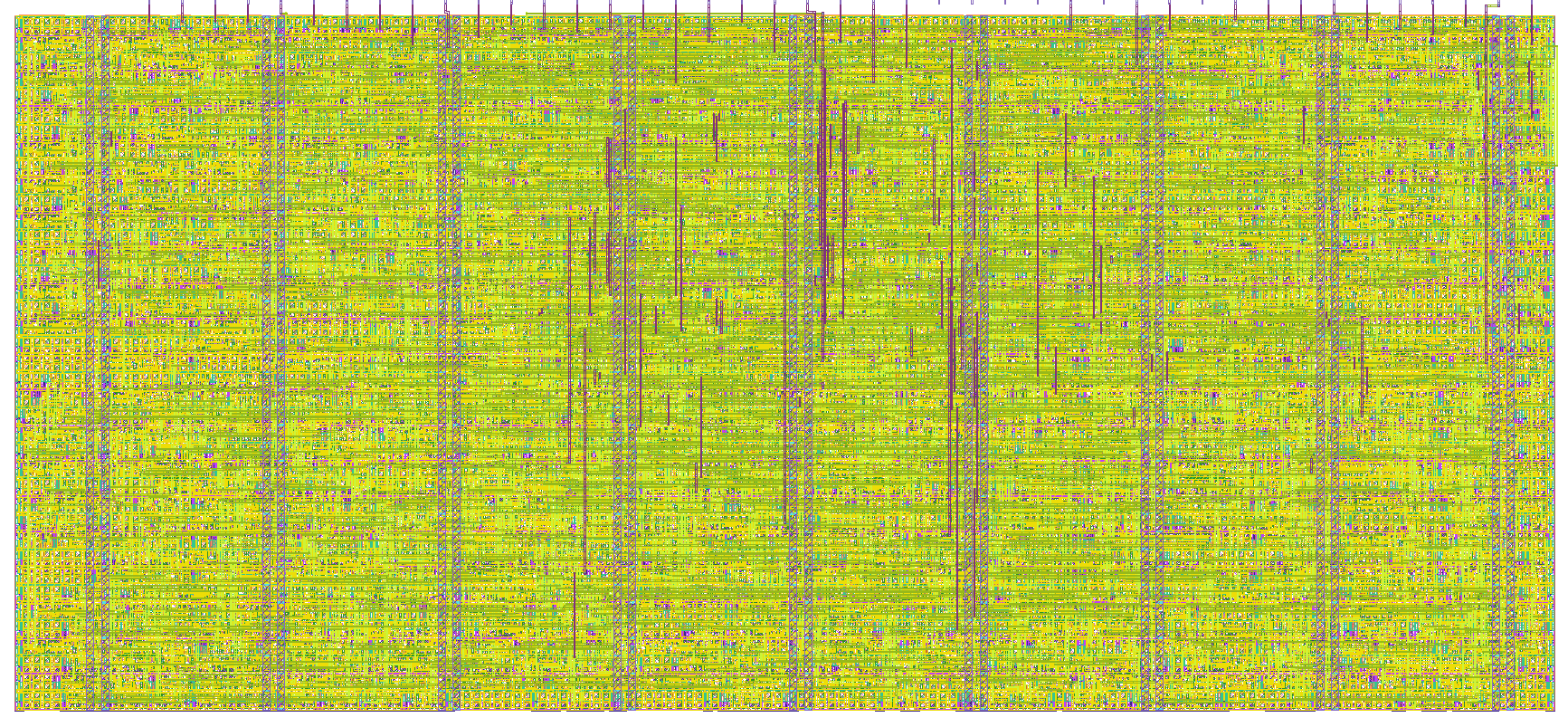
- Author: Prof. Santhosh Sivasubramani, IIT Delhi
- Description: GF180mcuD port of 5 SPI-configurable ring oscillators (7/11/15/21/31 gf180 stages) with 16-bit frequency counter, auto gate timer, configurable prescaler, XOR jitter TRNG, per-RO health history, differential RO beat-frequency mode, and frequency-bounds health monitor for cross-foundry PVT characterization
- GitHub repository
- Open in 3D viewer
- Open in Tiny Tapeout Explorer
- Clock: 50000000 Hz
How it works
This design is the GF180mcuD port of our SKY130 ring-oscillator PVT sensor (tt_um_santhosh_ring_osc). It implements five gatable ring oscillators (7, 11, 15, 21, and 31 gf180mcu_fd_sc_mcu7t5v0__inv_1 inverter-chain stages, each with a gf180mcu_fd_sc_mcu7t5v0__nand2_1 enable gate) together with a 16-bit frequency counter, a three-stage CDC synchronizer, an auto gate timer, a configurable prescaler, an XOR-jitter true random number generator (TRNG), a frequency-bounds health monitor, and a differential (beat-frequency) measurement mode. It is intended for cross-foundry PVT characterization: pairing this tile with the SKY130 sibling on the same chip family lets us compare ring-oscillator frequency, TRNG statistics, and aging drift between the two nodes from identical RTL.
All oscillator stages are tagged with (* keep, dont_touch *) so that the synthesis and placement flows preserve them as physical inverter/NAND chains rather than optimizing them into constant nets.
The block supports two control modes, selected by ui_in[6] (spi_mode):
- Parallel mode (
spi_mode=0) —ro_sel[2:0](ui_in[2:0]) chooses one of the five ROs,cnt_enable(ui_in[3]) starts/stops counting, a rising edge oncnt_clear_latch(ui_in[4]) latches the 16-bit count and clears the accumulator, andbyte_sel(ui_in[5]) multiplexesuo_outbetween the low (0) and high (1) bytes of the latched count.uio_out[4]is the overflow flag,uio_out[5]exposes the raw RO output,uio_out[6]the synchronized RO output, anduio_out[7]ismeas_donefrom the auto gate timer. - SPI mode (
spi_mode=1) — a 16-bit SPI slave (Mode 0, MSB first; CS onuio_in[0], MOSI onuio_in[1], MISO onuio_out[2], SCK onuio_in[3]) exposes a register file:
| Addr | Name | Access | Description |
|---|---|---|---|
| 0x00 | reg_ctrl |
R/W | [0]=auto_gate_start (self-clear); [1]=clear_meas_done; [2]=clear_health_history (self-clear, new on GF) |
| 0x01 | reg_ro_sel |
R/W | [2:0] RO select |
| 0x02 | reg_ro_en |
R/W | [4:0] per-RO enable — reset default 0x1F |
| 0x03 | reg_gate_l |
R/W | gate-time low byte |
| 0x04 | reg_gate_h |
R/W | gate-time high byte |
| 0x05 | reg_prescale |
R/W | [1:0] prescaler (÷8/÷16/÷32/÷64; reset default ÷16) |
| 0x06 | reg_status |
R | [0]=gate_active, [1]=overflow, [2]=meas_done |
| 0x07 | reg_count_l |
R | latched count [7:0] |
| 0x08 | reg_count_h |
R | latched count [15:8] |
| 0x09 | reg_trng_ctrl |
R/W | [0]=trng_en, [1]=health_en, [2]=diff_mode |
| 0x0A | reg_diff_sel |
R/W | [2:0] RO_B selector for beat/XOR modes |
| 0x0B | reg_health_lo |
R/W | expected frequency lower bound |
| 0x0C | reg_health_hi |
R/W | expected frequency upper bound |
| 0x0D | reg_trng_data |
R | 8-bit XOR-jitter byte |
| 0x0E | reg_health_status |
R | [0]=below, [1]=above, [2]=stuck, [3]=ok, [4]=trng_valid |
| 0x0F | reg_hh_stuck |
R | per-RO stuck history (sticky; new on GF) |
| 0x10 | reg_hh_below |
R | per-RO below-lo history (sticky; new on GF) |
The raw RO is synchronized into the system clock domain through a 3-stage flip-flop synchronizer (with an optional ÷8/÷16/÷32/÷64 prescaler ahead of it) before being rising-edge detected and counted. When diff_mode is set, two user-selected ROs are XORed prior to counting, producing the beat frequency |f_A − f_B|, which is very sensitive to local PVT mismatch. The TRNG collects XOR jitter bits into an 8-bit register readable at reg_trng_data; the health monitor flags the selected RO against reg_health_lo/reg_health_hi bounds into reg_health_status.
New on GF: per-RO health history
GF180 1×1 tile area (~55 712 µm²) holds more gates than SKY130 1×1 (~17 954 µm²) after process-scaling, so on this port we re-enable a feature that was deferred on the SKY submission: two sticky 5-bit history registers (reg_hh_stuck, reg_hh_below) that latch a bit per RO whenever that RO is the currently-selected one and is flagged stuck or below-lo by the health monitor. The registers survive until explicitly cleared by writing reg_ctrl[2]=1 (self-clearing pulse). This makes aging and fault detection possible without continuously polling from the host.
How to test
- Apply reset (
rst_nlow for ≥10 clock cycles, then release). - Simple parallel measurement: set
spi_mode=0, writero_sel[2:0]to select RO (0=7, 1=11, 2=15, 3=21, 4=31), pulsecnt_enablehigh for the desired gate time, pulsecnt_clear_latchhigh for ≥1 cycle to latch the count, then togglebyte_seland readuo_outto retrieve the low and high bytes of the 16-bit count. Checkuio_out[4]for overflow. - SPI-timed measurement: set
spi_mode=1, writereg_gate_l/hwith the desired gate cycle count, setreg_ctrl[0]=1to start the auto gate timer, pollreg_status(or watchuio_out[7]=meas_done) for completion, and readreg_count_l/reg_count_h. Writereg_ctrl[1]=1to clearmeas_donebefore the next run. - TRNG: in SPI mode, set
reg_trng_ctrl[0]=1and enable at least two ROs; readreg_trng_data(0x0D) to consume 8 jitter-XOR bits. - Health monitor: set
reg_trng_ctrl[1]=1, writereg_health_lo/reg_health_hito the expected frequency window, and readreg_health_status(0x0E) after each gate. For long-term audits, sweep all 5 ROs and readreg_hh_stuck(0x0F) /reg_hh_below(0x10); writereg_ctrl[2]=1to clear. - Differential mode: set
reg_trng_ctrl[2]=1, setreg_ro_selto RO_A andreg_diff_selto RO_B, then gate as usual — the count represents |f_A − f_B|.
A cocotb test suite (23 tests in test/test.py) exercises parallel counting, SPI register roundtrip, auto gate timing, prescaler selection, TRNG/health/differential modes, uio_oe direction control, and the new GF-only health-history registers and self-clearing reg_ctrl[2]. All tests pass on the RTL. Gate-level simulation is intentionally skipped in CI because the real gf180mcu inverter-chain ring oscillators produce ≈10⁹ events/s of simulated time and are not tractable in icarus.
External hardware
No external hardware is required for core operation. For SPI control, an SPI master (microcontroller or FPGA) is connected to uio[0] (CS), uio[1] (MOSI), uio[2] (MISO), uio[3] (SCK) at any clock rate up to half the system clock. Optional: an oscilloscope on uio_out[5] (raw RO) and uio_out[6] (synced RO) for direct frequency observation, and any 8-bit digital sink (logic analyzer or microcontroller GPIO) on uo_out[7:0] for reading the latched count byte in parallel mode.
IO
| # | Input | Output | Bidirectional |
|---|---|---|---|
| 0 | ro_sel[0] | freq_count[0] | spi_cs_n |
| 1 | ro_sel[1] | freq_count[1] | spi_mosi |
| 2 | ro_sel[2] | freq_count[2] | spi_miso |
| 3 | cnt_enable | freq_count[3] | spi_sck |
| 4 | cnt_clear_latch | freq_count[4] | overflow |
| 5 | byte_sel | freq_count[5] | ro_raw_out |
| 6 | spi_mode | freq_count[6] | ro_synced |
| 7 | freq_count[7] | meas_done |