103 Bitty

103 : Bitty
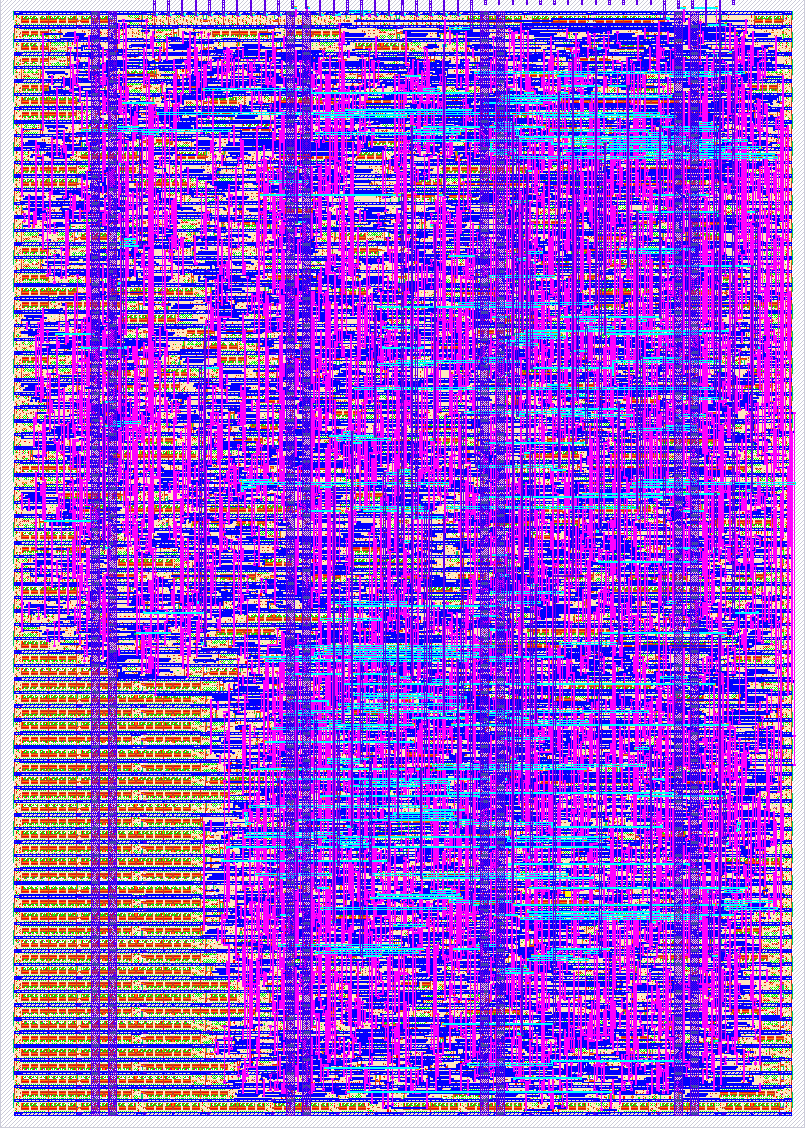
Design render

Bitty System: RTL Design and Verification Framework

This project implements a custom 16-bit processing system, including hardware modules for program counter (PC), instruction fetch, branch logic, UART communication, and integration with the BittyEmulator for co-simulation. The provided system allows robust testing of a Verilog-based design using a Python-based cocotb testbench. The testbench orchestrates data transfer via UART, interacts with shared memory, and verifies execution against the emulator.

System Overview

Core Components

Без имени

  1. Program Counter (PC):

    • Handles sequential and branch-based instruction execution.
    • Interfaces directly with the branch logic for control flow changes.
  2. Instruction Fetch Unit:

    • Reads and decodes instructions from memory.
    • Supplies data to the rest of the system.
  3. Branch Logic:

    • Evaluates branch conditions and modifies the PC as needed.
  4. UART Module:

    • Supports data exchange between the testbench and the DUT.
    • Operates with customizable baud rates and clock frequencies.
  5. Bitty Emulator:

    • Acts as a functional reference model.
    • Validates the outputs and internal states of the hardware implementation.
    • Includes: Control Unit, registers, ALU, mux

Bitty Top Module

Memory Map
  • Shared Memory:
    • Synchronizes data between the testbench, the hardware design (DUT), and the emulator.
    • Supports up to 256 entries.
  • Instruction Set:
    • Defined in instructions_for_em.txt, loaded by the testbench for execution. Here’s the revised version written as a description of a fully implemented system:

Instruction Set Architecture: Fully Implemented 16-bit Processor

Overview

This document outlines the complete instruction set architecture (ISA) for a 16-bit processor, detailing its capabilities, operations, and encoding formats. The ISA is designed to deliver robust functionality for arithmetic, logical, control flow, and memory operations while maintaining a simple, efficient structure.

The processor's instruction set enables dynamic memory interactions, conditional branching, and a wide range of data manipulation tasks, providing the foundation for executing complex algorithms and software applications.


Instruction Set

Arithmetic and Logical Operations

The processor supports both register-to-register and immediate operations, enabling developers to perform computations efficiently.

Register-to-Register Instructions:

изображение

  1. add rx, ry: Adds the value in ry to rx.

    • Operation: rx = rx + ry
  2. sub rx, ry: Subtracts the value in ry from rx.

    • Operation: rx = rx - ry
  3. and rx, ry: Performs a bitwise AND between rx and ry.

    • Operation: rx = rx & ry
  4. or rx, ry: Performs a bitwise OR between rx and ry.

    • Operation: rx = rx | ry
  5. xor rx, ry: Performs a bitwise XOR between rx and ry.

    • Operation: rx = rx ^ ry
  6. shl rx, ry: Shifts the bits in rx left by the number of positions specified in ry.

    • Operation: rx = rx << ry
  7. shr rx, ry: Shifts the bits in rx right by the number of positions specified in ry.

    • Operation: rx = rx >> ry
  8. cmp rx, ry: Compares the values in rx and ry.

    • Operation:
      • rx = 0 if rx == ry
      • rx = 1 if rx > ry
      • rx = 2 if rx < ry
Immediate Instructions:

изображение

  1. addi rx, #i: Adds the immediate value #i to rx.

    • Operation: rx = rx + #i
  2. subi rx, #i: Subtracts the immediate value #i from rx.

    • Operation: rx = rx - #i
  3. andi rx, #i: Performs a bitwise AND between rx and #i.

    • Operation: rx = rx & #i
  4. ori rx, #i: Performs a bitwise OR between rx and #i.

    • Operation: rx = rx | #i
  5. xori rx, #i: Performs a bitwise XOR between rx and #i.

    • Operation: rx = rx ^ #i
  6. shli rx, #i: Shifts rx left by #i positions.

    • Operation: rx = rx << #i
  7. shri rx, #i: Shifts rx right by #i positions.

    • Operation: rx = rx >> #i
  8. cmpi rx, #i: Compares the value in rx with the immediate value #i.

    • Operation:
      • rx = 0 if rx == #i
      • rx = 1 if rx > #i
      • rx = 2 if rx < #i

Memory Operations

Load and Store Instructions:

изображение

  1. ld rx, (ry): Loads the value from the memory address stored in ry into register rx.

    • Operation: rx = mem[ry]
  2. st rx, (ry): Stores the value in register rx into the memory address stored in ry.

    • Operation: mem[ry] = rx
Encoding Format:
  • Bits 15-13 (Rx): Destination register for ld or source register for st.
  • Bits 12-10 (Ry): Register holding the memory address.
  • Bits 9-3 (Reserved): Reserved for future extensions, currently set to zero.
  • Bit 2 (L/S): Load/Store flag (0 for ld, 1 for st).
  • Bits 1-0: Instruction format identifier (11 for memory operations).

Conditional Branching

The processor supports conditional branching with a dedicated encoding format for efficient control flow.

Conditional Branch Instructions:

изображение

  1. bie addr: Branch if equal (condition flag EQ is set).
  2. big addr: Branch if greater (condition flag GT is set).
  3. bil addr: Branch if less (condition flag LT is set).
Encoding Format:
  • Bits 15-4 (Immediate): Encodes the branch target address.
  • Bits 3-2 (Condition):
    • 00: Equal
    • 01: Greater than
    • 10: Less than
  • Bits 1-0 (Format): Instruction format identifier (10 for conditional branching).

Here’s a detailed step-by-step guide for users to set up and test their system with the assembler and testbench:


How to Use the System

Before running the testbench, you must first prepare the assembly instructions or machine code. Here’s how:

Step 1: Prepare Instructions
  1. Option 1: Generate machine code automatically
    Run the CIG_run.py script to generate output.txt automatically with pre-defined assembly instructions.

    python3 CIG_run.py
    

    This will create output.txt containing machine code.

  2. Option 2: Write custom assembly instructions
    If you prefer to write your own instructions, directly create or modify the output.txt file. These instructions will later be disassembled for further testing.

Step 2: Disassemble Machine Code

Disassemble the output.txt file (machine code) to generate instructions_for_em.txt (assembly code):

./er_tool -d -i output.txt -o instructions_for_em.txt

This step ensures that the instructions in instructions_for_em.txt are ready for use in the testbench.


Running the Testbench

Once you have the instructions_for_em.txt file ready, navigate to the bitty-tt10/test directory and execute the testbench using make:

cd ~/bitty-tt10/test
make

The testbench will:

  1. Load the instructions from instructions_for_em.txt.
  2. Simulate UART communication for instruction execution.
  3. Compare the outputs of the DUT (Device Under Test) with expected results.
  4. Log the results, including any discrepancies, into uart_emulator_log.txt.

Testbench Overview
Assembling Code

To convert instructions_for_em.txt into machine code (if needed for testing):

./er_tool -a -i instructions_for_em.txt -o output.txt 
Disassembling Code

To convert machine code (output.txt) back into assembly:

./er_tool -d -i output.txt -o instructions_for_em.txt 

Practical Workflow Example
  1. Generate Machine Code:
    Run CIG_run.py to create machine code:

    python3 CIG_run.py
    
  2. Disassemble Code:
    Use the er_tool to create instructions_for_em.txt:

    ./er_tool -d -i output.txt -o instructions_for_em.txt
    
  3. Run Testbench:
    Navigate to the test directory and run the testbench:

    cd ~/bitty-tt10/test
    make
    

Key Features of the Testbench
  • Simulated UART Communication: Generates UART signals and captures DUT transmissions.
  • Instruction Execution: Fetches and executes instructions in real-time.
  • State Validation: Logs and compares DUT outputs with expected results.
  • Error Reporting: Logs any mismatches in uart_emulator_log.txt.

Following these steps ensures smooth operation from writing or generating instructions to verifying the system’s functionality. If you encounter issues, double-check the prepared files or logs for guidance. Let me know if you need further clarification!

How to Use

Setup
  1. Prerequisites:

    • Install Python and cocotb.
    • Ensure Verilog simulation tools (Verilator, Iverilog) are installed.
    • Use the following command to install the dependencies:
       pip install -r requirements.txt
    
  2. Input Files:

    • Place the instruction file (instructions_for_em.txt) in the working directory.
    • Modify the file as needed to test specific scenarios.
  3. Shared Libraries:

    • Ensure BittyEmulator.py and shared_memory.py are in the project directory.
Running the Test
  1. Execute the cocotb testbench:

    make
    
  2. Observe the test results in the terminal and logs:

    • Successes and failures are detailed in uart_emulator_log.txt.

External Hardware

This system does not require external hardware. UART communication is emulated within the testbench.


Files Overview

Verilog Files
  • <module_name>.v: Contains the RTL design files for the system.
  • tb_<module_name>.v: Top-level Verilog testbench wrapper.
Python Files
  • test_bitty.py: The cocotb testbench described above.
  • BittyEmulator.py: Emulator for reference model validation.
  • shared_memory.py: Utility for creating shared memory structures.

Limitations and Future Work

  1. Hardware Expansion:

    • Current implementation is limited to basic arithmetic and control operations.
    • Future iterations could incorporate advanced features like pipelining or caching.
  2. Error Handling:

    • Expand error reporting for unresolved signals during simulation.
  3. Scalability:

    • Extend memory and instruction sets for larger programs.

This project demonstrates a robust framework for RTL verification, combining software co-simulation with hardware modeling for high-fidelity testing and validation.

IO

#InputOutputBidirectional
0rx_data_bittx_data_bit
1sel_baude_rate[0]
2sel_baude_rate[1]
3
4
5
6
7

Chip location

Controller Mux Mux Mux Mux Mux Mux Mux Mux Mux Mux Mux Analog Mux Mux Mux Mux Mux Mux Mux Mux Mux Mux Mux Analog Mux Mux Mux Mux Mux Mux Mux Mux Mux Mux tt_um_chip_rom (Chip ROM) tt_um_factory_test (Tiny Tapeout Factory Test) tt_um_oscillating_bones (Oscillating Bones) tt_um_urish_charge_pump (Dickson Charge Pump) tt_um_sonos_flash_party (SONOS Flash Party) tt_um_4Bit_SAR_ADC (4-Bit Successive Approximation ADC) tt_um_cw_vref (Current-Mode Bandgap Reference) tt_um_tt08_aicd_playground (AICD Playground) tt_um_tnt_diff_rx (TT08 Differential Receiver test) tt_um_rejunity_vga_logo (VGA Tiny Logo (1 tile)) tt_um_tommythorn_maxbw (Asynchronous Multiplier) tt_um_rebeccargb_universal_decoder (Universal Binary to Segment Decoder) tt_um_mattvenn_rgb_mixer (RGB Mixer demo5) tt_um_rebeccargb_hardware_utf8 (Hardware UTF Encoder/Decoder) tt_um_find_the_damn_issue (Find The Damn Issue) tt_um_brandonramos_VGA_Pong_with_NES_Controllers (VGA Pong with NES Controllers) tt_um_kb2ghz_xalu (4-bit minicomputer ALU) tt_um_rebeccargb_intercal_alu (INTERCAL ALU) tt_um_a1k0n_demo (Demo by a1k0n) tt_um_rburt16_bias_generator (Bias Generator) tt_um_zec_square1 ("SQUARE-1": VGA/audio demo) tt_um_jmack2201 (Sprite Bouncer with Looping Background Options) tt_um_ran_DanielZhu (Dice) tt_um_gfg_development_tinymandelbrot (TinyMandelbrot) tt_um_LnL_SoC (Lab and Lectures SoC) tt_um_htfab_pi_snake (Pi Snake) tt_um_quarren42_demoscene_top (asic design is my passion) tt_um_crispy_vga (Crispy VGA) tt_um_MichaelBell_canon (TT08 Pachelbel's Canon demo) tt_um_shuangyu_top (Calculator) tt_um_wokwi_407306064811090945 (DDR throughput and flop aperature test) tt_um_08_sws (Sine Wave Synthesizer) tt_um_favoritohjs_scroller (VGA Scroller) tt_um_tt08_wirecube (Wirecube) tt_um_vga_glyph_mode (Glyph Mode) tt_um_a1k0n_vgadonut (VGA donut) tt_um_roy1707018 (RO) tt_um_analog_factory_test (TT08 Analog Factory Test) tt_um_sign_addsub (CMOS design of 4-bit Signed Adder Subtractor) tt_um_patater_demokit (Patater Demo Kit Waggling Rainbow on a Chip) tt_um_algofoogle_tt08_vga_fun (TT08 VGA FUN!) tt_um_simon_cipher (simon_cipher) tt_um_thexeno_rgbw_controller (RGBW Color Processor) tt_um_demosiine_sda (DemoSiine) tt_um_bytex64_munch (Munch) tt_um_alexjaeger_ringoscillator (5MHz Ring Oscillator) tt_um_cfib_demo (cfib Demoscene Entry) tt_um_wokwi_407852791999030273 (Simple 8 Bit ALU) tt_um_Richard28277 (4-bit ALU) tt_um_betz_morse_keyer (Morse Code Keyer) tt_um_nvious_graphics (nVious Graphics) tt_um_tiny_pll (Tiny PLL) tt_um_ezchips_calc (8-Bit Calculator) tt_um_hack_cpu (HACK CPU) tt_um_noritsuna_Vctrl_LC_oscillator (Voltage Controlled LC-Oscillator) tt_um_ring_divider (Divided Ring Oscillator) tt_um_morningjava_r2r_from_matt (Bucket Brigade) tt_um_ephrenm_tsal (TSAL_TT) tt_um_kapilan_alarm (Alarm Clock) tt_um_stochastic_addmultiply_CL123abc (Stochastic Multiplier, Adder and Self-Multiplier) tt_um_wokwi_407760296956596225 (tt08-octal-alu) tt_um_dlfloatmac (DL float MAC) tt_um_wakki_0123_Raw_Transistors (Raw_Transistors) tt_um_faramire_rotary_ring_wrapper (Rotary Encoder WS2812B Control) tt_um_devstdin_LDO_OSC (LDO BG IREF OSC) tt_um_frequency_counter (Frequency Counter SSD1306 OLED) tt_um_rom_test (TT08 SKY130 ROM 'YOLO' Test) tt_um_i2c_peripheral_stevej (i2c peripherals: leading zero count and fnv-1a hash) tt_um_yuri_panchul_schoolriscv_cpu_with_fibonacci_program (schoolRISCV CPU with Fibonacci program) tt_um_yuri_panchul_adder_with_flow_control (Adder with Flow Control) tt_um_brailliance (Brailliance) tt_um_nyan (nyan) tt_um_MichaelBell_mandelbrot (VGA Mandelbrot) tt_um_ssp_opamp (2-stage Opamp Designs) tt_um_fountaincoder_top_ad (pulse_add) tt_um_edwintorok (Rounding error) tt_um_mac (MAC) tt_um_dpmu (DPMU) tt_um_JAC_EE_segdecode (7 Segment Decode) tt_um_wokwi_408118380088342529 (Traffic-light-sequence) tt_um_shiftreg_test (TT08 SKY130 Shift Register 'YOLO' Test) tt_um_yuri_panchul_sea_battle_vga_game (Sea Battle) tt_um_benpayne_ps2_decoder (PS2 Decoder) tt_um_meriac_play_tune (Super Mario Tune on A Piezo Speaker) tt_um_comm_ic_bhavuk (Comm_IC) tt_um_daosvik_aesinvsbox (AES Inverse S-box) tt_um_wokwi_408216451206371329 (Logic Test) tt_um_micro_tiles_container (Micro tile container) tt_um_cattuto_sr_latch (TT08 - experiments with latch-based shift registers) tt_um_rejunity_vga_test01 (VGA Drop (audio/visual demo)) tt_um_silice (Warp) tt_um_wokwi_408231820749720577 (Abacus Lock) tt_um_jayjaywong12 (mulmul) tt_um_emmyxu_obstacle_detection (Obstacle Detection) tt_um_neural_navigators (Neural Net ASIC) tt_um_a1k0n_nyancat (VGA Nyan Cat) tt_um_rebeccargb_styler (Styler) tt_um_resfuzzy (resfuzzy) tt_um_cejmu (CEJMU Beers and Adders) tt_um_16_mic_beamformer_arghunter (16 Mic Beamformer) tt_um_pdm_pitch_filter_arghunter (PDM Pitch Filter) tt_um_pdm_correlator_arghunter (PDM Correlator) tt_um_ddc_arghunter (DDC) tt_um_i2s_to_pwm_arghunter (I2S to PWM ) tt_um_georgboecherer_vco (Analog Voltage Controlled Oscillator) tt_um_supermic_arghunter (Supermic ) tt_um_dmtd_arghunter (DMTD ) tt_um_htfab_bouncy_capsule (Bouncy Capsule) tt_um_samuelm_pwm_generator (PWM generator) tt_um_mattvenn_analog_ring_osc (Ring Oscillators) tt_um_toivoh_demo_deluxe (Sequential Shadows Deluxe [TT08 demo competition]) tt_um_faramire_stopwatch (Simple Stopwatch) tt_um_micro_tiles_container_group2 (Micro tile container (group 2)) tt_um_johshoff_metaballs (Metaballs) tt_um_top (Flame demo) tt_um_NicklausThompson_SkyKing (SkyKing Demo) tt_um_Electom_cla_4bits (4-bit CLA) tt_um_vga_cbtest (Generate VGA output for Color Blindness Test) tt_um_zoom_zoom (Zoom Zoom) tt_um_dpmunit (DPM_Unit) tt_um_clock_divider_arghunter (Clock Divider ) tt_um_dlmiles_poc_fskmodem_hdlctrx (FSK Modem +HDLC +UART (PoC)) tt_um_emilian_muxpga (TinyFPGA resubmit for TT08) tt_um_pyamnihc_dummy_counter (Dummy Counter) tt_um_whynot (Why not?) tt_um_sudana_ota5t_1 (5-T OTA) tt_um_dlmiles_tt08_poc_uart (UART) tt_um_dendraws_donut (donut) tt_um_wokwi_408237988946759681 (Counter) tt_um_tmkong_rgb_mixer (RGB Mixer) tt_um_bgr_agolmanesh (Bandgap Reference) tt_um_z2a_rgb_mixer (RGB Mixer demo) tt_um_vga_clock (VGA clock) tt_um_synth_simple_mm (synth_simple) tt_um_gus16 (GUS16 CPU) tt_um_rejunity_ternary_dot (Ternary 128-element Dot Product) tt_um_virantha_enigma (Enigma - 52-bit Key Length) tt_um_atomNPU (AtomNPU) tt_um_alphaonesoc (AlphaOneSoC) tt_um_gxrii_spi_sevenseg (SPI 7-segment display) tt_um_urish_simon (Simon Says memory game) tt_um_branch_pred (TinyTapeout Minimal Branch Predictor) tt_um_xor_encryption (Xor-Logic) tt_um_MAC_Accelerator_OnSachinSharma (MAC Operation) tt_um_moody_mimosa (Moody-mimosa) tt_um_wrapper (6Digit7SegClock) tt_um_MichaelBell_tinyQV (TinyQV Risc-V SoC) tt_um_devmonk_ay8913 (Classic 8-bit era Programmable Sound Generator AY-3-8913) tt_um_toivoh_demo (Orion Iron Ion [TT08 demo competition]) tt_um_mattvenn_r2r_dac_3v3 (Analog 8 bit 3.3v R2R DAC) tt_um_2048_vga_game (2048 sliding tile puzzle game (VGA)) tt_um_test_commit (Microrobotics-Basic-IPs) tt_um_jimktrains_vslc (VSLC - Very Small Logic Controller with a timer and servo control) tt_um_gamepad_pmod_demo (Gamepad Pmod Demo) tt_um_mattvenn_adjustable_psu_counter (Adjustable supply digital counter) tt_um_tinytapeout_logo_screensaver (VGA Screensaver with Tiny Tapeout Logo) tt_um_mattvenn_spi_test (SPI test) tt_um_huffman_coder (Huffmann_Coder) tt_um_multiplier (Vedic multiplier) tt_um_wokwi_422964384478997505 (NAND) tt_um_wokwi_422964754310747137 (DaliaProjekt) tt_um_wokwi_422957918936350721 (TinyTapeout 4 bit ripple carry adder) tt_um_wokwi_422961309631153153 (Tinytapeout_design_ANP) tt_um_wokwi_422957954050029569 (Extremely cool stuff (secret)) tt_um_wokwi_422964381148718081 (test/15/02/25) tt_um_wokwi_422959954857061377 (example1) tt_um_wokwi_422960174616660993 (First design) tt_um_schoeberl_wildcat (Wildcat RISC-V) tt_um_wokwi_422962760920307713 (4 Bit Adder with Overflow Counter) tt_um_kentrane_tinyspectrum (Tiny piano) tt_um_wokwi_422962914561876993 (Emil Njor's Design) tt_um_i2c_regf (Asynchronous I2C Registerfile Interface) tt_um_wokwi_422960054456096769 (3-bit register print) tt_um_wokwi_422960130190575617 (Four basic building blocks) tt_um_wokwi_422965035809389569 (3 Bit Adder) tt_um_wokwi_422958894385882113 (TinyChipDesign) tt_um_tappu_tobias1012 (Tappu) tt_um_wokwi_422960332734617601 (Enter-Code) tt_um_wokwi_422960080008854529 (Special code for letter n) tt_um_wokwi_422957657550394369 (Full Adder) tt_um_mp_lif_schor (mp_LIF_neuron) tt_um_wokwi_422962959838345217 (Holm's TinyTapeOut 4-bit adder) tt_um_asgerwenneb (Custom SRAM) tt_um_wokwi_422960491546730497 (ANDNOT) tt_um_Strider93 (digital LIF Neuron) tt_um_wokwi_422960078645704705 (Hero on Tape) tt_um_wokwi_422959974126748673 (my_own_chip) tt_um_wokwi_422968416190311425 (Encoder) tt_um_wokwi_422962904571040769 (simplePass) tt_um_keszocze_ssmcl (SSMCl) tt_um_luke_clock (TT10_Luke_Clock) tt_um_enjens (Verilog based clock to 7-segment counter) tt_um_wokwi_422968696249282561 (Simple NAND 2) tt_um_wokwi_422960085743520769 (Adder) tt_um_UartMain (XOR Cipher) tt_um_torurstrom_async_lock (Asynchronous Locking Unit) tt_um_larva (LaRVa CPU) tt_um_zhouzhouthezhou_adder (tt10_zhouzhouthezhou_adder) tt_um_bg_DanielZhu123 (Bandgap) tt_um_jp_cd101_saw (KCH CD101 Saw Synth) tt_um_hpdl1414_uart_atudoroi (TT10 HPDL 1414 Uart) tt_um_jun1okamura_test0 (7-segment with LFSR) tt_um_strau0106_simple_viii (simple-viii) tt_um_obriensp_jtag (JTAG TAP) tt_um_10_vga_crossyroad (Crossyroad) tt_um_bilal_trng (TRNG) tt_um_space_invaders_game (Space Invaders ASIC) tt_um_sushi_demo (zc-sushi-demo) tt_um_kch_cd101 (kch cd101) tt_um_uart_bgdtanasa (ttUART) tt_um_zedulo_spitest1 (SimpleSPIdev) tt_um_daobaanh_rng (RNG_test) tt_um_mattvenn_level_shifter (Level Shifter) tt_um_gcd_stephan (15bit GCD) tt_um_alexandercoabad_mixedsignal (Mixed-Signal) tt_um_spacewar (XY Spacewar) tt_um_gregac_tiny_nn (Tiny Neural Network Accelerator) tt_um_log_afpm (16-bit Logarithmic Approximate Floating Point Multiplier) tt_um_rkarl_Spiral (TT_spiralPattern) tt_um_led_jellyant (ledtest) tt_um_project (Simple shift Reg) tt_um_DaDDS (DaDDS) tt_um_nithishreddykvs (Pulse Width Modulation) tt_um_monishvr_fifo (Synchronous FIFO) tt_um_reemashivva_fifo (Asynchronous FIFO) tt_um_save_buffer_hash_table (Tiny Hash Table) tt_um_drum_goekce (DRUM) tt_um_rte_sine_synth (Sine Synth) tt_um_simon2024_c_element_top (Muller C-element) tt_um_tiny_shader_mole99 (Tiny Shader) tt_um_flummer_ltc (Linear Timecode (LTC) generator) tt_um_bitty (Bitty) tt_um_ole_moller_priority_encoder_to_7_segment_decoder (Priority-encoder) tt_um_algofoogle_vga (IHP VGA demo) tt_um_ultra_tiny_cpu (UltraTiny-CPU) tt_um_uwasic_dinogame (UW ASIC - Optimized Dino) tt_um_Qwendu_spi_fpu (SPI FPU) tt_um_rte_eink_driver (E-ink display driver) tt_um_urish_sic1 (SIC-1 8-bit SUBLEQ Single Instruction Computer) tt_um_kianV_rv32ima_uLinux_SoC (KianV uLinux SoC) tt_um_autosel (I2C EEPROM Project Selection) tt_um_tnt_rom_test (TT09 SKY130 ROM Test) tt_um_tnt_rom_nolvt_test (TT09 SKY130 ROM Test (no LVT variant)) tt_um_tt_tinyQV (TinyQV SoC with additional peripherals) tt_um_htfab_dg_dac (Dempsey-Gorman DAC) tt_um_algofoogle_raybox_zero (raybox-zero TTCAD25a edition) tt_um_htfab_checkers (Overengineered Checkers) tt_um_sky130_as_sc_hs (sky130_as_sc_hs test) tt_um_sky130_as_sc_hs_dyn_test (sky130_as_sc_hs dyn test) tt_um_rejunity_z80 (Zilog Z80) tt_um_tnt_rf_yolo_test (TTCAD25a SKY130 RF YOLO Test) tt_um_2x2MatrixMult_Vort3xed (UART Matrix Multiplier) tt_um_zerotoasic_logo_screensaver (VGA Screensaver with Zero to ASIC Logo) tt_um_rejunity_lgn_mnist (LGN hand-written digit classifier (MNIST, 16x16 pixels)) tt_um_wokwi_422192563267712001 (Padlock) tt_um_rc_oscillators (R-C Oscillators) tt_um_tnt_ff_yolo_test (TTCAD25a SKY130 FF YOLO Test) Available Available Available Available Available Available Available Available Available Available Available Available Available Available Available Available Available Available Available Available Available Available Available Available Available Available Available Available Available