35 Moody-mimosa

35 : Moody-mimosa
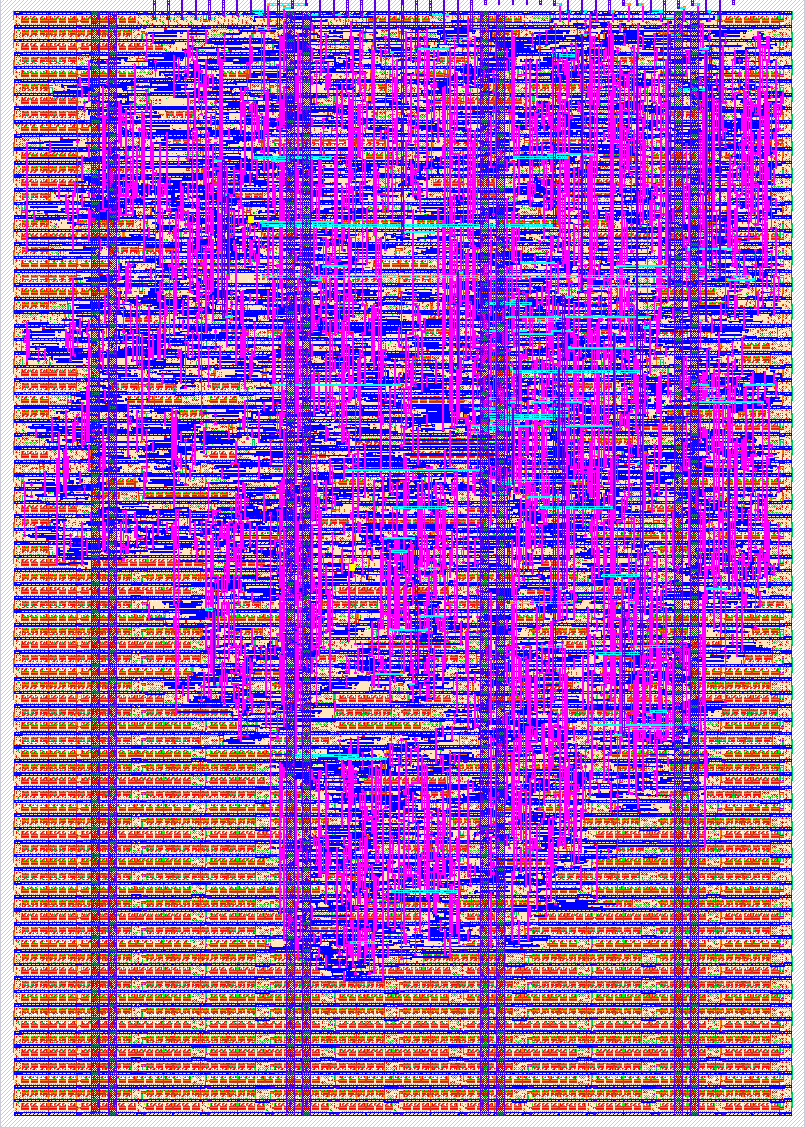
Design render

How it works

The original idea was quite simple: I wanted to design my first custom digital ASIC and implement a fun concept. Instead of developing something like an adder or encoder, I wanted to push the boundaries of what’s possible. A Tamagotchi-like, living creature—that’s the vision. A creature with an inner life, capable of interacting with the outside world, and something you can simply have fun with.

This original idea turned out to be a rabbit hole. What if the internal model closely follows biological processes and takes neurotransmitters and hormones into account, for example? Which neurotransmitters and hormons are relevantand what kind of emotions could emerge? How could sleep and hunger be modeled? What does the creature do? What is observable from the outside? How could illness be incorporated? How does something like this fit on the limited space of the chip? How could it be simulated or emulated on an FPGA? How could one still gain a complete view of the inner workings for debugging and testing? What might the hardware look like?

In the meantime, this project has evolved into several subprojects:

Folder Description
src The digital design of the Mimosa model, including the Verilog source code and the additional information required for hardening.
test Testing of the overall design, based on python and cocotb
module_test Testing of specific verilog submodules, based on python and cocotb
fpga Additional files (tcl, xdc) for creating the FPGA design for an Artix-7 Alchitry board. For this part, I use the vivado command line utilities and the alchitry loader.
simulation A simulation based on Pyverilator and PyQt6 with a graphical interface for optimizing the model (fine-tuning, feedback loops) and debugging the ASIC. Pyverilator uses the actual verilog sources, compiles them into a C/C++ application and allows to access it from within python.
misc/mimosa_logger An STM32 application for an STM32G474 microcontroller to debug the ASIC. This logs all inputs and outputs, returns them via UART/FTDI, and allows for reconstructing the complete history using the simulation. I also added a CppUTest unit test for illustration.

More details are described in the respective sections below. Whenever possible, I tried to install the required dependencies in the Dockerfile or with an additional batch script or added third-party repositories as git submodules, in order to comply with licensing regulations. However, the FPGA utilities (Vivado Suite from AMD) can only be installed with a personal account and therefore, you have to install it yourself. I also added makefiles or batch scripts in order to simplify building or running designs or applications.

Moody mimosa

Overview

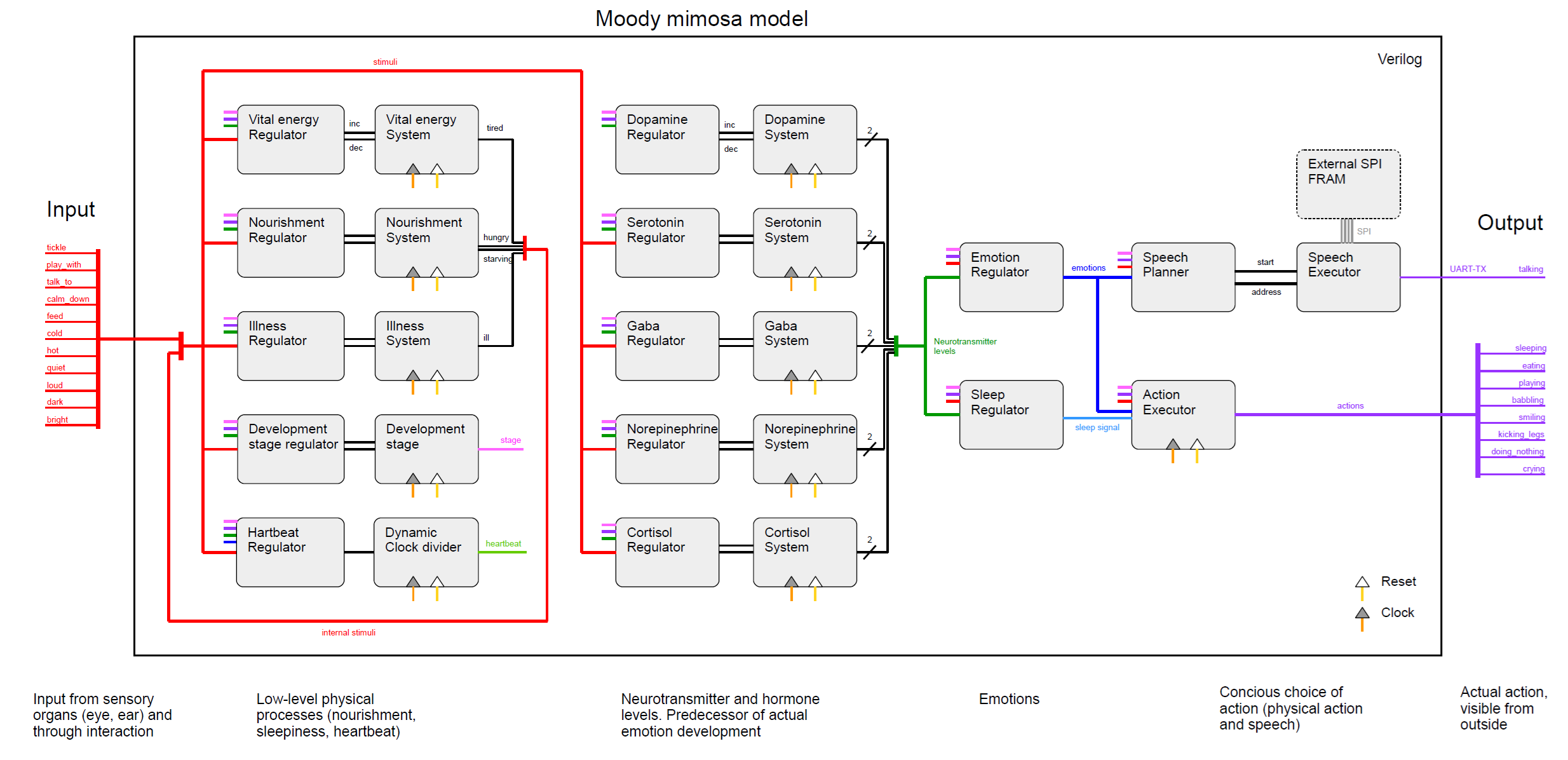
The moody mimosa model depends on several layers of abstraction.

  1. Actions: Sleeping, eating, playing, smiling, babbling, kicking legs, doing nothing, crying
  2. Emotions: Happiness, excitement, stress, nervousness, boredom, anger, calmness, apathy
  3. Stimuli: Input from the outer world, either from the environment (cold, hot, loud, bright) or from an interacting indivduum (tickle, play with, calm down, talk to, feed).
  4. Basic resources:
    • Neurotransmitters: Dopamine, Serotonin, Gamma-aminobutyric acid (Gaba), Norepinephrine
    • Hormons: Cortisol
    • Vital-energy, controlling sleepiness
    • Nourishment, controlling hunger
    • Illness, controlling whether the mimosa is ill or not

From the outher world, only one layer can be influenced directly (stimuli) and only one layer can be observed directly (actions). However, there are various indirect ways of how the stimuli influence the basic resources, emotions and actions and how the actions are influenced by emotions, basic resources and stimuli. The mimosa might cry because it is tired, ill, stressed, starving or angry because it cannot stand that it gets tickled all the time. You just don't know the reason. However, after some time, you develop an understanding of the creature and begin to realize what it might need.

Architecture
Implementation details

Each resource consists of a saturating counter (counting up or down) and a regulator, regulating whether it should count up or down, slow or fast, or remain unchanged. The main feedback behaviour is encoded in the regulators. I tried to mimick the biology of the neurotransmitters involved. The first-level, rapid stress response is mediated by norepinephrine (NE). If stress persists, the slower second-level response mediated by the hormone cortisol sets in and leads to long-term stress effects. The competing triple of serotonin, gaba and dopamine controls the mood and allows emotions such as happiness, excitement, boredom, anxiousness. During elevated periods of stress, all of them start to decrease, basically leading to a depressive state with negative emotions and without motivation. Hunger and tiredness also affects the neurotransmitters and even actions may lead to feedback effects, allowing both bottom-up and top-down emotion regulation ("smiling makes you feel better" vs. "if you feel good, you start smiling"). Although resources are themselv counters with 6-9 bits, only the upper two bits are used for emotion encoding and actions in order to limit gates needed.

Emotions are basically a combinational encoding of the resource levels (0=very low, 1=moderately low, 2=moderately high, 3=very high) and stimuli. In rare cases, several emotions can be present at once. Strictly speaking, emotions would not be necessary for the model. However, it turned out to be much more intuitive and simpler, to decide the resulting action based on emotions rather than on resource levels.

Actions are modelled as a state-machine. State transitions are mediated by stimuli and/or emotions. In rare cases, neurotransmitter levels may even target actions directly. At times, there are several routes how states may change. For example, the mimosa starts to sleep if it is moderately tired and not too stressed. If it is, however, stressed or starving or if you can't stop irritating it or if there are environmental influences (noise, heat), it just can not sleep. It surely will get angry, stressed, nervous and probably starts to cry but it can not sleep. After some time, it will get way too tired (zero vital energy) and start sleeping superficially.

Pinout

For the tiny tapeout ASIC, the pins are assigned as described in the following tables:

Pin Name Function
clk clk Base clock
rst_n rst_n Reset, active low
ui_in[0] stimulus_0 Interaction: Tickle
ui_in[1] stimulus_1 Interaction: Play with
ui_in[2] stimulus_2 Interaction: Talk to
ui_in[3] stimulus_3 Interaction: Calm down
ui_in[4] stimulus_4 Interaction: Feed
ui_in[5] stimulus_5 Environment: Cool
ui_in[6] stimulus_6 Environment: Hot
ui_in[7] stimulus_7 Environment: Quiet
Pin Dir Name Function
uio_in[0] 0 stimulus_8 Environment: Loud
uio_in[1] 0 stimulus_9 Environment: Dark
uio_in[2] 0 stimulus_10 Environment: Bright
uio_out[3] - - -
uio_out[4] - - -
uio_out[5] - - -
uio_out[6] - - -
uio_out[7] - - -
Pin Name Function
uo_out[0] action_0 Action: Sleeping
uo_out[1] action_1 Action: Eating
uo_out[2] action_2 Action: Playing
uo_out[3] action_3 Action: Smiling
uo_out[4] action_4 Action: Babbling
uo_out[5] action_5 Action: Kicking legs
uo_out[6] action_6 Action: Doing nothing
uo_out[7] action_7 Action: Crying

How to test

Several ways

External hardware

Simulation

No hardware required. Just run python simulation/mimosa_simulation.py. Make sure that you have run the scripts/set_up_dependencies.sh script and that you run a X-Server (e.g. VcXsrv) if you are working with Docker and Windows.

FPGA

Following external hardware is required:

  • Alchitry Au FPGA board
  • Alchitry Br Adapter board
  • Custom mimosa PCB [tbd] and USB-C cable

ASIC

Apart from the actual ASIC, the following external hardware is required:

  • Custom mimosa PCB [tbd] and USB-C cable

IO

#InputOutputBidirectional
0TICKLESLEEPINGLOUD
1PLAY_WITHEATINGBRIGHT
2TALK_TOPLAYINGSPI_MISO
3CALM_DOWNSMILINGSPI_SCK
4FEEDBABBLINGSPI_CS
5COOLKICKING_LEGSSPI_MOSI
6HOTDOING_NOTHINGUART_TX
7QUIETCRYINGCLK_MODEL

Chip location

Controller Mux Mux Mux Mux Mux Mux Mux Mux Mux Mux Mux Analog Mux Mux Mux Mux Mux Mux Mux Mux Mux Mux Mux Analog Mux Mux Mux Mux Mux Mux Mux Mux Mux Mux tt_um_chip_rom (Chip ROM) tt_um_factory_test (Tiny Tapeout Factory Test) tt_um_oscillating_bones (Oscillating Bones) tt_um_urish_charge_pump (Dickson Charge Pump) tt_um_sonos_flash_party (SONOS Flash Party) tt_um_4Bit_SAR_ADC (4-Bit Successive Approximation ADC) tt_um_cw_vref (Current-Mode Bandgap Reference) tt_um_tt08_aicd_playground (AICD Playground) tt_um_tnt_diff_rx (TT08 Differential Receiver test) tt_um_rejunity_vga_logo (VGA Tiny Logo (1 tile)) tt_um_tommythorn_maxbw (Asynchronous Multiplier) tt_um_rebeccargb_universal_decoder (Universal Binary to Segment Decoder) tt_um_mattvenn_rgb_mixer (RGB Mixer demo5) tt_um_rebeccargb_hardware_utf8 (Hardware UTF Encoder/Decoder) tt_um_find_the_damn_issue (Find The Damn Issue) tt_um_brandonramos_VGA_Pong_with_NES_Controllers (VGA Pong with NES Controllers) tt_um_kb2ghz_xalu (4-bit minicomputer ALU) tt_um_rebeccargb_intercal_alu (INTERCAL ALU) tt_um_a1k0n_demo (Demo by a1k0n) tt_um_rburt16_bias_generator (Bias Generator) tt_um_zec_square1 ("SQUARE-1": VGA/audio demo) tt_um_jmack2201 (Sprite Bouncer with Looping Background Options) tt_um_ran_DanielZhu (Dice) tt_um_gfg_development_tinymandelbrot (TinyMandelbrot) tt_um_LnL_SoC (Lab and Lectures SoC) tt_um_htfab_pi_snake (Pi Snake) tt_um_quarren42_demoscene_top (asic design is my passion) tt_um_crispy_vga (Crispy VGA) tt_um_MichaelBell_canon (TT08 Pachelbel's Canon demo) tt_um_shuangyu_top (Calculator) tt_um_wokwi_407306064811090945 (DDR throughput and flop aperature test) tt_um_08_sws (Sine Wave Synthesizer) tt_um_favoritohjs_scroller (VGA Scroller) tt_um_tt08_wirecube (Wirecube) tt_um_vga_glyph_mode (Glyph Mode) tt_um_a1k0n_vgadonut (VGA donut) tt_um_roy1707018 (RO) tt_um_analog_factory_test (TT08 Analog Factory Test) tt_um_sign_addsub (CMOS design of 4-bit Signed Adder Subtractor) tt_um_patater_demokit (Patater Demo Kit Waggling Rainbow on a Chip) tt_um_algofoogle_tt08_vga_fun (TT08 VGA FUN!) tt_um_simon_cipher (simon_cipher) tt_um_thexeno_rgbw_controller (RGBW Color Processor) tt_um_demosiine_sda (DemoSiine) tt_um_bytex64_munch (Munch) tt_um_alexjaeger_ringoscillator (5MHz Ring Oscillator) tt_um_cfib_demo (cfib Demoscene Entry) tt_um_wokwi_407852791999030273 (Simple 8 Bit ALU) tt_um_Richard28277 (4-bit ALU) tt_um_betz_morse_keyer (Morse Code Keyer) tt_um_nvious_graphics (nVious Graphics) tt_um_tiny_pll (Tiny PLL) tt_um_ezchips_calc (8-Bit Calculator) tt_um_hack_cpu (HACK CPU) tt_um_noritsuna_Vctrl_LC_oscillator (Voltage Controlled LC-Oscillator) tt_um_ring_divider (Divided Ring Oscillator) tt_um_morningjava_r2r_from_matt (Bucket Brigade) tt_um_ephrenm_tsal (TSAL_TT) tt_um_kapilan_alarm (Alarm Clock) tt_um_stochastic_addmultiply_CL123abc (Stochastic Multiplier, Adder and Self-Multiplier) tt_um_wokwi_407760296956596225 (tt08-octal-alu) tt_um_dlfloatmac (DL float MAC) tt_um_wakki_0123_Raw_Transistors (Raw_Transistors) tt_um_faramire_rotary_ring_wrapper (Rotary Encoder WS2812B Control) tt_um_devstdin_LDO_OSC (LDO BG IREF OSC) tt_um_frequency_counter (Frequency Counter SSD1306 OLED) tt_um_rom_test (TT08 SKY130 ROM 'YOLO' Test) tt_um_i2c_peripheral_stevej (i2c peripherals: leading zero count and fnv-1a hash) tt_um_yuri_panchul_schoolriscv_cpu_with_fibonacci_program (schoolRISCV CPU with Fibonacci program) tt_um_yuri_panchul_adder_with_flow_control (Adder with Flow Control) tt_um_brailliance (Brailliance) tt_um_nyan (nyan) tt_um_MichaelBell_mandelbrot (VGA Mandelbrot) tt_um_ssp_opamp (2-stage Opamp Designs) tt_um_fountaincoder_top_ad (pulse_add) tt_um_edwintorok (Rounding error) tt_um_mac (MAC) tt_um_dpmu (DPMU) tt_um_JAC_EE_segdecode (7 Segment Decode) tt_um_wokwi_408118380088342529 (Traffic-light-sequence) tt_um_shiftreg_test (TT08 SKY130 Shift Register 'YOLO' Test) tt_um_yuri_panchul_sea_battle_vga_game (Sea Battle) tt_um_benpayne_ps2_decoder (PS2 Decoder) tt_um_meriac_play_tune (Super Mario Tune on A Piezo Speaker) tt_um_comm_ic_bhavuk (Comm_IC) tt_um_daosvik_aesinvsbox (AES Inverse S-box) tt_um_wokwi_408216451206371329 (Logic Test) tt_um_micro_tiles_container (Micro tile container) tt_um_cattuto_sr_latch (TT08 - experiments with latch-based shift registers) tt_um_rejunity_vga_test01 (VGA Drop (audio/visual demo)) tt_um_silice (Warp) tt_um_wokwi_408231820749720577 (Abacus Lock) tt_um_jayjaywong12 (mulmul) tt_um_emmyxu_obstacle_detection (Obstacle Detection) tt_um_neural_navigators (Neural Net ASIC) tt_um_a1k0n_nyancat (VGA Nyan Cat) tt_um_rebeccargb_styler (Styler) tt_um_resfuzzy (resfuzzy) tt_um_cejmu (CEJMU Beers and Adders) tt_um_16_mic_beamformer_arghunter (16 Mic Beamformer) tt_um_pdm_pitch_filter_arghunter (PDM Pitch Filter) tt_um_pdm_correlator_arghunter (PDM Correlator) tt_um_ddc_arghunter (DDC) tt_um_i2s_to_pwm_arghunter (I2S to PWM ) tt_um_georgboecherer_vco (Analog Voltage Controlled Oscillator) tt_um_supermic_arghunter (Supermic ) tt_um_dmtd_arghunter (DMTD ) tt_um_htfab_bouncy_capsule (Bouncy Capsule) tt_um_samuelm_pwm_generator (PWM generator) tt_um_mattvenn_analog_ring_osc (Ring Oscillators) tt_um_toivoh_demo_deluxe (Sequential Shadows Deluxe [TT08 demo competition]) tt_um_faramire_stopwatch (Simple Stopwatch) tt_um_micro_tiles_container_group2 (Micro tile container (group 2)) tt_um_johshoff_metaballs (Metaballs) tt_um_top (Flame demo) tt_um_NicklausThompson_SkyKing (SkyKing Demo) tt_um_Electom_cla_4bits (4-bit CLA) tt_um_vga_cbtest (Generate VGA output for Color Blindness Test) tt_um_zoom_zoom (Zoom Zoom) tt_um_dpmunit (DPM_Unit) tt_um_clock_divider_arghunter (Clock Divider ) tt_um_dlmiles_poc_fskmodem_hdlctrx (FSK Modem +HDLC +UART (PoC)) tt_um_emilian_muxpga (TinyFPGA resubmit for TT08) tt_um_pyamnihc_dummy_counter (Dummy Counter) tt_um_whynot (Why not?) tt_um_sudana_ota5t_1 (5-T OTA) tt_um_dlmiles_tt08_poc_uart (UART) tt_um_dendraws_donut (donut) tt_um_wokwi_408237988946759681 (Counter) tt_um_tmkong_rgb_mixer (RGB Mixer) tt_um_bgr_agolmanesh (Bandgap Reference) tt_um_z2a_rgb_mixer (RGB Mixer demo) tt_um_vga_clock (VGA clock) tt_um_synth_simple_mm (synth_simple) tt_um_gus16 (GUS16 CPU) tt_um_rejunity_ternary_dot (Ternary 128-element Dot Product) tt_um_virantha_enigma (Enigma - 52-bit Key Length) tt_um_atomNPU (AtomNPU) tt_um_alphaonesoc (AlphaOneSoC) tt_um_gxrii_spi_sevenseg (SPI 7-segment display) tt_um_urish_simon (Simon Says memory game) tt_um_branch_pred (TinyTapeout Minimal Branch Predictor) tt_um_xor_encryption (Xor-Logic) tt_um_MAC_Accelerator_OnSachinSharma (MAC Operation) tt_um_moody_mimosa (Moody-mimosa) tt_um_wrapper (6Digit7SegClock) tt_um_MichaelBell_tinyQV (TinyQV Risc-V SoC) tt_um_devmonk_ay8913 (Classic 8-bit era Programmable Sound Generator AY-3-8913) tt_um_toivoh_demo (Orion Iron Ion [TT08 demo competition]) tt_um_mattvenn_r2r_dac_3v3 (Analog 8 bit 3.3v R2R DAC) tt_um_2048_vga_game (2048 sliding tile puzzle game (VGA)) tt_um_test_commit (Microrobotics-Basic-IPs) tt_um_jimktrains_vslc (VSLC - Very Small Logic Controller with a timer and servo control) tt_um_gamepad_pmod_demo (Gamepad Pmod Demo) tt_um_mattvenn_adjustable_psu_counter (Adjustable supply digital counter) tt_um_tinytapeout_logo_screensaver (VGA Screensaver with Tiny Tapeout Logo) tt_um_mattvenn_spi_test (SPI test) tt_um_huffman_coder (Huffmann_Coder) tt_um_multiplier (Vedic multiplier) tt_um_wokwi_422964384478997505 (NAND) tt_um_wokwi_422964754310747137 (DaliaProjekt) tt_um_wokwi_422957918936350721 (TinyTapeout 4 bit ripple carry adder) tt_um_wokwi_422961309631153153 (Tinytapeout_design_ANP) tt_um_wokwi_422957954050029569 (Extremely cool stuff (secret)) tt_um_wokwi_422964381148718081 (test/15/02/25) tt_um_wokwi_422959954857061377 (example1) tt_um_wokwi_422960174616660993 (First design) tt_um_schoeberl_wildcat (Wildcat RISC-V) tt_um_wokwi_422962760920307713 (4 Bit Adder with Overflow Counter) tt_um_kentrane_tinyspectrum (Tiny piano) tt_um_wokwi_422962914561876993 (Emil Njor's Design) tt_um_i2c_regf (Asynchronous I2C Registerfile Interface) tt_um_wokwi_422960054456096769 (3-bit register print) tt_um_wokwi_422960130190575617 (Four basic building blocks) tt_um_wokwi_422965035809389569 (3 Bit Adder) tt_um_wokwi_422958894385882113 (TinyChipDesign) tt_um_tappu_tobias1012 (Tappu) tt_um_wokwi_422960332734617601 (Enter-Code) tt_um_wokwi_422960080008854529 (Special code for letter n) tt_um_wokwi_422957657550394369 (Full Adder) tt_um_mp_lif_schor (mp_LIF_neuron) tt_um_wokwi_422962959838345217 (Holm's TinyTapeOut 4-bit adder) tt_um_asgerwenneb (Custom SRAM) tt_um_wokwi_422960491546730497 (ANDNOT) tt_um_Strider93 (digital LIF Neuron) tt_um_wokwi_422960078645704705 (Hero on Tape) tt_um_wokwi_422959974126748673 (my_own_chip) tt_um_wokwi_422968416190311425 (Encoder) tt_um_wokwi_422962904571040769 (simplePass) tt_um_keszocze_ssmcl (SSMCl) tt_um_luke_clock (TT10_Luke_Clock) tt_um_enjens (Verilog based clock to 7-segment counter) tt_um_wokwi_422968696249282561 (Simple NAND 2) tt_um_wokwi_422960085743520769 (Adder) tt_um_UartMain (XOR Cipher) tt_um_torurstrom_async_lock (Asynchronous Locking Unit) tt_um_larva (LaRVa CPU) tt_um_zhouzhouthezhou_adder (tt10_zhouzhouthezhou_adder) tt_um_bg_DanielZhu123 (Bandgap) tt_um_jp_cd101_saw (KCH CD101 Saw Synth) tt_um_hpdl1414_uart_atudoroi (TT10 HPDL 1414 Uart) tt_um_jun1okamura_test0 (7-segment with LFSR) tt_um_strau0106_simple_viii (simple-viii) tt_um_obriensp_jtag (JTAG TAP) tt_um_10_vga_crossyroad (Crossyroad) tt_um_bilal_trng (TRNG) tt_um_space_invaders_game (Space Invaders ASIC) tt_um_sushi_demo (zc-sushi-demo) tt_um_kch_cd101 (kch cd101) tt_um_uart_bgdtanasa (ttUART) tt_um_zedulo_spitest1 (SimpleSPIdev) tt_um_daobaanh_rng (RNG_test) tt_um_mattvenn_level_shifter (Level Shifter) tt_um_gcd_stephan (15bit GCD) tt_um_alexandercoabad_mixedsignal (Mixed-Signal) tt_um_spacewar (XY Spacewar) tt_um_gregac_tiny_nn (Tiny Neural Network Accelerator) tt_um_log_afpm (16-bit Logarithmic Approximate Floating Point Multiplier) tt_um_rkarl_Spiral (TT_spiralPattern) tt_um_led_jellyant (ledtest) tt_um_project (Simple shift Reg) tt_um_DaDDS (DaDDS) tt_um_nithishreddykvs (Pulse Width Modulation) tt_um_monishvr_fifo (Synchronous FIFO) tt_um_reemashivva_fifo (Asynchronous FIFO) tt_um_save_buffer_hash_table (Tiny Hash Table) tt_um_drum_goekce (DRUM) tt_um_rte_sine_synth (Sine Synth) tt_um_simon2024_c_element_top (Muller C-element) tt_um_tiny_shader_mole99 (Tiny Shader) tt_um_flummer_ltc (Linear Timecode (LTC) generator) tt_um_bitty (Bitty) tt_um_ole_moller_priority_encoder_to_7_segment_decoder (Priority-encoder) tt_um_algofoogle_vga (IHP VGA demo) tt_um_ultra_tiny_cpu (UltraTiny-CPU) tt_um_uwasic_dinogame (UW ASIC - Optimized Dino) tt_um_Qwendu_spi_fpu (SPI FPU) tt_um_rte_eink_driver (E-ink display driver) tt_um_urish_sic1 (SIC-1 8-bit SUBLEQ Single Instruction Computer) tt_um_kianV_rv32ima_uLinux_SoC (KianV uLinux SoC) tt_um_autosel (I2C EEPROM Project Selection) tt_um_tnt_rom_test (TT09 SKY130 ROM Test) tt_um_tnt_rom_nolvt_test (TT09 SKY130 ROM Test (no LVT variant)) tt_um_tt_tinyQV (TinyQV SoC with additional peripherals) tt_um_htfab_dg_dac (Dempsey-Gorman DAC) tt_um_algofoogle_raybox_zero (raybox-zero TTCAD25a edition) tt_um_htfab_checkers (Overengineered Checkers) tt_um_sky130_as_sc_hs (sky130_as_sc_hs test) tt_um_sky130_as_sc_hs_dyn_test (sky130_as_sc_hs dyn test) tt_um_rejunity_z80 (Zilog Z80) tt_um_tnt_rf_yolo_test (TTCAD25a SKY130 RF YOLO Test) tt_um_2x2MatrixMult_Vort3xed (UART Matrix Multiplier) tt_um_zerotoasic_logo_screensaver (VGA Screensaver with Zero to ASIC Logo) tt_um_rejunity_lgn_mnist (LGN hand-written digit classifier (MNIST, 16x16 pixels)) tt_um_wokwi_422192563267712001 (Padlock) tt_um_rc_oscillators (R-C Oscillators) tt_um_tnt_ff_yolo_test (TTCAD25a SKY130 FF YOLO Test) Available Available Available Available Available Available Available Available Available Available Available Available Available Available Available Available Available Available Available Available Available Available Available Available Available Available Available Available Available