359 Tiny FABulous FPGA (3.3V version)
359 : Tiny FABulous FPGA (3.3V version)
- Author: Leo Moser
- Description: A tiny FABulous FPGA fabric, ready for use with Yosys and nextpnr.
- GitHub repository
- Open in 3D viewer
- Open in Tiny Tapeout Explorer
- Clock: 0 Hz
How it works
Tiny FABulous FPGA for GF0p3 (3.3V version).
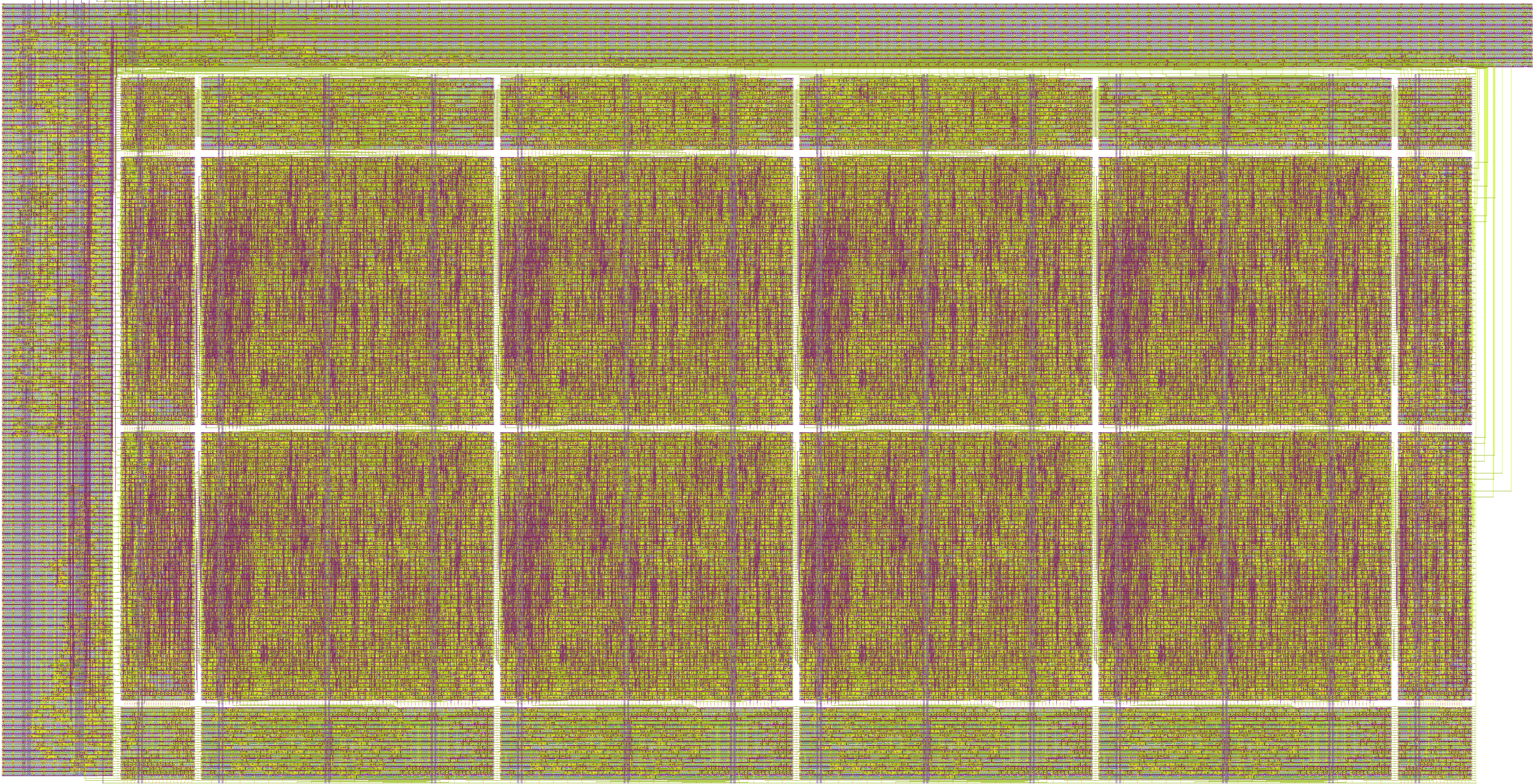
This design implements a tiny FPGA with 64 LUT4+FF. The FPGA fabric is 6x4 tiles in size, of which 4x2 are LUT4x8_ha tiles. The logic cells include a vertical carry-chain in upwards direction, allowing for fast additions up to 15-bits.
The I/Os resemble the Tiny Tapeout interface, allowing for clk, rst_n, uo, ui and uio signals. This enables to directly implement simple Tiny Tapeout designs on the FPGA.
The user design is synthesized using Yosys and implemented using nextpnr (currently forks are required to be used, but the changes will be upstreamed).
The bitstream is uploaded to the fabric using a bitbang interface (see how to test). The bitbang interface is active while reset is applied, this ensures that all I/Os are available for the active user design.
The exact available resources can be seen in this table:
| Primitive | Available | Description |
|---|---|---|
| FABULOUS_LC | 64 | Logic cells with LUT4+FF and carry-chain. |
| IOBUF | 26 | Input/output buffers. |
| GBUF | 4 | Global buffers to supply clock, reset and enable to the flip-flops. |
| SYS_RESET | 1 | Can be used to reset the design after configuration. |
Even though there are 26 IOBUF are available, only the uio signals are actually bidirectional. uo will always read zero when read from, and writing to clk, rst_n and ui has no effect.
The GBUFs are used for high-fanout signals. Their use is mandatory for the clock signal of flip-flops to ensure a balanced clock network. This means up to 4 clock domains are possible. The GBUFs can also be used for reset and enable of the FFs, although those can also be routed through "normal" fabric routing.
SYS_RESET applies a reset during fabric reconfiguration and can only be directly connected to a GBUF.
How to test
First, compile a bitstream for your user design. The bitstream is big-endian with 32-bit words.
- Set rst_n to 1 to reset the configuration interface.
- Set rst_n to 0 to enable the configuration interface.
- Write the bitstream bits to ui[1] (MSB first) and the sample signal on ui[0].
The data is sampled on a rising edge of the sample signal. The interface is synchronous, so ensure that the clk signal is toggling faster than the sample signal. Is anything is unclear, have a look at the top-level cocotb tests.
Finally, set rst_n to 1 and enjoy your design on Tiny FABulous FPGA!
External hardware
None
IO
| # | Input | Output | Bidirectional |
|---|---|---|---|
| 0 | ui[0] or sample_i | uo[0] | uio[0] |
| 1 | ui[1] or data_i | uo[1] | uio[1] |
| 2 | ui[2] | uo[2] | uio[2] |
| 3 | ui[3] | uo[3] | uio[3] |
| 4 | ui[4] | uo[4] | uio[4] |
| 5 | ui[5] | uo[5] | uio[5] |
| 6 | ui[6] | uo[6] | uio[6] |
| 7 | ui[7] | uo[7] | uio[7] |