517 I2C Slave Template with Emulated Sensor
517 : I2C Slave Template with Emulated Sensor
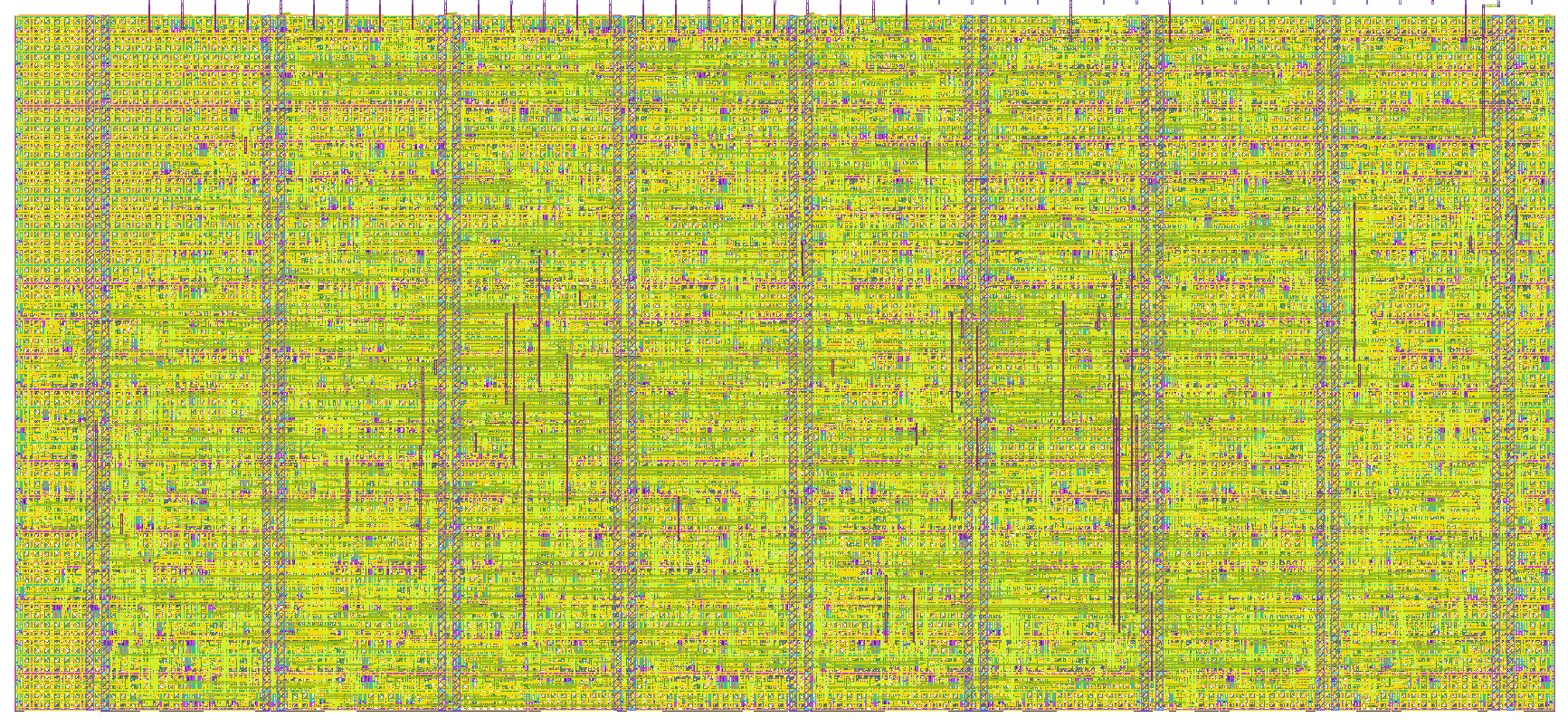
- Author: Sebastian Budde, Janina Speckmann
- Description: I2C slave (tested up to FM+) with eight writable registers and eight read-only registers fed by an internal LFSR that emulates a sensor - a reusable template for a real I2C sensor.
- GitHub repository
- Open in 3D viewer
- Open in Tiny Tapeout Explorer
- Clock: 25000000 Hz
How it works
This project implements an I2C slave that emulates a real-world sensor. It exposes two register banks of eight 8-bit registers each, addressed by the I2C master via register indices 0x00-0x0F.
Block A (0x00-0x07) is writable by the master and serves as configuration registers - a placeholder for the configuration interface a real sensor would expose. Block B (0x08-0x0F) is read-only for the master and is driven by an internal LFSR (linear-feedback shift register) that cyclically updates each register with pseudo-random values. The master can reads these as simulated sensor data that changes over time.
A constant device signature is available at addresses 0xF8-0xFF. Reads from any unmapped address return 0x00, and writes to read-only or unmapped addresses are acknowledged on the bus but have no effect. The slave operates at all three standard bus speeds: Standard Mode (100 kHz), Fast Mode (400 kHz) and Fast Mode Plus (1 MHz), with a 25 MHz system clock.
The design is a reusable template: replacing the LFSR with a real sensor frontend turns it into a functional I2C sensor.
How to test
The device responds at 7-bit I2C address 0x55. To read a register, write the register index, then issue a repeated START and read one or more bytes (the register pointer auto-increments for bulk reads). To write Block A, send the register index followed by one or more data bytes (the register pointer auto-increments for bulk writes).
The design was verified on hardware using a Sipeed Tang Primer 25K FPGA with an ESP32-C6 acting as I2C master, running a test suite at all three bus speeds. The full setup, firmware and results are documented in the FPGA test report:
External hardware
External pull-up resistors (e.g. 4.7 kΩ to 3.3 V) on the SCL pin (uio[0]) and the SDA pin (uio[3]). No other external hardware is required.
IO
| # | Input | Output | Bidirectional |
|---|---|---|---|
| 0 | SCL | ||
| 1 | |||
| 2 | |||
| 3 | SDA | ||
| 4 | |||
| 5 | |||
| 6 | |||
| 7 |