577 SPI-CPU
577 : SPI-CPU
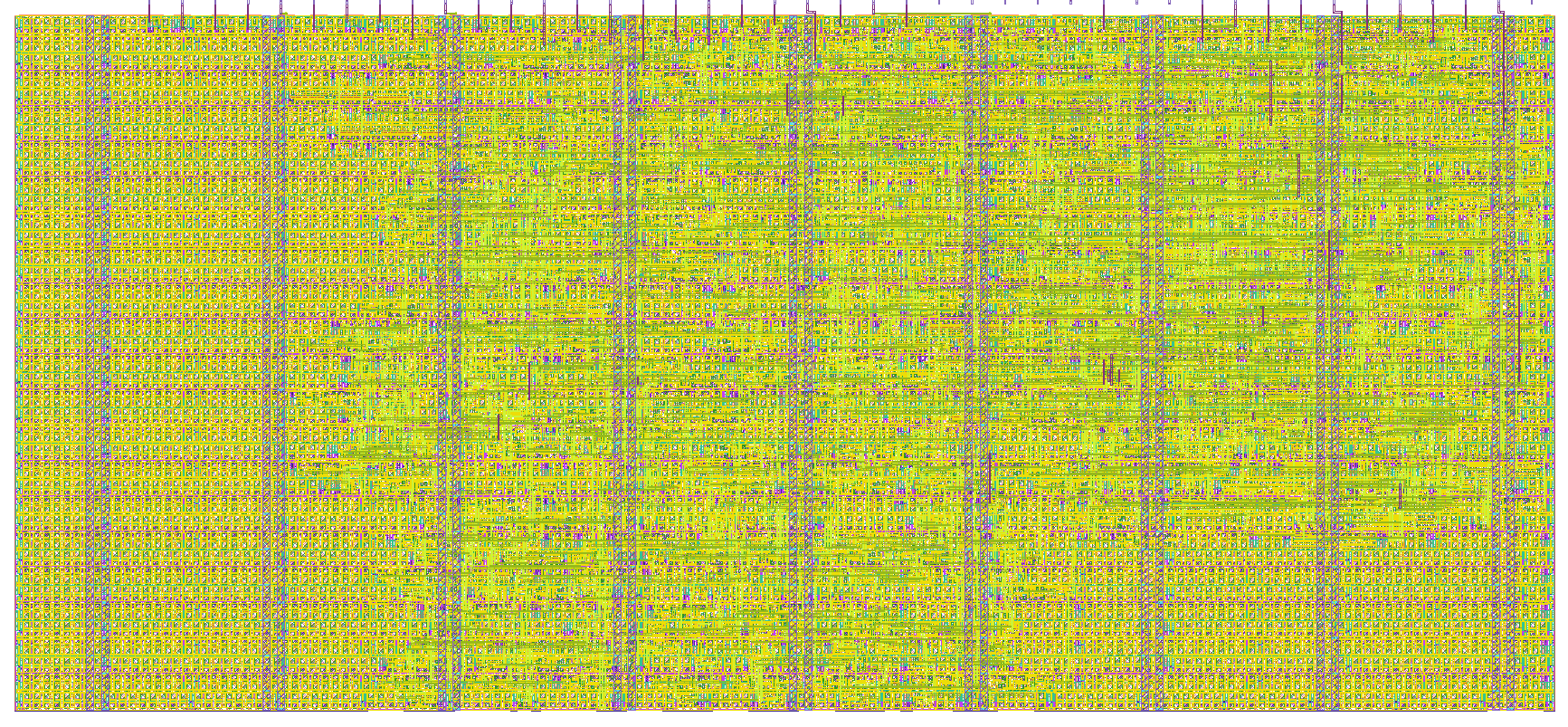
- Author: MS College of Engineering
- Description: A 4-bit CPU using the SPI Flash RAM from the QSPI PMOD to load programs.
- GitHub repository
- Open in 3D viewer
- Open in Tiny Tapeout Explorer
- Clock: 30000000 Hz
Info - TinyTapeout SPI Microcoded CPU
How it Works
This project implements a compact, 4-bit microcoded CPU designed for the TinyTapeout (GF180MCU) platform. Rather than using limited on-chip area for program storage, the CPU fetches and executes its instructions directly from an external SPI RAM (such as a physical 23LC512 memory chip or an RP2040 microcontroller emulating it).
Hardware Architecture
The design is split into three main functional blocks:
- TinyTapeout Wrapper (
tt_um_spi_cpu_top): Handles top-level ASIC pins and bridges them to the internal logic. - SPI Fetch & CPU Wrapper (
spi_wrap): Manages the 12-bit Program Counter (PC), an FSM to decode instructions fetched over SPI, and a byte-wide SPI master engine (spi_read_byte). - Execution Unit Datapath (
ExecutionUnit): Based on the Aeolus CPU Core topology, it coordinates an 8-bit Accumulator (ACC), a 4-bit Register File (Registers A, B, and O), an 8-bit shift register with a overflow flag (SF), and a 4-bit slice ALU.
Instruction Fetch & Execution Pipeline
To optimize memory bandwidth, every byte fetched from the SPI RAM packs two 4-bit micro-operations:
opcode1 = spi_data[3:0](Executed first)opcode2 = spi_data[7:4](Executed second)
The spi_wrap controller cycles through a sequential Finite State Machine (FSM):
S_FETCH_START: Triggers a memory read when the SPI engine is idle.S_FETCH_WAIT_OPCODE: Waits for the transaction to finish and latches the instruction byte.S_EXECUTE_1: Sets the execution bus toopcode1and pulsescpu_start.S_EXECUTE_2: Sets the execution bus toopcode2, pulsescpu_start, increments the PC, and loops back to fetch the next pair.
The underlying spi_read_byte module executes a standard 23LC512 READ (0x03) command sequence, transmitting {8'h03, 16'b0, pc} MSB-first over MOSI before shifting in the payload.
The Microprogram (Firmware)
As a proof-of-concept hardware demonstration, the pre-loaded microcode implements a 4×4-bit to 8-bit software binary multiplier using a shift-and-add algorithm:
ui_in[7:4]= Operand A (4-bit)ui_in[3:0]= Operand B (4-bit)uo_out[7:0]= Product Output ($A \times B$)
Conditional instructions like SNZA and SNZS check the state of the shift register flag, allowing the datapath to selectively add values into the accumulator to dynamically handle binary multiplication without complex, rigid hardware branching paths.
How to Test
Verification workspace parameters rely on cocotb coupled with Icarus Verilog (iverilog).
Dependencies
Ensure your environment includes Python 3.11+ and the proper HDL toolchain packages:
pip install cocotb
sudo apt install iverilog
IO
| # | Input | Output | Bidirectional |
|---|---|---|---|
| 0 | DATA_A[0] | OUT_REG[0] | SPI_CS_N |
| 1 | DATA_A[1] | OUT_REG[1] | SPI_MOSI |
| 2 | DATA_A[2] | OUT_REG[2] | SPI_MISO |
| 3 | DATA_A[3] | OUT_REG[3] | SPI_SCK |
| 4 | DATA_B[0] | OUT_REG[4] | |
| 5 | DATA_B[1] | OUT_REG[5] | |
| 6 | DATA_B[2] | OUT_REG[6] | |
| 7 | DATA_B[3] | OUT_REG[7] | CPU_VALID |