581 Aswarby INT8 MAC
581 : Aswarby INT8 MAC
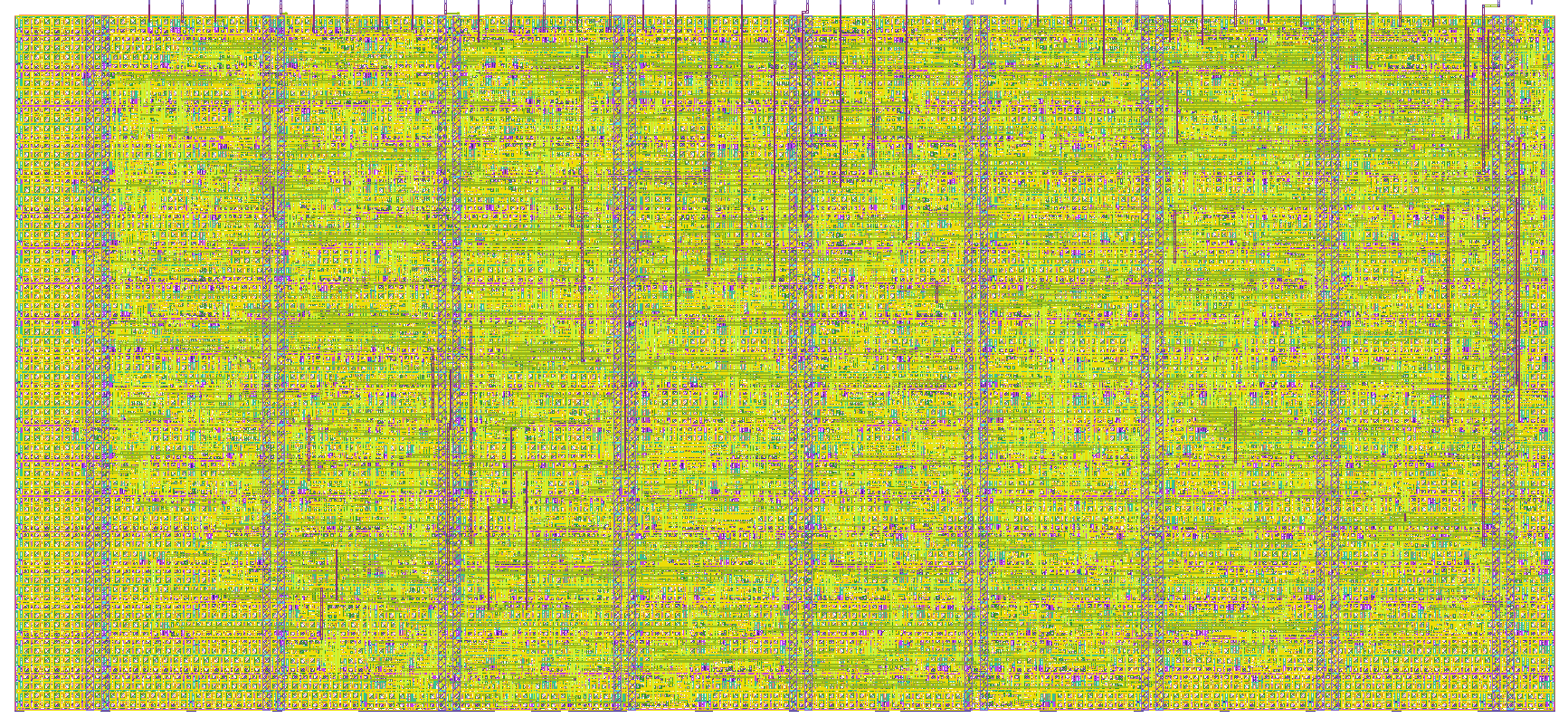
- Author: Mark Shilton
- Description: Byte-serial weight-stationary signed INT8 multiply-accumulate engine
- GitHub repository
- Open in 3D viewer
- Open in Tiny Tapeout Explorer
- Clock: 50000000 Hz
How it works
This is a weight-stationary signed-INT8 multiply-accumulate (MAC) engine — the single compute primitive at the heart of every quantized convolution layer. A weight is loaded once and held "stationary" while a stream of activation bytes is multiplied into a 32-bit accumulator:
acc = clamp_int32( acc + weight * activation )
Both operands are signed 8-bit (two's complement, range −128..127). The product
is signed 16-bit; it is added into a signed 32-bit accumulator whose add
saturates at the INT32 limits (+2147483647 / −2147483648) so overflow is
well-defined, exactly as in real fixed-point inference hardware. A sticky
ovf flag records whether saturation has ever occurred since the last clear.
Internally the design is two small modules:
mac_core— the datapath: weight register, signed 8×8 multiplier, saturating 32-bit accumulator, and a combinational byte-select mux for readout. The MAC is 4-stage pipelined — split-multiply, reconstruct product, 33-bit add, then saturate/clamp, each in its own cycle — so the result commits to the accumulator four cycles after the command is accepted. (The multiply is split into two parallel nibble-products because a full 8×8 multiply alone is too long a path for 50 MHz on the 180 nm node.)mac_fsm— a 2-state controller that converts each rising edge ofstrobeinto a single-cycle execute pulse (one strobe = exactly one operation, no repeated accumulation while strobe is held high) and raisesdoneonce the pipelined result has committed.
Everything is fully synchronous to clk, single clock domain, active-low reset.
The pipeline keeps each stage's logic to a single operation so the design closes
timing at the 50 MHz tile target on the 180 nm GF180 process (a single-cycle
multiply-and-accumulate does not — see the project notes). Per-operation latency
is hidden behind done, so the host protocol is unchanged.
Pin map
| Pins | Dir | Name | Meaning |
|---|---|---|---|
ui_in[7:0] |
in | data | signed INT8 operand (weight or activation) |
uio_in[1:0] |
in | cmd | 00 NOP · 01 load weight · 10 MAC · 11 clear |
uio_in[2] |
in | strobe | rising edge executes one command |
uio_in[4:3] |
in | rd_sel | which accumulator byte appears on uo_out (0=LSB … 3=MSB) |
uo_out[7:0] |
out | acc_byte | selected accumulator byte |
uio_out[5] |
out | done | one-cycle completion pulse |
uio_out[6] |
out | ovf | sticky saturation flag |
How to test
Each operation is a three-step handshake from the Commander:
- Drive
ui_in(data) anduio_in[1:0](command), withstrobelow. - Raise
strobe(uio_in[2]); the engine executes on the rising edge and pulsesdone(uio_out[5]) one cycle later. - Lower
strobeto re-arm for the next operation.
To read the 32-bit result, set rd_sel (uio_in[4:3]) to 0,1,2,3 in turn and
read uo_out each time; concatenate as little-endian to recover the signed
INT32 accumulator.
Worked example (compute 3·5 + 3·5 = 30):
| Step | cmd | data | result |
|---|---|---|---|
| load weight | 01 |
3 | weight = 3 |
| MAC | 10 |
5 | acc = 15 |
| MAC | 10 |
5 | acc = 30 |
| read | 00 |
rd_sel 0→3 | 1E 00 00 00 → 30 |
The cocotb suite in test/ drives exactly this protocol and checks
every result against a Python golden model, including signed operands, clear,
byte-streamed readout, a 150-step randomized sequence, and both saturation
directions (the exhaustive saturation tests are gated behind SKIP_SLOW=1).
Vectors can be generated with tools/export_vectors.py, which can also pull a
real INT8 weight/activation row from a quantized detector layer so the silicon
is exercised with mission-representative data.
External hardware
None. The design is driven entirely from the Tiny Tapeout demo board (RP2040 + Commander); no PMOD or external parts required.
IO
| # | Input | Output | Bidirectional |
|---|---|---|---|
| 0 | data[0] (signed INT8 in) | acc_byte[0] (selected accumulator byte) | cmd[0] (in) |
| 1 | data[1] | acc_byte[1] | cmd[1] (in) |
| 2 | data[2] | acc_byte[2] | strobe (in) |
| 3 | data[3] | acc_byte[3] | rd_sel[0] (in) |
| 4 | data[4] | acc_byte[4] | rd_sel[1] (in) |
| 5 | data[5] | acc_byte[5] | done (out) |
| 6 | data[6] | acc_byte[6] | ovf (out) |
| 7 | data[7] | acc_byte[7] |