96 Asynchronous-AER Spike Router (4-phase REQ/ACK, 16-entry routing table, GF180)
96 : Asynchronous-AER Spike Router (4-phase REQ/ACK, 16-entry routing table, GF180)
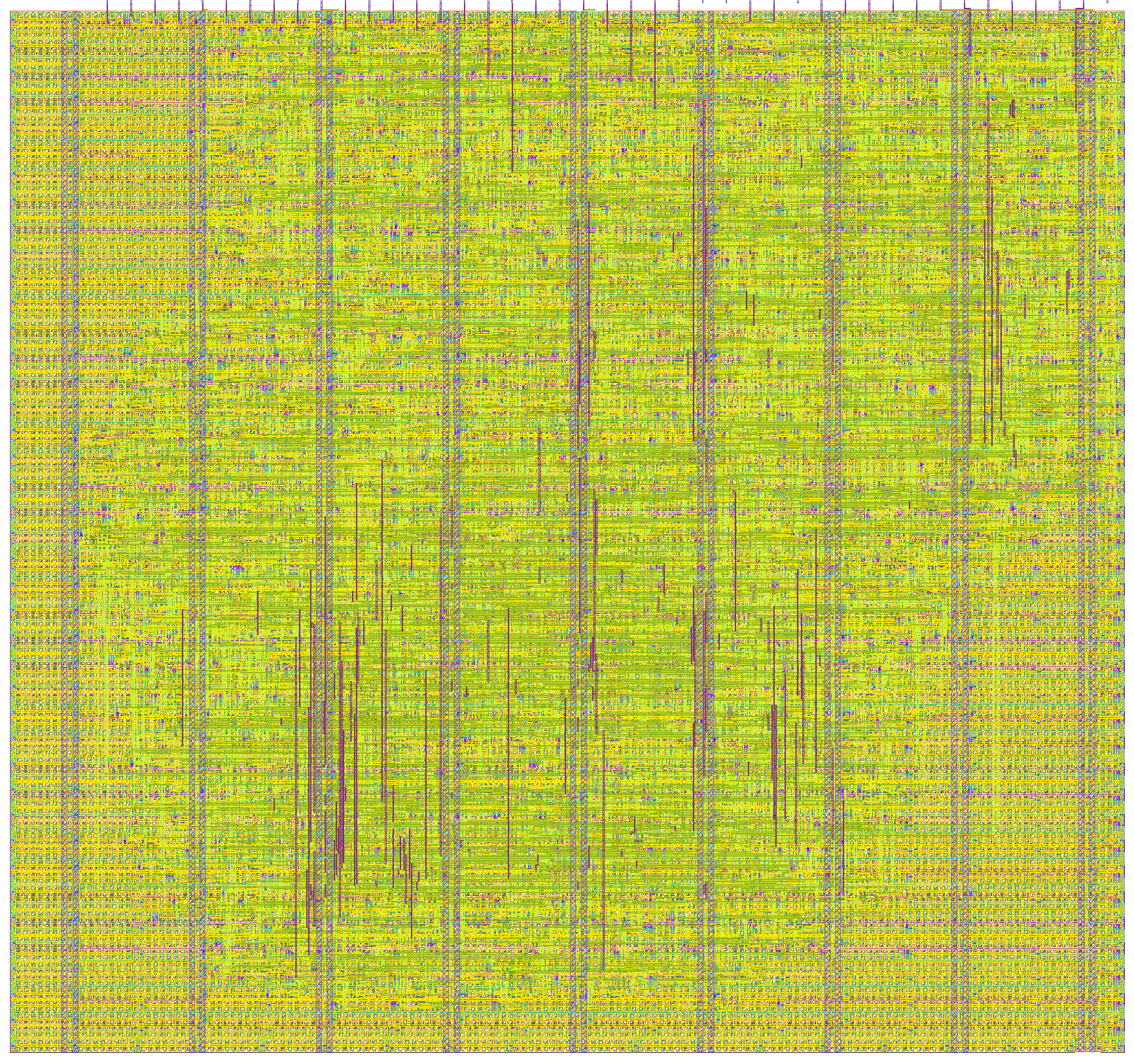
- Author: Prof. Santhosh Sivasubramani, IIT Delhi
- Description: GF180mcuD synchronous implementation of a 4-input / 4-output AER (address-event-representation) spike router. Time-multiplexed AER input and output buses each carry one event at a time as a 2-bit channel tag plus 6-bit address. Each incoming event is captured using a double-flop-synchronised 4-phase bundled-data REQ/ACK handshake, looked up in a 16-entry {dst_ch, dst_addr} routing table (or bypassed to pass through unchanged), queued in a 4-deep FIFO, and emitted out the output port with another 4-phase REQ/ACK handshake. Drops on FIFO overflow are counted in a 16-bit saturating drop counter with a sticky overflow_ever bit. Per-input 8-bit saturating event counters and IN_LAST / OUT_LAST debug latches are readable over SPI. 25 MHz signoff clock.
- GitHub repository
- Open in 3D viewer
- Open in Tiny Tapeout Explorer
- Clock: 25000000 Hz
How it works
A 4-input / 4-output AER (Address-Event-Representation) spike router implemented entirely in GF180mcuD digital logic. The external AER handshakes are 4-phase bundled-data REQ/ACK, double-flop-synchronised into a single clock domain for STA cleanliness.
Event flow
 (upstream sender)                               (downstream receiver)
   ui_in[7:6] = src_ch      +-------------+       uo_out[7:6] = dst_ch
   ui_in[5:0] = src_addr    |             |       uo_out[5:0] = dst_addr
   uio[4]     = in_req  --> |   ROUTER    | -->   uio[6]      = out_req
   uio[5]     = in_ack  <-- |             | <--   uio[7]      = out_ack
                            +------+------+
                                   |
                                SPI slave
                            (uio[0..3] = cs/mosi/miso/sck)
Internal pipeline per event:
 IS_IDLE  --(in_req rising, global_en=1)--> IS_LOOKUP
 IS_LOOKUP--(compute route_out)          --> IS_PUSH
 IS_PUSH  --(push FIFO, or drop++)       --> IS_ACK
 IS_ACK   --(drive in_ack=1, wait in_req=0)--> IS_IDLE
Output side drains the FIFO with a symmetric 4-phase handshake:
 OS_IDLE     --(fifo non-empty)--> OS_DRIVE     (load uo_out, raise out_req)
 OS_DRIVE    --(out_ack=1)     --> OS_WAIT_REL  (drop out_req, pop FIFO)
 OS_WAIT_REL --(out_ack=0)     --> OS_IDLE
Routing table
16-entry lookup table, each entry 8 bits: {dst_ch[1:0], dst_addr[5:0]}.
The index is the low 4 bits of the source address (src_addr[3:0]).
This is a deliberate design simplification: 4 source channels × 64 addresses
is a 256-entry space, but only 16 routing slots exist on-chip. The low-nibble
hash lets any source whose address ends in the same nibble share a routing
slot, which is enough for most AER test workloads (neuron cluster → neuron
cluster remapping) without blowing the area budget.
With CTRL.bypass = 1 the table is skipped and the output payload is
exactly the input payload ({src_ch, src_addr}).
Back-pressure — drops and drop counter
The output FIFO is 4 events deep. If a new event arrives while the FIFO is full, it is dropped:
drop_cnt(16-bit saturating, regs0x02..0x03) increments.STATUS.overflow_ever(sticky bit) is latched.- The per-input
evt_cntcounter is still incremented (the event was captured; it just didn't fit).
Both counters are cleared by writing 1 to CTRL.clear_drop /
CTRL.clear_evt (those bits are 1-cycle pulses, self-clearing).
Register map
| Addr | Name | Description |
|---|---|---|
0x00 |
CTRL |
{4'd0, clear_drop, clear_evt, bypass, global_en} |
0x01 |
STATUS |
{fifo_full, fifo_empty, overflow_ever, out_busy, in_busy, fifo_cnt[2:0]} |
0x02 |
DROP_LO |
drop counter low byte |
0x03 |
DROP_HI |
drop counter high byte |
0x04..0x07 |
EVT_CNT[0..3] |
8-bit saturating per-input event counters |
0x08 |
IN_LAST |
{src_ch, src_addr} of most recent captured event |
0x09 |
OUT_LAST |
{dst_ch, dst_addr} of most recent emitted event |
0x10..0x1F |
ROUTE[0..15] |
8-bit {dst_ch, dst_addr}; index = src_addr[3:0] |
Pinout
ui_in[5:0]— source address (6 bits)ui_in[7:6]— source channel tag (2 bits, selects which of 4 inputs)uo_out[5:0]— destination address (6 bits)uo_out[7:6]— destination channel tag (2 bits)uio[0]—spi_cs_nuio[1]—spi_mosiuio[2]—spi_misouio[3]—spi_sckuio[4]—in_requio[5]—in_ackuio[6]—out_requio[7]—out_ack
How to test
# 1. Enable, route mode
spi_write(R_CTRL, 0x01)              # global_en=1, bypass=0
# 2. Program a route: src_addr[3:0]=5 -> {dst_ch=1, dst_addr=0x2A}
spi_write(R_ROUTE_BASE + 5, 0x6A)    # (1<<6)|0x2A
# 3. Host 4-phase send on input port:
#    drive {src_ch=3, src_addr=0x25} on ui_in, raise in_req;
#    when chip asserts in_ack on uio[5], drop in_req; when in_ack drops, done
# 4. Consume on output port:
#    wait for chip to raise out_req on uio[6]; read uo_out = 0x6A;
#    raise out_ack on uio[7]; when chip drops out_req, drop out_ack
External hardware
Any AER-compliant source (silicon retina, spiking sensor emulator, FPGA event generator) and any AER-compliant sink. Upstream and downstream use a 4-phase bundled-data REQ/ACK protocol; the router tolerates arbitrary handshake timing on either side because both REQ and ACK are double-flop-synchronised at the input boundary.
IO
| # | Input | Output | Bidirectional |
|---|---|---|---|
| 0 | src_addr[0] (AER in, LSB) | dst_addr[0] (AER out, LSB) | spi_cs_n (in) |
| 1 | src_addr[1] | dst_addr[1] | spi_mosi (in) |
| 2 | src_addr[2] | dst_addr[2] | spi_miso (out) |
| 3 | src_addr[3] | dst_addr[3] | spi_sck (in) |
| 4 | src_addr[4] | dst_addr[4] | in_req (AER in, REQ from upstream sender) |
| 5 | src_addr[5] (MSB of 6-bit src addr) | dst_addr[5] (MSB of 6-bit dst addr) | in_ack (AER in, ACK to upstream sender) |
| 6 | src_ch[0] (AER in channel tag LSB) | dst_ch[0] (AER out channel tag LSB) | out_req (AER out, REQ to downstream receiver) |
| 7 | src_ch[1] (AER in channel tag MSB) | dst_ch[1] (AER out channel tag MSB) | out_ack (AER out, ACK from downstream receiver) |