297 SIMD2 Math Accelerator Unit
297 : SIMD2 Math Accelerator Unit
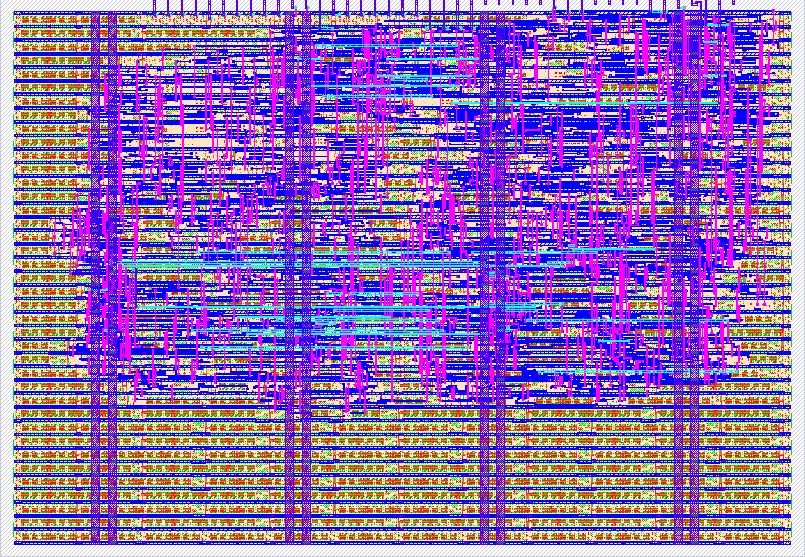
- Author: MZ
- Description: SIMD2 Math Accelerator Unit
- GitHub repository
- Open in 3D viewer
- Open in Tiny Tapeout Explorer
- Clock: 0 Hz
<img src="./img/blockdiagram_v3.png" alt="Initial Proposal Block Diagram" width="2259">
How it works
This 1x1 tile contains a math-accelerator unit (MAU) built around a 4-bit ALU pipeline.
A host device communicates with the MAU over a simple SPI-style interface using the TinyTapeout pins.
Each operation is encoded as a 20-bit “instruction word”:
- 4 bits of opcode: which math operation to run (dot product, vector add/sub, sum of squares, distance², 2×2 determinant, scalar multiply, lerp, etc.)
- Four 4-bit operands:
a1,a2,b1,b2
The host sends this instruction 4 bits at a time on ui_in[3:0] while toggling:
uio_in[0]– SPI clockuio_in[1]– write strobe (load data into the RX stage)
After 5 nibbles, the RX stage has a complete instruction and asserts a valid signal to the decode stage.
The decode stage:
- Reads the opcode and selects which math operation to perform
- Routes the four 4-bit operands into two internal “lanes” (X and Y)
- Generates an
alu_ctrl_tcontrol signal package that is used to configure the ALU (pre-add, multiply mode, post-add/concat, add vs sub, etc.) - Sends a valid command to the ALU stage when the ALU indicates it is ready
alu_ctrl_t package
| Field | Width | Description |
|---|---|---|
| pre_x_en | 1 | X lane pre-adder enable (0:passthrough, 1:add/sub) |
| pre_x_sub | 1 | X lane pre-adder mode (0:add, 1:sub) |
| mul_x_en | 1 | X lane mul enable (0:passthrough, 1:mul) |
| mul_x_sel | 3 | X lane mul input select (0:x0, 1:x1, 2:sqr 3:c 4:passthrough) |
| pre_y_en | 1 | Same as X but for Y lane |
| pre_y_sub | 1 | Same as X but for Y lane |
| mul_y_en | 1 | Same as X but for Y lane |
| mul_y_sel | 3 | Same as X but for Y lane |
| post_en | 1 | Post-adder en (0:concat, 1:add/sub) |
| post_sub | 1 | Post-adder mode (0:add, 1:sub) |
| post_sel | 1 | Post-adder input select (0:Y lane, 1:zero) |
The ALU stage is a single-cycle 4-bit core with:
- Per lane pre-adders (for adding or subtracting operand pairs)
- Per lane multiplier blocks that can multiply, square, or pass values through
- A combined post-stage that either concatenates the two lanes or adds/subtracts them
By enabling or bypassing these blocks, different opcodes implement functionality as outlined in the opcode table:
| Operation | OPCODE | Formula Index | a0 | a1 | b0 | b1 | Notes |
|---|---|---|---|---|---|---|---|
| NOOP | 0x00 | 0. a<sub>0</sub>, a<sub>1</sub>, b<sub>0</sub>, b<sub>1</sub> | x<sub>0</sub> | x<sub>1</sub> | y<sub>0</sub> | y<sub>1</sub> | returns input |
| DOT2 | 0x01 | 1. a<sub>0</sub>*a<sub>1</sub> + b<sub>0</sub>*b<sub>1</sub> | x<sub>0</sub> | y<sub>0</sub> | x<sub>1</sub> | y<sub>1</sub> | |
| WSUM | 0x02 | 1. | x | a | y | b | |
| PROJ | 0x03 | 1. | x | u<sub>x</sub> | x | u<sub>y</sub> | |
| SUMSQ | 0x04 | 1. | x | x | y | y | |
| SCSUM | 0x05 | 1. | x | c | y | c | |
| VADD2 | 0x06 | 2. (a<sub>0</sub> + a<sub>1</sub>), (b<sub>0</sub> + b<sub>1</sub>) | x0 | y0 | x1 | y1 | |
| VSUB2 | 0x07 | 3. (a<sub>0</sub> - a<sub>1</sub>), (b<sub>0</sub> - b<sub>1</sub>) | x0 | y0 | x1 | y1 | order into each lane matters |
| DIFF2 | 0x08 | 4. (a<sub>0</sub>*a<sub>1</sub>) - (b<sub>0</sub>*b<sub>1</sub>) | x0 | x1 | y0 | x1 | order of lanes matter |
| DET2 | 0x09 | 4. | x<sub>0</sub> | y<sub>1</sub> | y<sub>0</sub> | x<sub>1</sub> | order of lanes matter |
| DIFFSQ | 0x0A | 4. | x | x | y | y | order of lanes matter |
| DIST2 | 0x0B | 5. (a<sub>0</sub> - a<sub>1</sub>)² - (b<sub>0</sub> - b<sub>1</sub>)² | x<sub>0</sub> | x<sub>1</sub> | y<sub>0</sub> | y<sub>1</sub> | order into and of each lane matters |
| POLY | 0x0C | 6. (a<sub>0</sub>*a<sub>1</sub>) + (b<sub>0</sub>) | a | x | b | - | |
| SCMUL | 0x0D | 7. (a<sub>0</sub>*a<sub>1</sub>), (b<sub>0</sub>*b<sub>1</sub>) | a | b | x | y | output concats to lower 9 bits for each lane |
| LERPX | 0x0E | 8. (a<sub>0</sub>) + (a<sub>1</sub>*(b<sub>1</sub> - b<sub>0</sub>)) | x<sub>1</sub> | c | y<sub>0</sub> | y<sub>1</sub> | order into and of each lane matters, c = (y2-y1)/(x2-x1) |
| LERPY | 0x0F | 9. (b<sub>0</sub>) + (b<sub>1</sub>*(a<sub>1</sub> - a<sub>0</sub>)) | x<sub>0</sub> | x<sub>1</sub> | y<sub>1</sub> | c | order into and of each lane matters, c = (y2-y1)/(x2-x1) |
DOT2– 2D dot productVADD2/VSUB2– vector add/subSUMSQ,DIST2,DIFFSQ– sum of squares / distance² / squared differenceDET2– 2×2 determinantSCMUL,WSUM,PROJU,LERPX,LERPY– scalar multiply, weighted sums, projection, and simple linear interpolation
The ALU produces a 10-bit result plus a carry flag, which are stored in a small output register.
The TX stage then serializes this result back to the host:
- Result bits are packed into 4-bit chunks and driven on
uo_out[3:0] - The carry flag is exposed on
uio_out[3] - The host clocks the data out using
uio_in[0](SPI clock) anduio_in[2](read enable)
All stages use valid/ready handshakes, so if the host stops reading results, backpressure propagates and the ALU will stop accepting new commands without losing any results.
How to Test
This section provides a basic example of how to interact with the MAU hardware once it's fabricated on the TinyTapeout chip. The code snippet demonstrates loading a 40 bit (upper half of each byte is unused) instruction and reading the result through the psuedo SPI interface.
def send_instruction(tt, opcode, operands):
    #Load a 40 bit instruction into the MAU over 5 SPI clock cycles.
    #Args:
    #    tt: TinyTapeout interface object
    #    opcode: 8 bit operation code (e.g., 0x01 for DOT2)
    #    operands: List of four 8-bit operands [x0, x1, y0, y1]

    #Pack instruction into 5 bytes: [opcode, x0, x1, y0, y1]
    instruction_bytes = [opcode] + operands

    #Send each byte sequentially over the 8-bit input bus
    for byte in instruction_bytes:
        tt.input_byte = byte           #Place byte on ui_in[7:0]
        tt.uio.SPI_W = 1               #Assert write enable signal
        tt.clock_tick()                #Rising edge of SPI_clk to latch data
        tt.uio.SPI_W = 0               #Deassert write enable

def read_result(tt, num_bytes=3):
    #Read the result from the MAU over multiple SPI clock cycles.
    #Args:
    #    tt: TinyTapeout interface object
    #    num_bytes: Number of 8 bit chunks to read (3-5 depending on result size)
    #Returns:
    #    List of bytes representing the result (LSB first)

    result_bytes = []

    #Read each byte of the result sequentially
    for _ in range(num_bytes):
        tt.uio.SPI_R = 1                     #Assert read enable signal
        tt.clock_tick()                      #Rising edge of SPI_clk to output next byte
        result_bytes.append(tt.output_byte)  #Capture byte from ui_out[7:0]
        tt.uio.SPI_R = 0                     #Deassert read enable

    return result_bytes

#Example usage: Compute 2x1 vector dot product (DOT2)
#Operation: x0*x1 + y0*y1 = 2*3 + 4*5 = 6 + 20 = 26
send_instruction(tt, opcode=0x01, operands=[2, 3, 4, 5])

#Read 3 bytes of result (18-bit result + carry spans 3 bytes)
result = read_result(tt, num_bytes=3)

#Reconstruct the full result from received bytes
final_result = result[0] | (result[1] << 8) | (result[2] << 16)
print(f"DOT2 result: {final_result}")  # Expected: 26
The MAU processes instructions through its custom SPI interface, reading operands in sequence and returning results across multiple clock cycles to accommodate the 18-bit output width on an 8-bit bus.
IO
| # | Input | Output | Bidirectional |
|---|---|---|---|
| 0 | in0 | o0 | u1 |
| 1 | in1 | o1 | u2 |
| 2 | in2 | o2 | u3 |
| 3 | in3 | o3 | u4 |
| 4 | in4 | o4 | u5 |
| 5 | in5 | o5 | u6 |
| 6 | in6 | o6 | u7 |
| 7 | in7 | o7 | u8 |