515 Sky26a Advanced TRNG
515 : Sky26a Advanced TRNG
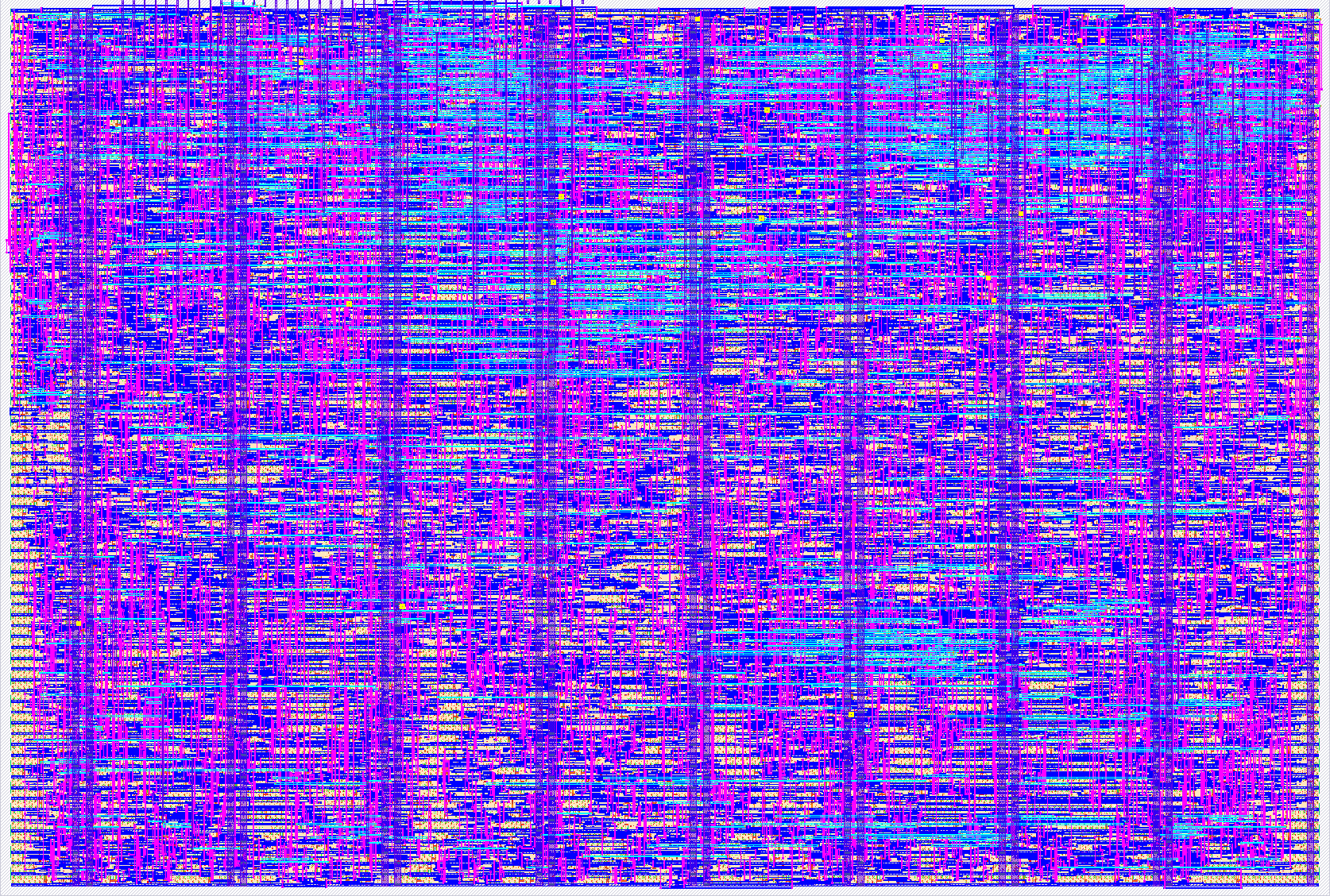
- Author: Josh Gillespie
- Description: 8-RO bank TRNG with NIST health monitors and 6 chaotic whiteners.
- GitHub repository
- Open in 3D viewer
- Open in Tiny Tapeout Explorer
- Clock: 10000000 Hz
How it works
This project implements a research-grade True Random Number Generator (TRNG) based on the phase jitter of an 8-oscillator Ring Oscillator (RO) bank, with comprehensive characterization and debug features.
Entropy Core
Eight independent Ring Oscillators are instantiated using Sky130 standard cells (NAND2 + inverter chains). One RO is "tunable" (3–31 stages via ui_in[7:5]), while seven have fixed prime-number lengths (13, 17, 19, 23, 29, 31, 37 stages) with varied drive strengths (inv_1, inv_2, inv_4) to maximize frequency diversity and prevent phase-locking.
Entropy Pipeline (3 selectable modes)
- Default (XOR→sync): All 8 RO outputs are XORed together, then passed through a 4-stage synchronizer. This is the standard mode for maximum entropy mixing.
- Sync-before-XOR (
entropy_ctrl[0]=1): Each RO is independently synchronized through a 2-stage synchronizer, then the 8 synchronized outputs are XORed. This provides independent sampling with better theoretical randomness properties. - Single-RO bypass (
ctrl_reg[0]=1): A single RO (selected byfreq_mux_sel) is routed through a 4-stage synchronizer, bypassing the XOR combiner. This mode enables individual RO characterization and frequency measurement.
Health Monitoring
Real-time NIST SP 800-90B compliant health monitors run continuously:
- Repetition Count Test (RCT): Detects stuck-at failures. Cutoff = 32 consecutive identical bits.
- Adaptive Proportion Test (APT): Detects bias over a sliding window. Window = 1024 bits, cutoff = 600 matches.
Failures trigger an alarm that drives the auto-tuner to cycle RO configurations. Debug registers provide real-time visibility into RCT count, APT match count, and individual test pass/fail status. A test injection mode allows deterministic alarm verification by inserting known bit patterns into the monitor input.
Conditioning (7 selectable modes)
The conditioner processes the sampled entropy bits before output, selected via ctrl_reg[7:5]:
| Mode | Description |
|---|---|
| 0 | von Neumann corrector (default, bias elimination) |
| 1 | Bypass (raw bits, no conditioning) |
| 2 | Tent map (chaotic, 16-bit fixed-point) |
| 3 | Coupled Tent map (two coupled chaotic maps) |
| 4 | Logistic map (chaotic, 16-bit fixed-point) |
| 5 | Bernoulli map (chaotic, 16-bit fixed-point) |
| 6 | Lorenz map (chaotic, sequential multiply for area efficiency) |
| 7 | LFSR (32-bit linear feedback shift register) |
Output Interfaces
- Parallel: 8-bit random bytes on
uo_out[7:0]with valid strobe onuio_out[0]. - UART TX: Random bytes streamed at 115200 baud on
uio_out[1]. - UART RX: Register read/write commands on
uio_in[2]at 115200 baud. Provides full register access as an alternative to SPI. - SPI: Register-based follower on
uio[3:6](CS_N, SCLK, MOSI, MISO). CPOL=0, CPHA=0.
SPI / UART Register Map
| Address | R/W | Description |
|---|---|---|
| 0x00–0x02 | R | Frequency count (24-bit, LSB first) |
| 0x10 | R/W | Status / Freq mux select: {3'b0, alarm, 1'b0, freq_mux_sel[2:0]} |
| 0x11 | R | Random byte output |
| 0x12 | R | RO selection readback (auto-tuner output) |
| 0x13 | R/W | Control register (see below) |
| 0x14–0x1A | R | Conditioner state readback |
| 0x1B | R | NIST debug: {rct_fail, apt_fail, rct_count[5:0]} |
| 0x1C | R | APT match count [7:0] |
| 0x1D | R | Conditioner capability bitmask |
| 0x1E | R | APT match count [9:8] (bits [1:0]) |
| 0x20 | R/W | Scratchpad (link verification) |
| 0x21 | R/W | Entropy control register (see below) |
Control register (0x13):
| Bit(s) | Name | Description |
|---|---|---|
| 0 | ro_bypass |
1 = single-RO mode (bypass XOR, RO selected by freq_mux_sel) |
| 1 | force_manual |
1 = ignore auto_en pin for RO tuning |
| 2 | mask_alarm |
1 = suppress NIST alarm for auto-tuning |
| 4:3 | uo_mux_sel |
Output mux: 0=random byte, 1=freq count LSB, 2=status, 3=raw sampled_bit |
| 7:5 | cond_sel |
Conditioner select (0–7, see table above) |
Entropy control register (0x21):
| Bit(s) | Name | Description |
|---|---|---|
| 0 | sync_before_xor |
1 = sync each RO independently before XOR |
| 1 | nist_inject_en |
1 = enable NIST test injection (overrides entropy source for monitor) |
| 2 | nist_inject_bit |
Bit value to inject when injection is enabled |
| 3 | uart_stream_en |
1 = stream random bytes on UART TX (default off) |
| 7:4 | reserved |
UART Command Protocol
The UART command interface mirrors the SPI register protocol over a 2-wire UART connection (115200 baud, 8N1):
- Write: Send
{1, addr[6:0]}then{data[7:0]}(2 bytes). Bit 7 of byte 1 = 1 for write. - Read: Send
{0, addr[6:0]}then{0x00}(dummy byte). Device responds with 1 byte on TX containing the register value.
This provides a fallback interface if SPI is unavailable, using only the UART TX/RX pins.
How to test
Quick Start
- Set
ui_in[3](Enable) to1. Random data flows onuo_outand the UART TX pin immediately. - Verify SPI link: write
0xA5to scratchpad register0x20, read it back. - Verify UART link: send
{0x80|0x20, 0x5A}on UART RX to write0x5Ato scratchpad, send{0x20, 0x00}to read it back.
RO Characterization
- Enable bypass mode: write
ctrl_reg(0x13) =0x01. - Select each RO via
freq_mux_sel(write to 0x10). - Read frequency count from 0x00–0x02 (24-bit).
- Sweep tunable RO0 via
ui_in[7:5](0–7) and record frequency vs. chain length.
NIST Health Monitor Testing
- Enable test injection: write
entropy_ctrl(0x21) =0x06(inject constant 1s). - Wait ~50 clock cycles. Read 0x1B to verify
rct_fail(bit 7) = 1. - Switch to inject 0s: write 0x21 =
0x02. Read 0x1B to verify count reset. - Disable injection: write 0x21 =
0x00.
Conditioner Testing
Set ctrl_reg[7:5] to select each conditioner (0–7). Collect random bytes from 0x11. Read conditioner state from 0x14–0x1A. Check capability bitmask at 0x1D.
See test_plan.md for the comprehensive silicon test and characterization plan.
External hardware
None required. Standard Tiny Tapeout carrier board. UART TX/RX on uio[1:2] and SPI on uio[3:6] are available on the bidirectional PMOD connector. UART pins follow the Digilent Pmod UART standard (TXD=uio[1], RXD=uio[2]).
IO
| # | Input | Output | Bidirectional |
|---|---|---|---|
| 0 | Random Byte Bit 0 | Byte Valid Strobe | |
| 1 | Random Byte Bit 1 | UART TX Output (115200 baud) | |
| 2 | Random Byte Bit 2 | UART RX Input (115200 baud) | |
| 3 | Enable (1=On, 0=Off) | Random Byte Bit 3 | SPI CS_N (Active Low) |
| 4 | Auto Mode Enable | Random Byte Bit 4 | SPI SCLK |
| 5 | Tunable Select Bit 0 | Random Byte Bit 5 | SPI MOSI (Address/Data In) |
| 6 | Tunable Select Bit 1 | Random Byte Bit 6 | SPI MISO (Register Out) |
| 7 | Tunable Select Bit 2 | Random Byte Bit 7 |