289 IEEE Bubble Sort Engine
289 : IEEE Bubble Sort Engine
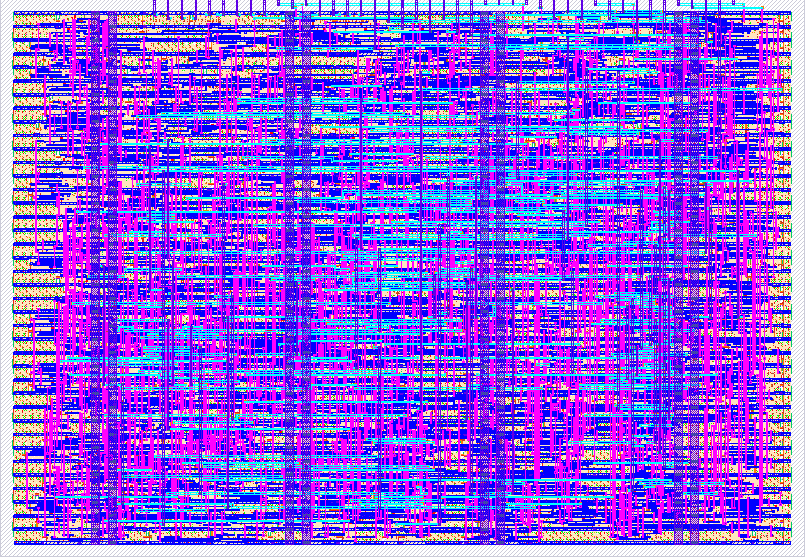
- Author: Dat Dinh Trong
- Description: A bubble sort from DSA with love <3
- GitHub repository
- Open in 3D viewer
- Open in Tiny Tapeout Explorer
- Clock: 0 Hz
Purpose
Bubble Sort Engine is a hardware macro that sorts an array of 8-bit elements using the Bubble Sort algorithm. Instead of software-based sorting, this module accelerates the process by running it directly in hardware, supporting up to 8 elements with handshaking. It is designed to optimize sorting operations with low latency based on data streaming.
Register Map / I/O Map
The design does not use a traditional Register Map addressable interface. Instead, it communicates directly via configured pins using a Data Stream model with Valid/Ready signals:
- Data Inputs (
ui_in[7:0]): Contains the input value (in_data[7:0]) to feed into the sorter. - Data Outputs (
uo_out[7:0]): Contains the output value (out_data[7:0]) in ascending sorted order. - Control Pins (
uio_in/uio_out):uio_in[0] - start: A start pulse to reset the hardware and prepare it to receive data.uio_in[1] - in_valid: Master indicates that the currentin_dataon the bus is valid.uio_in[2] - in_last: Indicates that the currently pushed element is the last element of the array.uio_in[3] - out_ready: External Master indicates it is ready to receive output results.uio_out[4] - in_ready: Engine indicates it is ready to receive new data from the Master.uio_out[5] - out_valid: Engine indicates the data present on theout_dataport is valid.uio_out[6] - out_last: Engine indicates the current output element is the largest/last element of the array.
Usage
- Start Phase: Issue a single pulse on
uio_in[0](start = 1) to reset the module to IDLE mode and make it ready to receive inputs (uio_out[4]/in_ready = 1). - Input Phase:
- Drive the 8-bit data into the
ui_in[7:0](in_data) pins. - Set
uio_in[1](in_valid = 1). Whenever bothuio_in[1](in_valid) anduio_out[4](in_ready) are 1 at the rising edge of the clock, the data is latched internally. - When transmitting the last element of the array (maximum length 8), assert
uio_in[2](in_last = 1) concurrently withuio_in[1](in_valid = 1).
- Drive the 8-bit data into the
- Sort Phase: After receiving the last element, the module automatically runs the internal Bubble Sort algorithm. This phase executes automatically over multiple clock cycles.
- Output Phase: Once sorting is completed, the circuit asserts
uio_out[5](out_valid = 1). The External Master must assertuio_in[3](out_ready = 1) to read each element continuously from theuo_out[7:0](out_data) pins. The signal onuio_out[6](out_last = 1) notifies the Master that the entire sorted array has been successfully streamed out and the Engine will return to theIDLEstate.
How to test
This project employs two approaches to ensure reliability in the digital design:
1. Testbench Simulation (TB & Cocotb)
The module is set up with a testbench powered by the cocotb framework. You can use the test/test.py script alongside Icarus Verilog (iverilog) by running the make command inside the test/ directory.
The testbench automatically loads various array test suites and manipulates the Valid/Ready flags. It meticulously uses the ReadOnly() phase to capture synchronous data correctly and perform assert checks against the Python software equivalent, identifying edge cases related to latency.
2. Formal Verification
The system mathematics and edge cases are formally verified using the Cadence/Siemens Jasper Formal Verification tool.
Since testbench coverage cannot guarantee 100% bug elimination, Formal Verification ensures absolute handshaking logic in the State Machine, boundaries on memories and counters (count, out_ptr), and mathematically proves the design avoids deadlocks and invalid states via SVA (SystemVerilog Assertions).
Bubble Sort Time Complexity
Bubble sort has the following time complexities:
-
Worst-case time complexity:
$O(n^2)$ -
Average-case time complexity:
$O(n^2)$ -
Best-case time complexity (with swap flag optimization):
$O(n)$
External hardware
All built-in, we are all in-house, no need to outsource, because we are strong enough
IO
| # | Input | Output | Bidirectional |
|---|---|---|---|
| 0 | in_data[0] | out_data[0] | start |
| 1 | in_data[1] | out_data[1] | in_valid |
| 2 | in_data[2] | out_data[2] | in_last |
| 3 | in_data[3] | out_data[3] | out_ready |
| 4 | in_data[4] | out_data[4] | in_ready |
| 5 | in_data[5] | out_data[5] | out_valid |
| 6 | in_data[6] | out_data[6] | out_last |
| 7 | in_data[7] | out_data[7] |