558 64 Sample FFT ASIC
558 : 64 Sample FFT ASIC
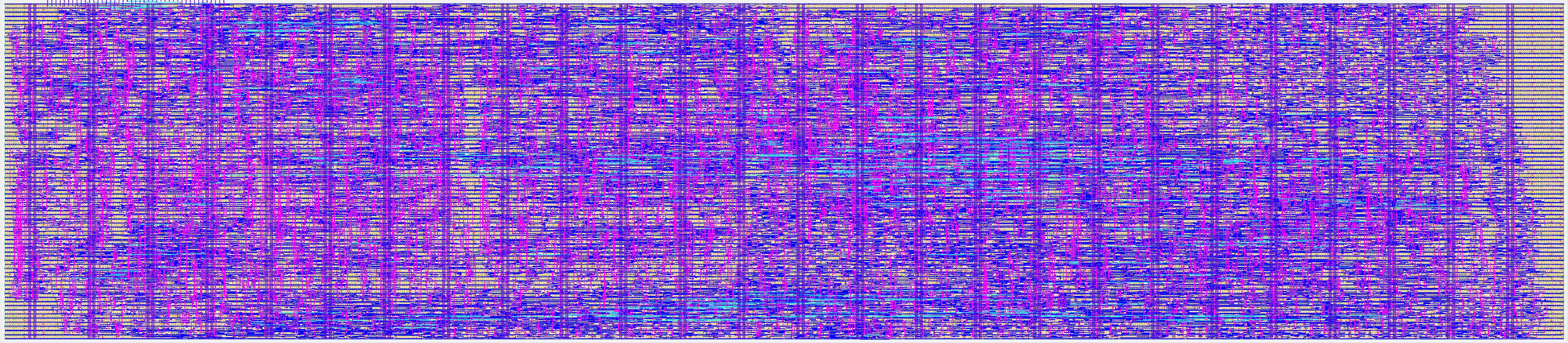
- Author: UGRA IIT(BHU)
- Description: This is the 64 sample FFT IC
- GitHub repository
- Open in 3D viewer
- Open in Tiny Tapeout Explorer
- Clock: 10000000 Hz
How it works
This design implements a 64-point Radix-2 Single Delay Feedback (SDF) Decimation-In-Frequency (DIF) FFT in silicon, targeting the Tiny Tapeout 6×2 tile footprint.
Architecture
The pipeline consists of 6 cascaded sdf_stage modules (since log₂(64) = 6). Each stage contains:
- A delay line (shift register) whose depth halves per stage: 32 → 16 → 8 → 4 → 2 → 1.
- A Radix-2 DIF butterfly unit that computes the complex sum
A+Band the twiddle-multiplied difference(A−B)·W. - An asynchronous twiddle ROM storing 32 pre-computed phase factors W₆₄⁰⁻³¹ as 8-bit signed real/imaginary coefficients.
Data routing through each stage is controlled by a single sel bit derived from the shared 6-bit master_cnt counter in top.v.
Numerical Format
All data paths are 8-bit signed two's complement integers. To prevent overflow, each butterfly stage applies an arithmetic right-shift (division by 2) with convergent rounding (+0.5 LSB before truncation, computed in 16-bit intermediates). This introduces a cumulative pipeline gain of 1/64. The output order is bit-reversed, which is the natural output order of Radix-2 DIF.
Control State Machine
A 128-cycle frame controller lives in project.v:
| Phase | Cycles | Description |
|---|---|---|
| Idle | — | System waits for the trigger byte 0xAA on ui_in while ena is high |
| Ingest | 0–63 | 64 real samples are clocked in from ui_in |
| Sync emit | Cycle 63 | A 2-stage slip buffer injects the sync marker 0xAA on both outputs |
| Flush | 64–127 | ui_in is internally forced to 0x00; 64 FFT bins stream out on uo_out (real) and uio_out (imaginary) simultaneously |
| Halt | 128 | running deasserts; system returns to idle |
Separating the ingest and flush phases into a strict 128-cycle frame prevents memory contamination between back-to-back transforms.
Module Hierarchy
tt_um_fft_adityaamehra  (project.v)   — 128-cycle FSM, sync slip buffer, output gating
└── top                 (top.v)        — master_cnt counter, 6× sdf_stage instantiation
    └── sdf_stage × 6   (sdf_stage.v)  — delay line + butterfly + twiddle ROM per stage
        ├── delay_line  (delay_line.v) — parameterised shift register (depth = N/2^(stage+1))
        ├── Butterfly   (Butterfly.v)  — Radix-2 DIF complex butterfly with convergent rounding
        └── twiddle_rom (twiddle_rom.v)— 32-entry async ROM of W₆₄ coefficients
How to test
Basic operation
- Assert
rst_nlow for at least one clock cycle to reset all pipeline registers and the frame counter. - Drive
enahigh. - Send the trigger byte
0xAA(decimal 170) onui_in. On the next rising clock edge therunningflag asserts and the 128-cycle frame begins. - For cycles 0–63 (the ingest phase), clock 64 consecutive 8-bit signed real samples into
ui_in, starting from the cycle immediately following the trigger. Sample order is time-sequential (n = 0, 1, … 63). - After the ingest phase ends, the design asserts a sync marker (
0xAA) on bothuo_outanduio_outfor one cycle. This signals that the next 64 output cycles will carry valid FFT data. - Read back 64 complex output samples from
uo_out(real part, X_k real) anduio_out(imaginary part, X_k imag). Note: the bins arrive in bit-reversed order. To reconstruct natural frequency order, reverse the 6-bit index of each output sample. - After cycle 127,
runningdeasserts and the design returns to idle, ready for the next0xAAtrigger.
Expected output characteristics
- DC input (constant value): energy appears only in bin 0 (index
0b000000). - Unit impulse (1 at n=0, 0 elsewhere): all 64 bins should have equal magnitude.
- Single-tone sine/cosine at frequency k₀: energy concentrated at bins k₀ and 64−k₀.
- Magnitude scaling: due to the per-stage /2 gain reduction, all output magnitudes are 1/64 of the unscaled DFT result. Account for this when comparing against a software FFT reference.
- LSB deviation: fixed-point quantisation and convergent rounding introduce ≤ 4 LSBs of error per bin relative to a floating-point reference (typical observed maximum ≈ 2 LSBs).
Testbench
The included CocoTB test suite (test/test.py) validates the design against numpy.fft.fft. It exercises DC, unit impulse, single-tone sine, single-tone cosine, Nyquist, and pseudo-random noise inputs, and performs a point-by-point LSB deviation check after correcting for bit-reversal.
To run the tests locally:
cd test
make
External hardware
The design requires an external controller (e.g., an FPGA or microcontroller) to:
- Generate the trigger sequence: assert
ena, then send0xAAonui_infollowed by 64 data samples on successive clock cycles. - Capture output samples: latch
uo_outanduio_outon each of the 64 cycles following the0xAAsync marker. - Bit-reverse correction (optional): if natural frequency order is required, the controller or post-processing software should reorder the 64 captured bins by reversing their 6-bit indices.
- Clock supply: the design targets a 10 MHz system clock (100 ns period). The external controller must provide this clock on the
clkpin.
No analog or mixed-signal peripherals are required. The interface is entirely synchronous digital.
IO
| # | Input | Output | Bidirectional |
|---|---|---|---|
| 0 | Input real bit 0 | Output real bit 0 | Output imag bit 0 |
| 1 | Input real bit 1 | Output real bit 1 | Output imag bit 1 |
| 2 | Input real bit 2 | Output real bit 2 | Output imag bit 2 |
| 3 | Input real bit 3 | Output real bit 3 | Output imag bit 3 |
| 4 | Input real bit 4 | Output real bit 4 | Output imag bit 4 |
| 5 | Input real bit 5 | Output real bit 5 | Output imag bit 5 |
| 6 | Input real bit 6 | Output real bit 6 | Output imag bit 6 |
| 7 | Input real bit 7 | Output real bit 7 | Output imag bit 7 |