448 Wave Lattice
448 : Wave Lattice
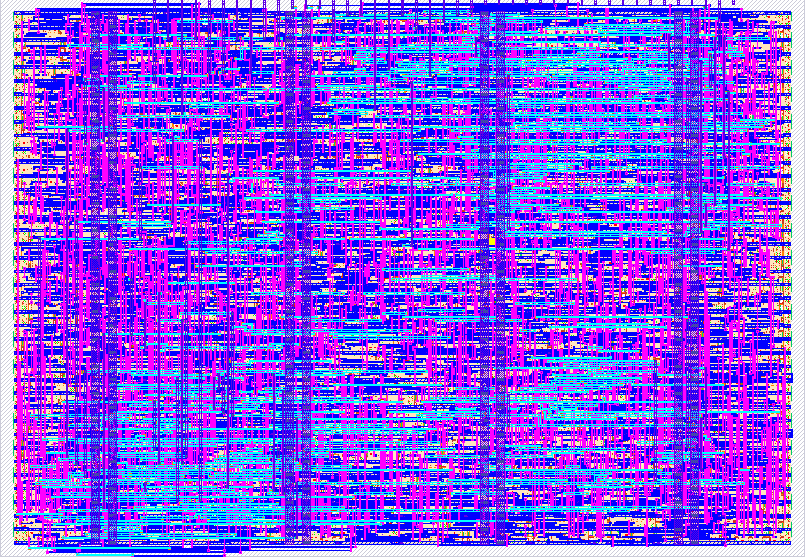
- Author: Kilian
- Description: A 40x30 dot lattice displaced by two interfering wave sources on a Lissajous trajectory — no CPU, no memory, pure logic
- GitHub repository
- Open in 3D viewer
- Open in Tiny Tapeout Explorer
- Open in VGA Playground
- Clock: 50350000 Hz
How it works
Wave Lattice is a port of Taylor Troesh's browser sketch at https://taylor.town/waves (itself inspired by Zach Lieberman) to pure silicon logic. A 40×30 grid of dots is drawn against a black background over VGA. Two radial wave sources interfere across the screen; where each dot would land is displaced by that interference field, so the regular lattice warps into compression rings around the sources.
A single virtual "pointer" slowly traces a Lissajous figure (3:5
frequency ratio between the x and y axes) within a ±64-pixel box
around screen centre, completing one full woven cycle every ~17
seconds. Source A sits at the pointer, source B at its point-mirror
(640-x, 480-y) — directly analogous to the JS original where the
second source is the mirror of the mouse position.
2× internal clock
To fit the design into a single Tiny Tapeout tile, the internal logic
runs at 50.35 MHz — twice the 25.175 MHz VGA pixel rate. A 1-bit
phase register toggles every clock, splitting each VGA pixel into two
internal cycles:
phase = 0— pixel cycle: VGA timing advances, source A's state updates, the output is sampled to the screen.phase = 1— free cycle: source B's state updates.
A single 14-bit adder, subtractor, or predicate whose operands are
muxed on phase replaces what would otherwise be two parallel copies
(one for A, one for B). Only the state registers remain duplicated
(r1a/r1b, r2a/r2b, ra_lat/rb_lat, signed / far-from-axis latches) —
they have to, because both values are read simultaneously when the
display-time displacement field is decoded.
Interference field
The interference surface is computed per-pixel by a distance-squared
accumulator trick that avoids any multipliers on the hot path — just
adders and an XOR-like phase extraction. Displacement direction comes
from the sign of the (already-signed) pixel-to-centre delta;
displacement magnitude from the phase bits of the accumulator, with
one of those bits acting as a sign that flips across each radial ridge
(the silicon equivalent of tanh(sharp · sin) in the JS original —
dots compress onto ridges and rarefy in troughs).
There is no frame buffer, no line buffer, and no per-dot state: the only storage is the two 14-bit accumulators per source, a pair of 12-bit lattice-anchor latches, and the counter needed for the Lissajous trajectory.
How to test
Connect a TinyVGA Pmod to the output pins. The design expects a 50.35 MHz clock (2× the VGA pixel rate). After reset you should see a field of white dots on black, warping around the two source centres as the pointer weaves a slow Lissajous figure through the centre of the screen. All input pins are unused in this variant.
External hardware
TinyVGA Pmod (VGA output)
IO
| # | Input | Output | Bidirectional |
|---|---|---|---|
| 0 | R1 | ||
| 1 | G1 | ||
| 2 | B1 | ||
| 3 | VSYNC | ||
| 4 | R0 | ||
| 5 | G0 | ||
| 6 | B0 | ||
| 7 | HSYNC |