719 tt_um_neutern_0
719 : tt_um_neutern_0
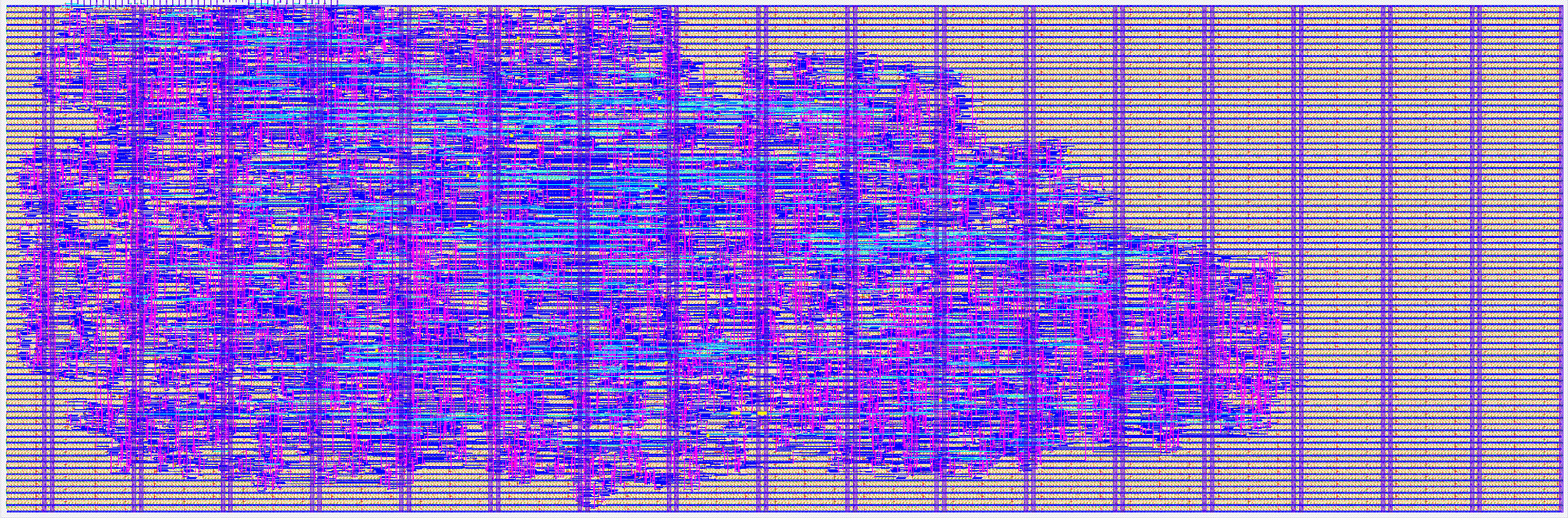
- Author: Nikola Cucuk
- Description: SNN network 2x2 neurons
- GitHub repository
- Open in 3D viewer
- Open in Tiny Tapeout Explorer
- Clock: 15000000 Hz
How it works
tt_um_neutern_0 is a Spiking Neural Network (SNN) tile implementing 4 Leaky Integrate-and-Fire (LIF) neurons arranged in a 2×2 grid. The neurons share a single microcode-driven compute worker that processes spike events in round-robin order.
Neuron Model
Each neuron maintains three 4-bit biological state registers:
| Register | Bits | Role |
|---|---|---|
vm — membrane potential |
4-bit signed | Accumulates synaptic input; resets after firing |
accum — synaptic accumulator |
4-bit signed | Integrates weighted spikes before committing to vm |
θ — threshold |
4-bit signed | Firing threshold, loaded from microcode initialisation |
When a spike arrives the neuron's microcode program runs: accumulate the weight into vm, compare vm ≥ θ, and if true emit an output spike and reset vm to zero.
Flit Formats (Mode-dependent)
The same 8-bit input bus carries spikes and configuration headers.
Spike mode (uio[2]=0):
ui[7:4] = weight[3:0]   4-bit signed synaptic weight
ui[3:2] = 0             reserved in spike mode
ui[1]   = neuron_y[0]   row address
ui[0]   = neuron_x[0]   column address
Weight header mode (uio[2]=1, uio[3]=0):
ui[7:4] = weight[3:0]   write payload (ignored for read)
ui[2]   = rd_wr         0=write weight, 1=read current weight
ui[1]   = neuron_y[0]   target row
ui[0]   = neuron_x[0]   target column
ISA header mode (uio[2]=1, uio[3]=1):
ui[7:3] = op5           micro-op opcode field
ui[2]   = barrier       instruction barrier/tag bit
ui[1]   = neuron_y[0]   target row
ui[0]   = neuron_x[0]   target column
Neuron addressing inside the 2×2 grid:
neuron_y[0] |
neuron_x[0] |
Neuron index |
|---|---|---|
| 0 | 0 | neuron 0 |
| 0 | 1 | neuron 1 |
| 1 | 0 | neuron 2 |
| 1 | 1 | neuron 3 |
Handshake Signals
| Pin | Direction | Meaning |
|---|---|---|
uio[0] — rv_in_ready |
output | Tile is ready to accept a new input spike |
uio[1] — rv_out_valid |
output | Output spike on uo[7:0] is valid this cycle |
Input is accepted when both the sender asserts the data and rv_in_ready is high. Output is captured when rv_out_valid is high.
How to test
Required signals
| Signal | Pin | Direction |
|---|---|---|
| Clock | clk |
input |
| Reset (active-low) | rst_n |
input |
| Spike input byte | ui[7:0] |
input |
| Spike output byte | uo[7:0] |
output |
| Header mode select | uio[2] |
input |
| Header type select | uio[3] |
input |
| Tile ready to receive | uio[0] |
output |
| Output spike valid | uio[1] |
output |
Step 1 — Reset
Assert rst_n = 0 for at least 4 clock cycles, then release (rst_n = 1). All neuron contexts are cleared and thresholds will be loaded when the microcode initialisation program runs on first dispatch.
Step 2 — Send a spike to a neuron
-
Poll
uio[0](rv_in_ready). Wait until it is high. -
Drive
ui[7:0]with the desired spike flit:Neuron target ui[7:4]weightui[2]yui[0]xExample byte neuron 0 0001(+1)0 0 0b00010000=0x10neuron 1 0001(+1)0 1 0b00010001=0x11neuron 2 0001(+1)1 0 0b00010100=0x14neuron 3 0001(+1)1 1 0b00010101=0x15 -
Hold the value for one clock cycle.
Step 2b — Configure/read neuron weight using header packets
- Set header mode:
uio[2]=1,uio[3]=0. - Weight write: drive
ui[2]=0, setui[7:4]=weight, set target inui[1:0]. - Weight read: drive
ui[2]=1, same target inui[1:0]. - Observe returned output flit on
uo[7:0];uo[7:4]carries the readback weight.
Step 3 — Observe output spikes
- Monitor
uio[1](rv_out_valid) each cycle. - When
rv_out_validis high, sampleuo[7:0]. The flit format is identical to the input:uo[7:4]= emitted weight,uo[2]= sourceneuron_y[0],uo[0]= sourceneuron_x[0].
Step 4 — Threshold test (fire a neuron)
Send repeated spikes with weight +1 to the same neuron until vm ≥ θ. The default threshold is θ = 7. Sending 7 consecutive weight-1 spikes to neuron 0 should produce one output spike with source address neuron_x=0, neuron_y=0:
# 7 input flits: weight=+1, neuron_x=0, neuron_y=0
ui = 0x10  (×7 cycles, waiting for rv_in_ready between each)
# Expected: one output flit with uo = 0x10, rv_out_valid = 1
After firing, vm resets to zero and the neuron is ready to integrate again.
Step 5 — Multi-neuron test
Target different neurons in interleaved fashion to confirm independent state:
# Spike to neuron 0 with weight +3
ui = 0b00110000  (weight=3, y=0, x=0)

# Spike to neuron 3 with weight +7
ui = 0b01110101  (weight=7, y=1, x=1)
# neuron 3 fires immediately (vm=7 ≥ θ=7), output flit expected on uo
Cocotb test reference
The supplied test/test.py exercises the above sequence using the TinyTapeout cocotb harness. Run with:
cd test && make
Waveforms are written to test/tb.fst and can be viewed with GTKWave using the pre-configured test/tb.gtkw layout.
IO
| # | Input | Output | Bidirectional |
|---|---|---|---|
| 0 | neuron_x[0] | spike_out[0] neuron_x[0] | rv_in_ready (output: tile ready to receive spike) |
| 1 | neuron_y[0] | rv_out_valid (output: tile output spike valid) | |
| 2 | weight header rd_wr bit / ISA barrier bit | spike_out[2] neuron_y[0] | rv_in_is_header (input: 1=header/config mode, 0=normal spike mode) |
| 3 | op5[0] (ISA mode only) | rv_in_header_is_isa (input: with uio[2]=1, 1=ISA config header, 0=weight config header) | |
| 4 | weight[0] / op5[1] | spike_out[4] weight[0] | |
| 5 | weight[1] / op5[2] | spike_out[5] weight[1] | |
| 6 | weight[2] / op5[3] | spike_out[6] weight[2] | |
| 7 | weight[3] / op5[4] | spike_out[7] weight[3] |