802 Prime Quine
802 : Prime Quine
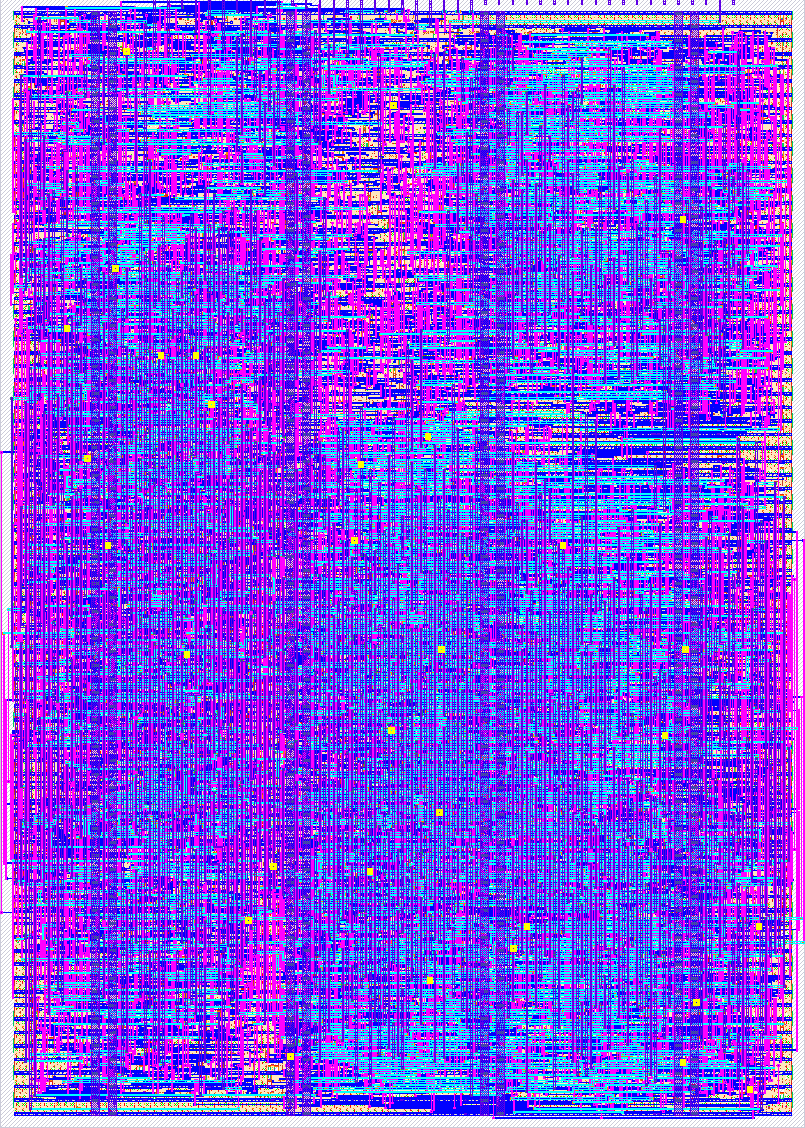
- Author: James Ross
- Description: This circuit takes no input and reproduces its own source code as VGA output
- GitHub repository
- Open in 3D viewer
- Open in Tiny Tapeout Explorer
- Open in VGA Playground
- Clock: 25175000 Hz
How it Works
This is a standalone VGA demo that runs, intentionally, without input. All input pins are unused, including the reset and enable pins. This project is what is known as a quine. A quine is generally a computer program which takes no input and a produces a copy of its own source code as output. Typically, this involves creating a specially formatted string of source code and the program emits that approximate string once, and then one nearly like again. Typically, software quines leverage a mountain of software abstractions that make it easier to implement a quine in your language of choice. They generally build upon standard libraries, operating systems, and other implicit software inputs that are not included in the output. Verilog and other HDLs generally provide none of this helpful abstraction.
If you inspect the source of this project, you will find two sections which are nearly identical, separated by a long hexadecimal array, which encodes the 96-character visible ASCII character codes into a bitmap/pixel font. Each character 4x8 pixels wide. The 640x480 VGA display output separates code characters by one pixel in the horizontal direction and two pixels vertically. That enables displaying up to 128x48 (6144) characters. While this limitation could be problematic for binary encoding of the 3072 bits necessary for the 96-character 4x8 pixel font, we can encode 4 bits per hexadecimal value. This results in a 768 character array, well within the character limitation. Since the source array is approximately repeated twice within the quine, that leaves us with about 2688 characters of Verilog. Since whitespace is only required between keywords, techniques to limit the source array were used. Consequently, the smaller sources minimizes the combinatorial logic required to encode the source and makes for a smaller circuit. Multiple statements were combined when possible, single character variables were used, and if a value was used once, it was rolled into the calculation. Otherwise helpful parentheses were deleted when order of operations could be leveraged instead. The result is a very compact, nearly indecipherable blob of logic:
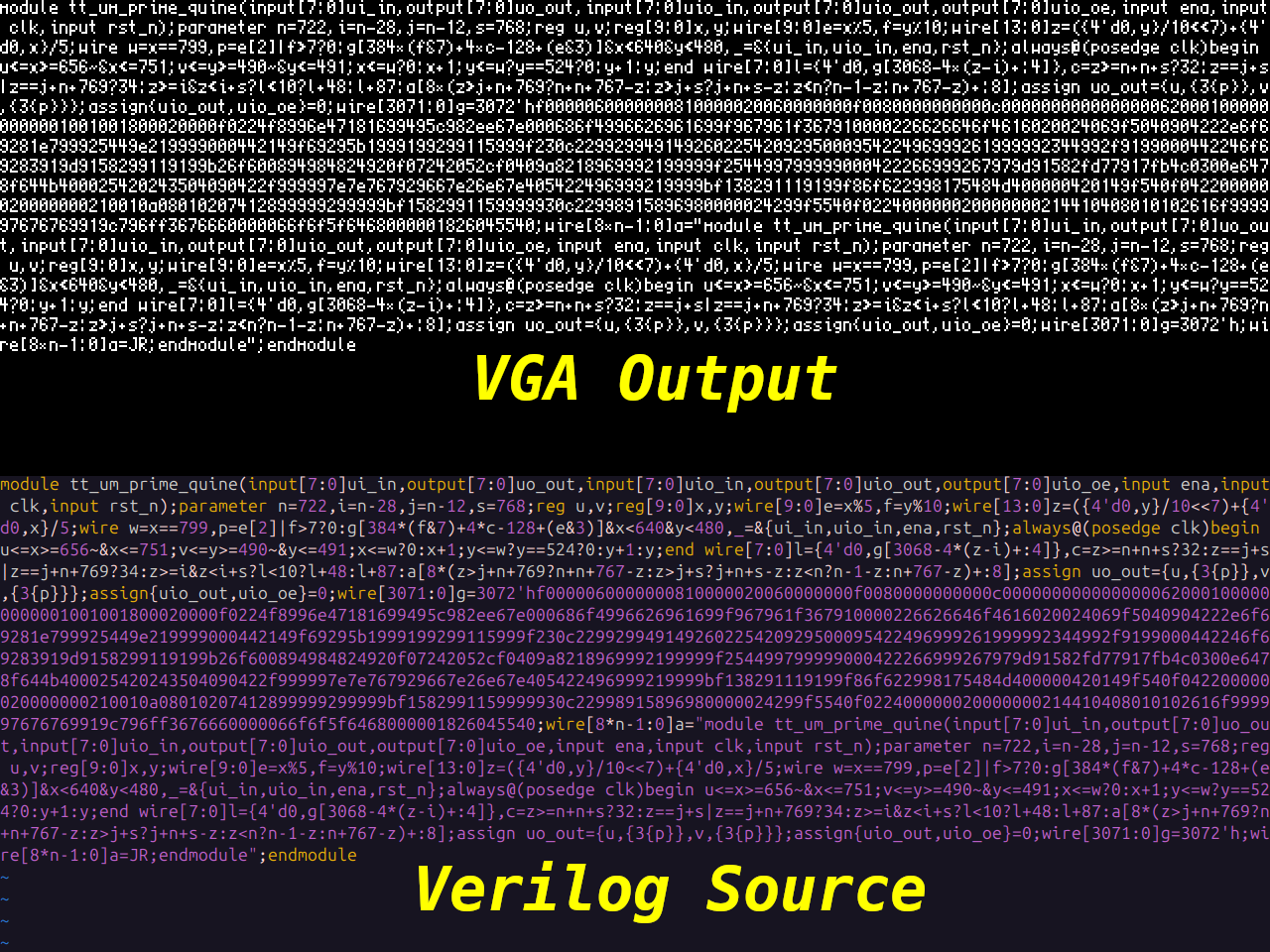
In my research I found two examples of Verilog-based quines which output their own source over UART and have been demonstrated to work on a small FPGA. To my knowledge this project is the first Verilog quine to output with VGA signaling and also the world's first hardened quine.
How to Test
Plug into a VGA monitor and select this circuit to test. The circuit must be clocked at (or very near) to 25.175 MHz.
External hardware
Requires the TinyVGA PMOD
IO
| # | Input | Output | Bidirectional |
|---|---|---|---|
| 0 | R1 | ||
| 1 | G1 | ||
| 2 | B1 | ||
| 3 | VSync | ||
| 4 | R0 | ||
| 5 | G0 | ||
| 6 | B0 | ||
| 7 | HSync |