458 Digital STDP Learning Controller
458 : Digital STDP Learning Controller
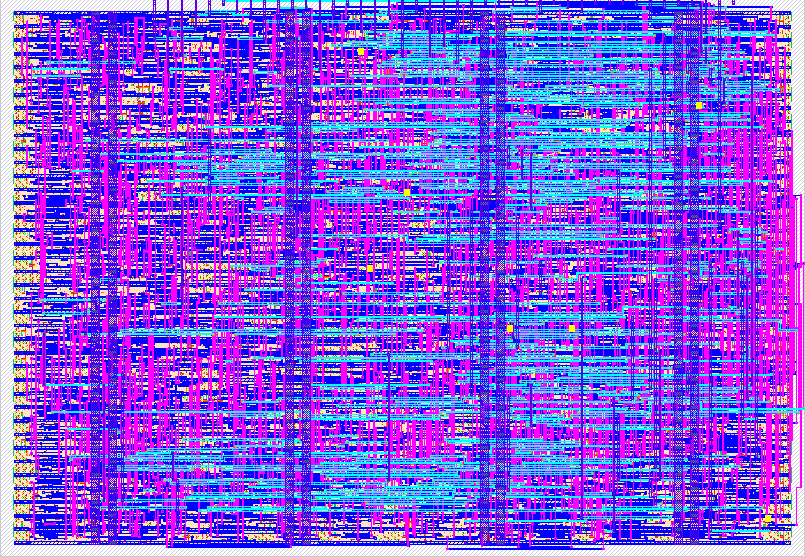
- Author: Prof. Santhosh Sivasubramani, IIT Delhi
- Description: Standalone spike-timing-dependent plasticity engine with programmable LUT, configurable learning rate, R-STDP reward-gated updates, anti-Hebbian mode, eligibility trace with leaky counter, and SPI interface
- GitHub repository
- Open in 3D viewer
- Open in Tiny Tapeout Explorer
- Clock: 50000000 Hz
How it works
This design is a standalone digital spike-timing-dependent plasticity (STDP) learning controller. It captures the timestamps of pre- and post-synaptic spikes on an independent timestamp clock, computes the signed time difference deltaT = post_ts − pre_ts, looks up the magnitude of the weight change from an 8-entry programmable STDP curve LUT (entries 0–3 = LTP/potentiation, entries 4–7 = LTD/depression, indexed by |deltaT|), and scales the result by a configurable learning rate. It also adds three biologically-motivated features beyond plain pair-based STDP: an R-STDP reward gate that only releases weight updates when an external reward signal is asserted, an anti-Hebbian mode that inverts the LTP/LTD polarity (useful for inhibitory synapses and predictive-coding models), and an eligibility trace — a leaky counter that remembers recent plasticity events so that a delayed reward can still credit the correct update.
Pre- and post-synaptic spikes arrive on ui_in[0] and ui_in[1], the independent timestamp clock on ui_in[2], a hard learning enable on ui_in[3], and the R-STDP reward on ui_in[4]. A 16-bit SPI slave (Mode 0, MSB-first; CS=uio_in[0], MOSI=uio_in[1], MISO=uio_out[2], SCK=uio_in[3]) exposes the configuration: reg_ctrl at 0x00 ([0]=enable, [1]=reset, [2]=single_shot, [3]=anti_hebbian, [4]=reward_gate_en, [5]=trace_en), reg_learn_rate at 0x01 ([3:0]=learning rate, [7:4]=trace decay), reg_time_window at 0x02 ([3:0] = |deltaT| window width in LUT index units), read-only reg_pre_ts/reg_post_ts/reg_delta_t/reg_weight_update/reg_status at 0x03–0x07, and the 8-entry STDP curve LUT at 0x08–0x0F. The reset defaults install an exponential curve (LTP: 127/63/31/15, LTD: 100/50/25/12).
On each post-synaptic spike the FSM classifies deltaT as LTP or LTD, reads the matching LUT entry, optionally inverts polarity if anti-Hebbian is enabled, right-shifts by the learning-rate field, and applies the reward gate if enabled. update_ready (uo_out[0]) pulses high when a (reward-gated) update is available, alongside potentiation (uo_out[1]), depression (uo_out[2]), a weight_overflow flag (uo_out[3]) when the LUT saturates at 0xFF, and the low 4 bits of the (reward-gated) weight delta on uo_out[7:4]. Four debug taps — pre_valid, post_valid, and FSM state bits — are exposed on uio_out[7:4] for bring-up and silicon debug.
How to test
- Apply reset (
rst_nlow, then high) and, over SPI, write the desiredreg_ctrl(e.g.0x01for basic enable,0x11to also gate updates on the reward,0x31to also enable the eligibility trace,0x09for anti-Hebbian + enable), the learning-rate and trace-decay register 0x01, and the time window 0x02. - (Optional) Overwrite the STDP LUT at 0x08–0x0F with a custom curve.
- Assert
learn_enable(ui_in[3]) and driveui_in[2]with the timestamp clock. Issue a pre-synaptic spike onui_in[0], then a post-synaptic spike onui_in[1](or vice-versa for pure LTD). - When a computation completes,
update_readypulses onuo_out[0]; the polarity is onuo_out[2:1](LTP/LTD) and the low 4 bits of the gated weight delta appear onuo_out[7:4]. Reads of SPI registers 0x05 (delta_t), 0x06 (weight_update), 0x07 (status) return the last computed values. - For R-STDP, set
reg_ctrl[4]=1and driveui_in[4]high during the qualifying spike pair — without reward the output is suppressed but the internal update is still computed (visible via SPI reads). - For anti-Hebbian, set
reg_ctrl[3]=1— the LUT output polarity swaps (what would have been LTP becomes LTD and vice-versa). - For the eligibility trace, set
reg_ctrl[5]=1; the trace increments on each qualifying pair and decays at a rate set byreg_learn_rate[7:4].
A cocotb suite (22 tests in test/test.py) covers reset, SPI register roundtrip, LUT programming, single-shot vs continuous, weight overflow, R-STDP gating, anti-Hebbian inversion, eligibility-trace decay, and uio_oe direction control. All tests pass in RTL and post-synthesis gate-level simulation.
External hardware
An SPI master (microcontroller or FPGA) on uio[0:3] is required to configure the learning rate, time window, STDP LUT, and control bits. Pre- and post-synaptic spike sources drive ui_in[0] and ui_in[1]; an independent timestamp clock on ui_in[2] allows biological timescales (kHz range) to be used together with the system clock (50 MHz). An external reward signal on ui_in[4] is required only when R-STDP (reg_ctrl[4]=1) is used. The four output weight-delta bits (uo_out[7:4]) feed whatever weight-storage element the user wires up (memristor driver, skyrmion track, SRAM etc.).
IO
| # | Input | Output | Bidirectional |
|---|---|---|---|
| 0 | pre_spike | update_ready | spi_cs_n |
| 1 | post_spike | potentiation | spi_mosi |
| 2 | timestamp_clk | depression | spi_miso |
| 3 | learn_enable | weight_overflow | spi_sck |
| 4 | reward | weight_delta[0] | debug_pre_valid |
| 5 | weight_delta[1] | debug_post_valid | |
| 6 | weight_delta[2] | debug_fsm[0] | |
| 7 | weight_delta[3] | debug_fsm[1] |