Tiny Tapeout > Tiny Tapeout Chips > Tiny Tapeout SKY 26a > 867 IEEE Open Silicon 2026: UTB Hex Counter and Logic Gate Validator
867 IEEE Open Silicon 2026: UTB Hex Counter and Logic Gate Validator
867 : IEEE Open Silicon 2026: UTB Hex Counter and Logic Gate Validator
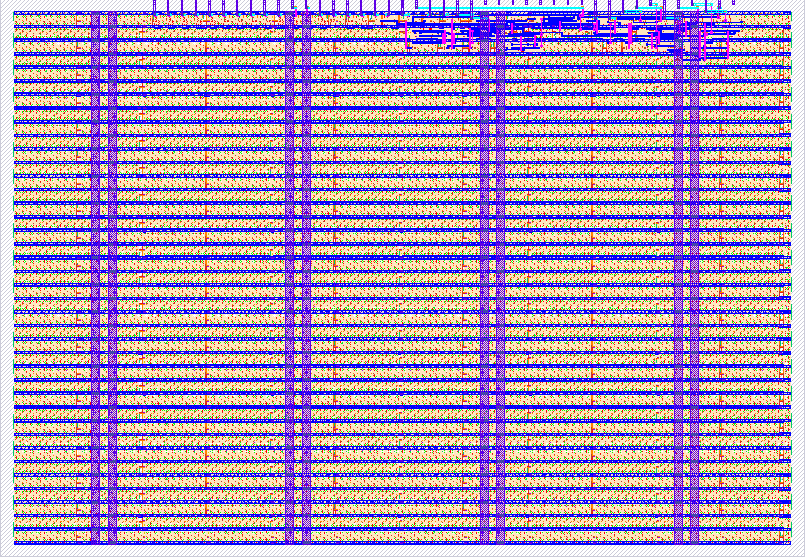
- Author: George Archbold, Karoll Silva, Camilo Miranda
- Description: A 4-bit asynchronous hex counter paired with a programmable 4-function logic gate tester.
- GitHub repository
- Open in 3D viewer
- Open in Tiny Tapeout Explorer
- View in Wokwi
- Clock: 0 Hz
How it works
This project features two independent digital modules within a single ASIC tile:
- Hexadecimal Up-Counter: A 4-bit ripple counter that increments on every rising edge of the clock. It provides raw binary outputs (COUNT_B0 to COUNT_B3) representing values from 0 to F.
- Programmable Logic Validator: A combinational circuit that evaluates Boolean functions based on two data bits (BIT_A, BIT_B) and two control bits (CTR_1, CTR_2).
-
Selection Logic:
- 00: AND (A & B)
- 01: OR (A | B)
- 10: XOR (A ^ B)
- 11: NOT (~A)
-
Modifiers: INV (Bit 4) enables a final NOT stage (turning AND to NAND, etc.), and EN (Bit 5) enables the output (Low = Active, High = Force to GND).
-
Signal Buffers: Two independent paths (BUFF1 and BUFF2) route input signals through internal silicon delay chains to verify path integrity.
How to test
- Counter: Apply a pulse to the clock pin and monitor uo[0:3]. The binary sequence should increment from 0000 to 1111. Use the rst_n pin to clear the count to zero.
- Logic Unit:
- Set EN (ui[5]) to 0.
- Set CTR_1 (ui[2]) and CTR_2 (ui[3]) to the desired gate code.
- Toggle BIT_A and BIT_B to verify the truth table at LOGIC_OUT (uo[4]).
- Toggle INV (ui[4]) to verify the result is negated.
- Buffers: Ensure signals at ui[6:7] are replicated at uo[5:7].
External hardware
- 7-Segment Display: An external decoder (like a 74HC4511 or similar) is required to convert the raw COUNT_B0-B3 bits into a human-readable hex display.
- Logic Indicators: 1 LED for monitoring output from the logic lab. Also, LEDs for the buffers evaluation.
- Input Controls: DIP switches for the 8-bit input bus and a push-button for manual clock stepping or a clock signal.
IO
| # | Input | Output | Bidirectional |
|---|---|---|---|
| 0 | BIT_A | COUNT_B0 | |
| 1 | BIT_B | COUNT_B1 | |
| 2 | CTR_1 | COUNT_B2 | |
| 3 | CTR_2 | COUNT_B3 | |
| 4 | INV | LOGIC_OUT | |
| 5 | EN | BUFF1_OUT | |
| 6 | BUFF1_IN | BUFF2_OUT | |
| 7 | BUFF2_IN | BUFF2_OUT |