516 Programmable Chaotic NLFSR
516 : Programmable Chaotic NLFSR
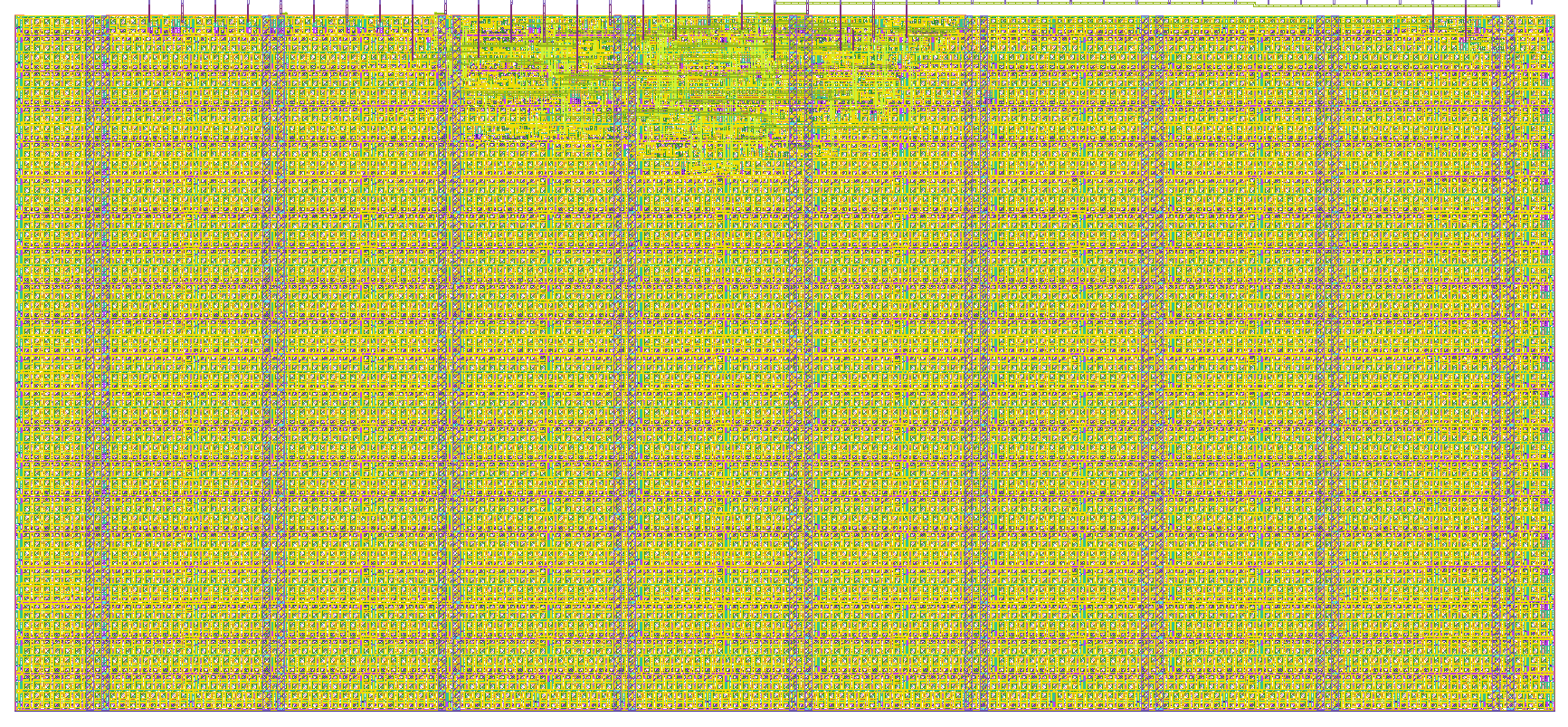
- Author: Aishu
- Description: A 16-bit NLFSR with two switchable non-linear feedback functions for cryptographic chaos.
- GitHub repository
- Open in 3D viewer
- Open in Tiny Tapeout Explorer
- Clock: 10000000 Hz
How it works
This project implements a 16-bit Non-Linear Feedback Shift Register (NLFSR) designed for cryptographic primitives and pseudo-random number generation. Unlike a standard LFSR, this design utilizes non-linear logic gates (AND/OR) in the feedback path to increase algebraic complexity. The design is programmable, allowing the user to switch between two distinct non-linear feedback functions in real-time by toggling the mode_select input (ui[0]). Function A (Mode 0) focuses on high algebraic degree using AND/XOR logic, while Function B (Mode 1) provides a chaotic variant using an alternate tap configuration.
How to test
- Apply a clock signal to the
clkpin. - Set the
enapin to high and pulse therst_npin low to load the internal 16-bit seed (0xACE1). - Observe the resulting bitstream on the 8 dedicated output pins (
uo_outfor bits 15:8) and the 8 bidirectional pins (uio_outfor bits 7:0). - To verify the programmable logic, toggle the
ui[0]input and observe the output sequence divergence. In Gate Level (GL) simulation or hardware, allow at least 30 clock cycles for the two modes to produce unique, non-overlapping sequences.
External hardware
This project is self-contained and does not require complex external hardware. It can be tested using the standard TinyTapeout Demo Board switches to control input pins and a logic analyzer or oscilloscope to capture the 16-bit output state from the uo_out and uio_out pins.
IO
| # | Input | Output | Bidirectional |
|---|---|---|---|
| 0 | mode_select | nlfsr_8 | nlfsr_0 |
| 1 | nlfsr_9 | nlfsr_1 | |
| 2 | nlfsr_10 | nlfsr_2 | |
| 3 | nlfsr_11 | nlfsr_3 | |
| 4 | nlfsr_12 | nlfsr_4 | |
| 5 | nlfsr_13 | nlfsr_5 | |
| 6 | nlfsr_14 | nlfsr_6 | |
| 7 | nlfsr_15 | nlfsr_7 |