547 Tiny RIng Oscillator PUF
547 : Tiny RIng Oscillator PUF
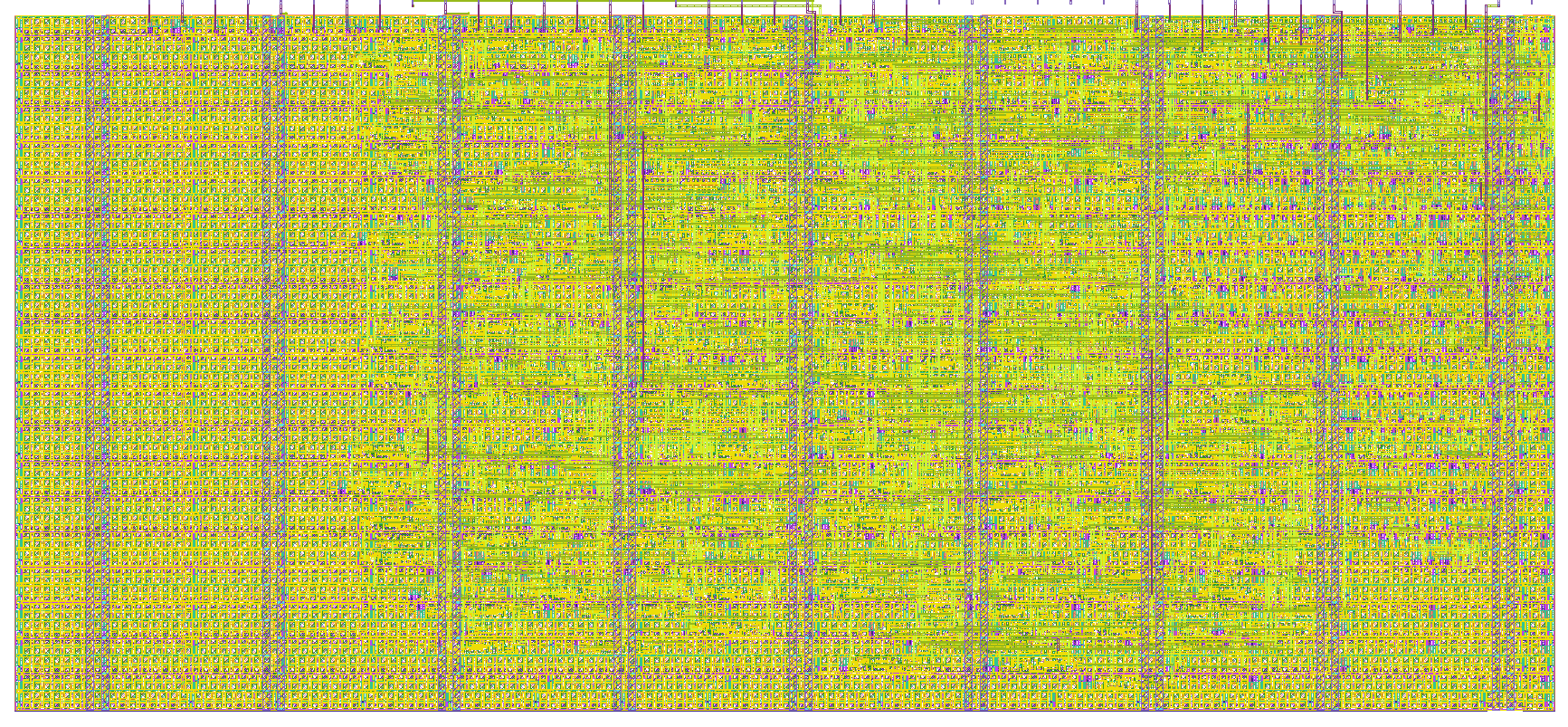
- Author: Manuel Roales
- Description: A Ring Oscillators PUF wit programmable characteristics
- GitHub repository
- Open in 3D viewer
- Open in Tiny Tapeout Explorer
- Clock: 50000000 Hz
How it works
This project implements a Programmable Length Ring Oscillator designed as a Physical Unclonable Function (PUF) for hardware security applications. The core architecture consists of an inverter chain whose effective delay path can be dynamically configured using digital selection signals.
By manipulating the multiplexer controls, the user can select different feedback loops and vary the number of active inverting stages. Due to sub-nanosecond propagation delays and microscopic process variations unique to each die during the GlobalFoundries 180nm (gf180mcu) manufacturing process, the circuit oscillates at a unique, device-specific frequency for each challenge combination. This chaotic asynchronism acts as a silicon fingerprint.
An integrated control path monitors the state of the circuit, sample capture events, and triggers a telemetry transmission when the output is ready.
Top-Level Port Mapping (Tiny Tapeout Template Integration)
The hardware signals have been packed and mapped into the standard Tiny Tapeout 8-bit buses as follows:
Dedicated Inputs (ui_in)
| Bit | Signal Name | Type | Description |
|---|---|---|---|
| [1:0] | sel_mux_0 |
Input | Multiplexer 0 selection lines (Challenge bits 0-1) |
| [3:2] | sel_mux_1 |
Input | Multiplexer 1 selection lines (Challenge bits 2-3) |
| [6:4] | n_inv |
Input | Number of active inverter stages selection (Challenge bits 4-6) |
| [7] | enable |
Input | Ring Oscillator hardware enable (1 = Run, 0 = Standby/Gated) |
Bidirectional Controls (uio_in / uio_out)
Note: Configured as inputs for control handshake.
| Bit | Signal Name | Type | Description |
|---|---|---|---|
| [0] | tx_ready |
Input | Handshake signal indicating receiver is ready for data |
| [1] | op_mode |
Input | Operation Mode configuration bit |
| [7:2] | Unused | Input | Reserved (Driven to 0) |
Dedicated Outputs (uo_out)
The output ports stream out the digitized frequency signatures or telemetry data generated by the PUF core.
How to test
To prevent excessive power consumption and thermal saturation, the Ring Oscillator features a gated input. Follow these sequential steps to test the project behavior:
- System Reset: Drive
rst_nLOW for at least 10 clock cycles while keepingui_inanduio_inat0. Then release the reset by drivingrst_nHIGH. - Challenge Selection: Provide the desired delay path configuration by assigning values to
sel_mux_0,sel_mux_1, andn_invusing the lower 7 bits ofui_in. - Core Activation: Drive
ui_in[7](enable) HIGH. The Ring Oscillator will immediately start oscillating at its native physical frequency. - Data Acquisition: Set
uio_in[0](tx_ready) HIGH to enable the internal transmission logic. Observe the output data streams or frequency signatures on the dedicated output pins (uo_out). - Safe Standby: Once data collection is completed, immediately drive
ui_in[7](enable) back to0to gate the oscillator loop and release system resources.
External hardware
No external hardware is strictly required for basic evaluation, as the digital control buses can be fully driven using Tiny Tapeout's standard digital input switches.
However, for high-precision validation:
- An Oscilloscope or Logic Analyzer can be connected to the dedicated output pins (
uo_out) to measure raw digital jitter or frequency deviations. - A Microcontroller or FPGA board (via PMOD) can be attached to automate challenge injection loops (
ui_in) and analyze the uniqueness and reliability metrics of the PUF responses.
IO
| # | Input | Output | Bidirectional |
|---|---|---|---|
| 0 | sel_mux_0[0] | debug_ro[0] | tx_ready |
| 1 | sel_mux_0[1] | debug_ro[1] | op_mode |
| 2 | sel_mux_1[0] | debug_ro[2] | |
| 3 | sel_mux_1[1] | debug_ro[3] | |
| 4 | n_inv[0] | valid_out[0] | |
| 5 | n_inv[1] | valid_out[1] | |
| 6 | n_inv[2] | cnt_data_out[0] | debug_done_out[0] |
| 7 | puf_enable | cnt_data_out[1] | debug_done_out[1] |