230 Canright SBOX
230 : Canright SBOX
- Author: Gijs Burghoorn
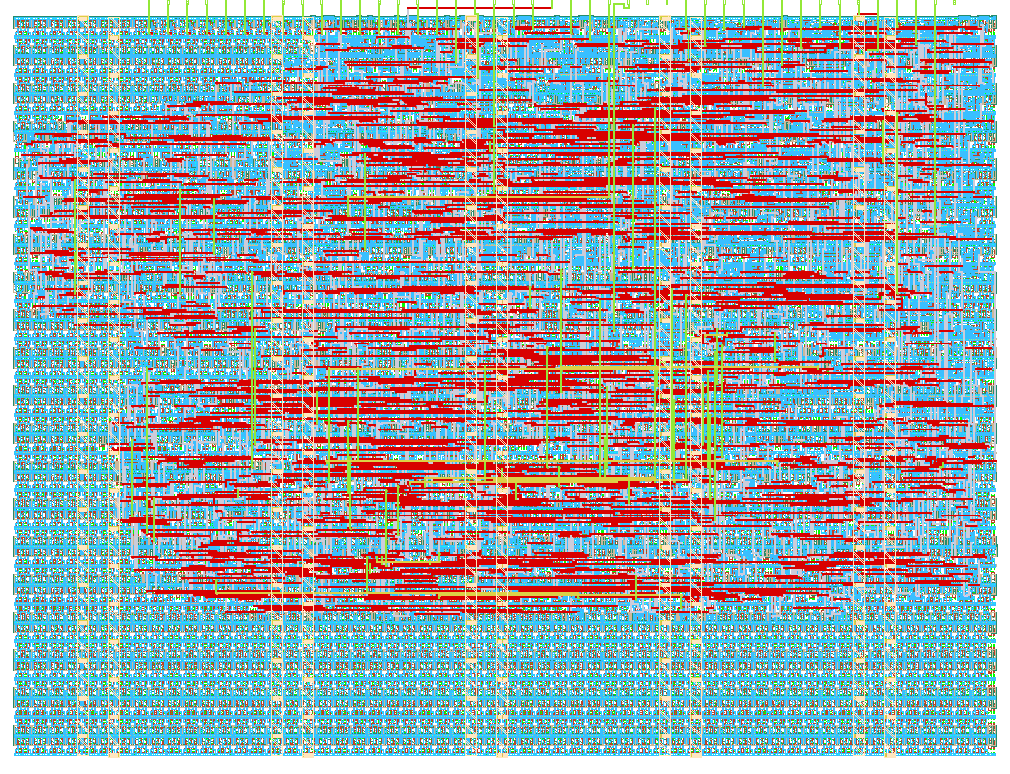
- Description: Canright SBOX for the AES block cipher.
- GitHub repository
- Open in 3D viewer
- Open in Tiny Tapeout Explorer
- Clock: 50 Hz
How it works
The design is driven by commands on uio_in[3:0].
uio_in[3:0] |
Command | Description |
|---|---|---|
0000 |
IDLE |
No-operation command. Generally assumed to be default command. |
0001 |
DATA_IN |
Load the data from ui_in into the internal data_i register. |
0010 |
KEY_IN |
Load the data from ui_in into the internal key register. |
0011 |
MASK_IN |
Load the data from ui_in into the internal mask_i register. |
0100 |
PRD_7_0_IN |
Load the data from ui_in into prd_i[7:0] of the internal prd_i register. |
0101 |
PRD_15_8_IN |
Load the data from ui_in into prd_i[15:8] of the internal prd_i register. |
0110 |
PRD_17_16_IN |
Load the data from ui_in[1:0] into prd_i[17:16] of the internal prd_i register. |
1000 |
UNMASKED_DATA_OUT |
Drive the data output of the unmasked SBOX on uo_out. |
1001 |
MASKED_DATA_OUT |
Drive the data output of the masked SBOX on uo_out. |
1010 |
MASKED_MASK_OUT |
Drive the mask output of the masked SBOX on uo_out. |
Every posedge of the clk a command will be read and executed.
There are two SBOXes that are boxes that are triggered using uio_in[7:6].
If uio_in[7] is set to 1, the unmasked SBOX will evaluate UNMASKED_SBOX(data_i ^ key).
If uio_in[6] is set to 1, the masked SBOX will evaluate MASKED_SBOX(data_i ^ key, mask_i, prd_i).
How to test
The design is tested using cocotb by passing in a bunch of test vectors and
asserting the correct output value. This can be ran using make or by running
python3 runner.py from the test directory.
IO
| # | Input | Output | Bidirectional |
|---|---|---|---|
| 0 | DATA_I[0] | DATA_O[0] | STATE[0] |
| 1 | DATA_I[1] | DATA_O[1] | STATE[1] |
| 2 | DATA_I[2] | DATA_O[2] | |
| 3 | DATA_I[3] | DATA_O[3] | |
| 4 | DATA_I[4] | DATA_O[4] | |
| 5 | DATA_I[5] | DATA_O[5] | |
| 6 | DATA_I[6] | DATA_O[6] | |
| 7 | DATA_I[7] | DATA_O[7] |