237 RO-based security primitives
237 : RO-based security primitives
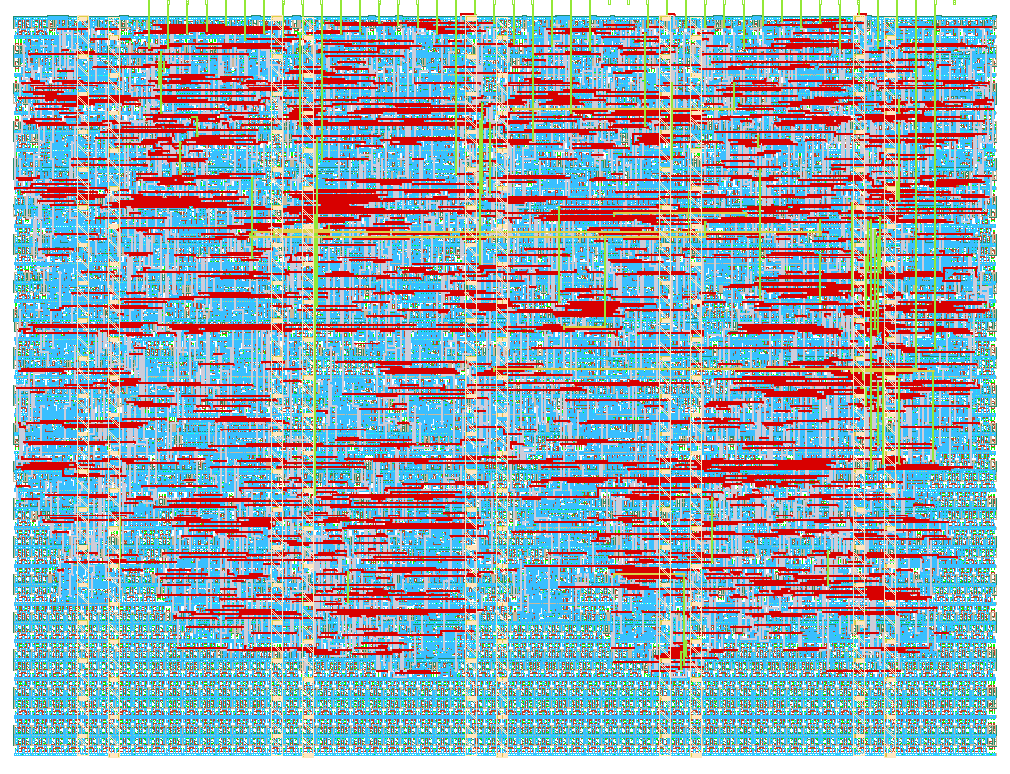
- Author: Simon Pankner
- Description: Two physical security primitives based on Ring-Oscillators: RO-PUF and TRNG.
- GitHub repository
- Open in 3D viewer
- Open in Tiny Tapeout Explorer
- Clock: 50000000 Hz
How it works
This tile implements two physical security primitives using a bank of 8 ring oscillators (ROs). No cryptographic algorithm is required, all security properties emerge from manufacturing process variation, which makes each chip unique.
Primitives
| Mode | uio_in[4:3] |
Description |
|---|---|---|
| RO-PUF | 00 |
4 oscillator pairs compared for a 4-bit device fingerprint in result[3:0] |
| TRNG | 10 |
8 measurement rounds; XOR of all 8 counter LSBs → 1 random byte |
Ring oscillator architecture
Each of the 8 ROs is modelled as a clock-divided flip-flop chain with a distinct half-period of (i + 2) clock cycles (i = 0..7). This provides deterministic, distinct frequencies for simulation and testing. On actual silicon, the physical ring oscillators should exhibit frequency variation caused by gate delay variation introduced during manufacturing.
RO-PUF
All 8 oscillators run for a configurable measurement window (default: 64 clock cycles). The number of rising edges is counted per oscillator in an 8-bit counter. The 4 pairs are compared:
PUF bit[i] = 1  if  cnt[2i] > cnt[2i+1]   (i = 0..3)
result[3:0] = PUF bits;  result[7:4] = 0
The frequency difference between paired oscillators is caused by gate delay variation introduced during manufacturing.
TRNG
The TRNG accumulates 1 bit per measurement round. After each window, the LSBs of all 8 counters are XORed together. Jitter (thermal noise in the oscillators) causes the LSB to vary unpredictably between measurements. After 8 rounds, 1 byte of random data is available.
Internal state machine
IDLE / DONE ──start──► MEASURE ──window expires──► DONE (PUF / TRNG byte 8)
                            │                            │
                            └── TRNG rounds 1-7 ─────────┘
                                (loop back to MEASURE)
Interface
State is configured and read one byte at a time through the 8-bit data bus. An internal 5-bit address counter advances automatically on each we or re pulse.
| Signal | Direction | Description |
|---|---|---|
ui_in[7:0] |
Input | Data byte to write |
uo_out[7:0] |
Output | Data byte to read |
uio_in[0] |
Input | we — write ui_in to config[addr], addr++ |
uio_in[1] |
Input | re — output result to uo_out, addr++ |
uio_in[2] |
Input | start — begin measurement (resets addr to 0) |
uio_in[4:3] |
Input | mode — 00=RO-PUF, 10=TRNG |
uio_in[5] |
Input | addr_clr — reset byte address to 0 |
uio_out[6] |
Output | busy — measurement in progress |
uio_out[7] |
Output | done — result ready to read |
uio_oe = 0xC0 — only bits 7 and 6 are driven by the tile.
Config address map (write)
| addr | Register | Default |
|---|---|---|
| 0 | window[7:0] — measurement duration in clock cycles |
64 |
Result address map (read)
| addr | Content |
|---|---|
| 0 | result[7:0] — 4 PUF bits (bits [3:0]) or TRNG byte |
How to test
Minimal sequence — RO-PUF
1. rst_n=0 for ≥3 cycles, then rst_n=1.

2. (Optional) Write config:
   ui_in=64, uio_in=0x01 (we=1)  → window = 64 cycles
   uio_in=0x00

3. Start:
   uio_in = 0x04  (start=1, mode=00=RO-PUF)
   rising edge
   uio_in = 0x00

4. Wait for done:
   Poll uio_out[7].  Asserts after (window + 2) clock cycles.

5. Read result:
   uio_in = 0x20  (addr_clr=1)
   rising edge
   uio_in = 0x02  (re=1)
   rising edge
   Read uo_out  →  4 PUF bits in uo_out[3:0]
   uio_in = 0x00
TRNG byte
1. Start TRNG:
   uio_in = 0x14  (start=1, mode=10=TRNG)

2. Wait done:
   TRNG runs 8 measurement rounds → done after ~8 × window cycles.

3. Read byte:
   addr_clr, then re → uo_out holds random byte.
External hardware
IO
| # | Input | Output | Bidirectional |
|---|---|---|---|
| 0 | data_in[0] | data_out[0] | we (IN) — write data_in to config register, addr++ |
| 1 | data_in[1] | data_out[1] | re (IN) — read result to data_out, addr++ |
| 2 | data_in[2] | data_out[2] | start (IN) — begin measurement |
| 3 | data_in[3] | data_out[3] | mode[0] (IN) — mode LSB: 00=RO-PUF, 10=TRNG |
| 4 | data_in[4] | data_out[4] | mode[1] (IN) — mode MSB |
| 5 | data_in[5] | data_out[5] | addr_clr (IN) — reset byte address to 0 |
| 6 | data_in[6] | data_out[6] | busy (OUT) — measurement in progress |
| 7 | data_in[7] | data_out[7] | done (OUT) — result ready |