576 Mini PSG
576 : Mini PSG
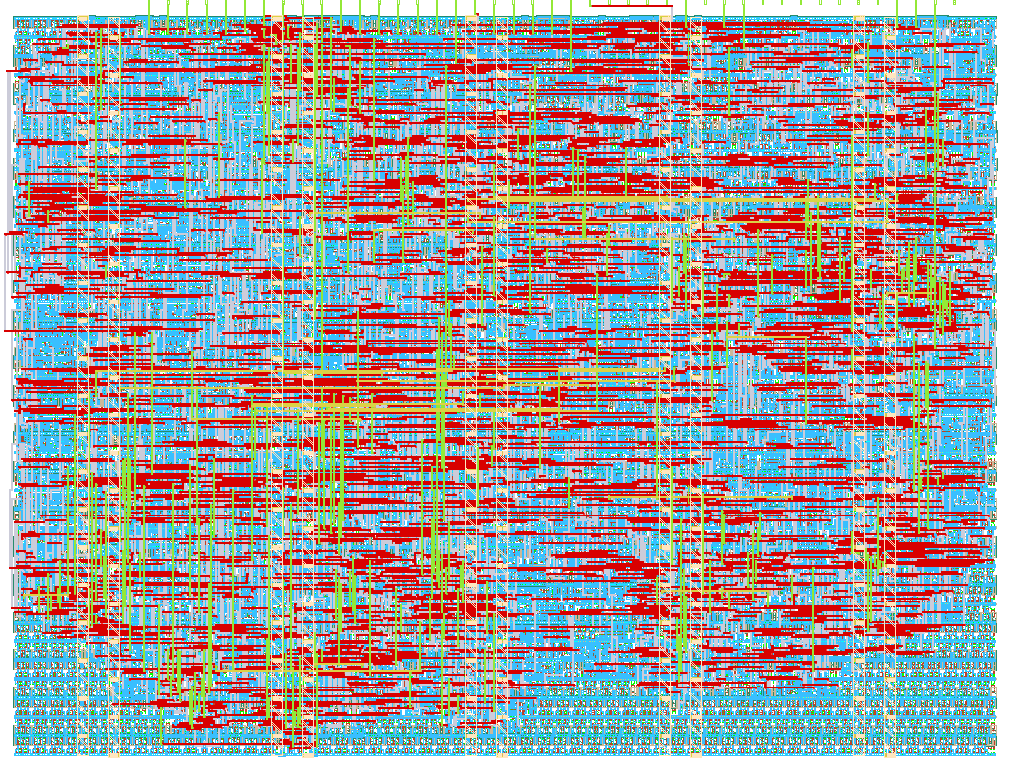
- Author: Peter Szentkuti
- Description: Compact SPI programmable sound generator
- GitHub repository
- Open in 3D viewer
- Open in Tiny Tapeout Explorer
- Clock: 25000000 Hz
How it works
Mini PSG is a compact sound generator for Tiny Tapeout IHP 26a.
It has two tone channels, one shared 3 bit envelope and a 1 bit audio output on uo_out[7]. Configuration is done over a write only SPI interface. The design uses a single 25 MHz clock domain.
Each channel stores a tone code and an octave value. Together they set the phase step for a 23 bit phase accumulator. That phase then drives one of four waveforms: square, pulse, saw or triangle.
The output of each channel is then scaled by either the channel volume setting or the shared envelope. The two channel outputs are mixed together and sent to a 1 bit DAC that drives the audio output.
               Channel A                            Channel B
                   |                                    |
                   v                                    v
        [ Tone generator ]                  [ Tone generator ]
                   |                                    |
                   v                                    v
     [ Waveform generator ]              [ Waveform generator ]
                   |                                    |
                   v                                    v
        [ Level control ] <------ [ Envelope ] ------> [ Level control ]
                   \                                    /
                    \                                  /
                     +----------- [ Mixer ] ----------+
                                   |
                                   v
                                 [ DAC ]
                                   |
                                   v
                               Audio out
Reset is asserted immediately. Internal logic leaves reset two clk cycles after rst_n is released.
When hard mute is active, the audio output is forced low and the 1 bit DAC returns to its idle state. After power up or reset, the chip remains silent until it is configured over the SPI interface.
Pin connections
| Pin | Function |
|---|---|
ui_in[0] |
hard mute |
uo_out[7] |
1 bit audio output |
uio_in[0] |
SPI_CS_N |
uio_in[1] |
SPI_MOSI |
uio_in[2] |
unused TT default SPI_MISO slot |
uio_in[3] |
SPI_SCK |
SPI interface
The SPI interface is write only and uses SPI mode 0. Each transfer consists of one command byte followed by one data byte.
| Byte | Format | Meaning |
|---|---|---|
0 |
0000 aaaa |
aaaa = write address (4 bits) |
1 |
dddd dddd |
dddd dddd = write data (8 bits) |
If CS_N changes state before the two byte frame is complete, the partial transfer is discarded. Additional clocks after the data byte are ignored until CS_N returns high. The chip does not support reads and never drives MISO.
The SPI inputs are sampled by the internal clk signal. SPI_SCK is not used as an internal clock. SPI_SCK must not exceed clk / 8. Keep SCK low and high for at least 4 clk cycles each. CS_N must be asserted at least 4 clk cycles before the first SCK rising edge, remain asserted for at least 4 clk cycles after the last SCK falling edge and remain deasserted for at least 4 clk cycles between frames.
Register map
| Address | Register | Function |
|---|---|---|
0x0 |
CONTROL |
audio enable and register clear |
0x1 |
NOTE_A |
tone setting for channel A |
0x2 |
CHANNEL_A_CONTROL |
waveform and tone control for channel A |
0x3 |
NOTE_B |
tone setting for channel B |
0x4 |
CHANNEL_B_CONTROL |
waveform and tone control for channel B |
0x5 |
VOLUME_AB |
channel output levels |
0x7 |
ENVELOPE_CONTROL |
envelope mode, restart pulse and channel assignment |
0x8 |
ENVELOPE_PERIOD |
envelope step period |
CONTROL
| Bit | Function |
|---|---|
0 |
audio enable |
1 |
clear all stored register values when written as 1 |
CONTROL[1] is a pulse on write, not a stored mode bit.
NOTE_A and NOTE_B
| Bits | Function |
|---|---|
[6:4] |
octave |
[3:0] |
tone code |
NOTE_*[3:0] = 0 to 9 are the 10 valid tone settings. 10 to 15 give no tone. The table is set for the 25 MHz clock and the 23 bit phase path.
CHANNEL_A_CONTROL and CHANNEL_B_CONTROL
| Bit | Function |
|---|---|
[1:0] |
waveform select |
2 |
tone enable |
4 |
enable envelope for that channel |
5 |
channel gate enable |
Waveform select:
| Value | Waveform |
|---|---|
0 |
square |
1 |
pulse |
2 |
saw |
3 |
triangle |
Tone enable and channel gate must both be high before that channel produces a tone.
VOLUME_AB
| Bits | Function |
|---|---|
[2:0] |
channel A level |
[6:4] |
channel B level |
0 is mute and 7 is full scale for that channel.
ENVELOPE_CONTROL
| Bit | Function |
|---|---|
0 |
envelope mode select |
2 |
envelope restart pulse when written as 1 |
3 |
apply envelope to channel A |
4 |
apply envelope to channel B |
Envelope modes:
| Value | Mode |
|---|---|
0 |
square |
1 |
saw |
ENVELOPE_PERIOD
| Bits | Function |
|---|---|
[7:0] |
envelope step period |
Lower values make the envelope run faster. Higher values make it run slower. 0 is treated as one clk step per envelope update.
Reset state
At reset, CONTROL comes up with audio disabled, both note registers come up in the no tone range, both channel control registers are cleared, both channel levels are 0, the envelope is off and ENVELOPE_PERIOD resets to 0x10.
How to test
For a minimal hardware bring up, keep ui_in[0] = 0 so hard mute is inactive, then write the following register values:
| Register | Address | Value |
|---|---|---|
CONTROL |
0x0 |
0x01 |
NOTE_A |
0x1 |
0x30 |
CHANNEL_A_CONTROL |
0x2 |
0x24 |
VOLUME_AB |
0x5 |
0x07 |
This sequence turns audio on, writes 0x30 to NOTE_A, enables square wave on channel A and sets channel A to full scale. The result is a steady 1 bit audio stream on uo_out[7].
A cocotb testbench is provided for the chip and its register settings.
Run it with:
make -C test -B
External hardware
An SPI master is needed to configure the chip.
The audio output is a 1 bit signal. Feed it into the TT Audio Pmod or into a simple RC low pass filter followed by an amplifier and speaker or headphones.
IO
| # | Input | Output | Bidirectional |
|---|---|---|---|
| 0 | HARD_MUTE | SPI_CS_N | |
| 1 | SPI_MOSI | ||
| 2 | |||
| 3 | SPI_SCK | ||
| 4 | |||
| 5 | |||
| 6 | |||
| 7 | AUDIO |