617 Gate-Level 8-bit MAC with Ripple-Carry Accumulator
617 : Gate-Level 8-bit MAC with Ripple-Carry Accumulator
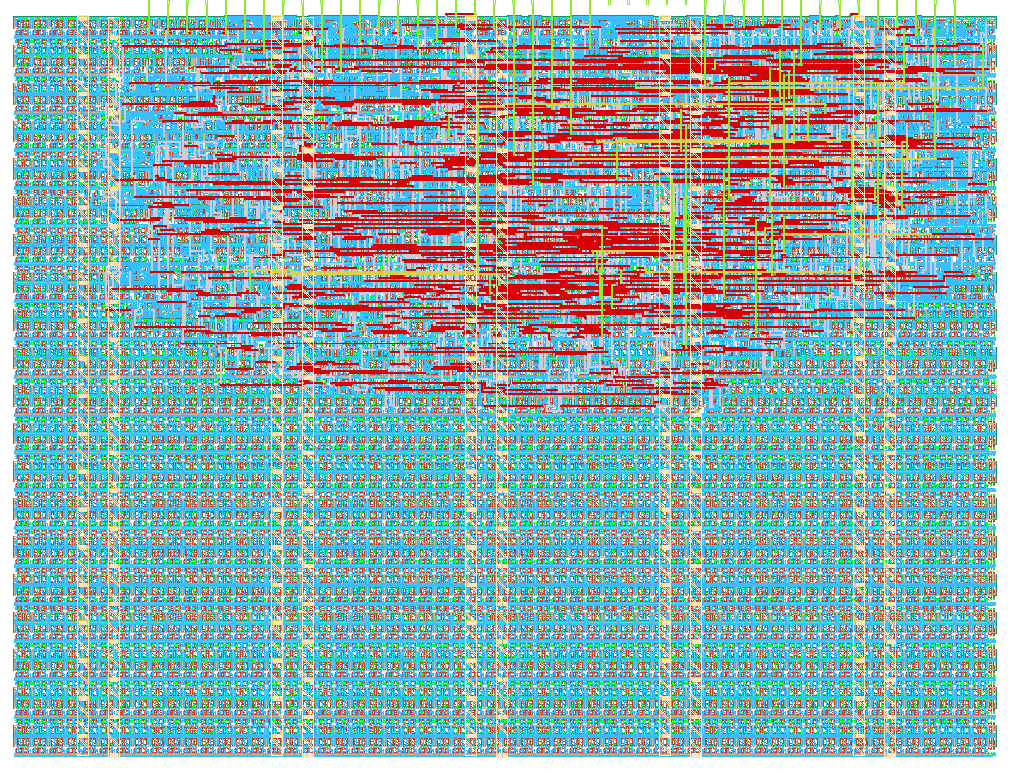
- Author: Malik
- Description: Structurally-optimized unsigned 8-bit MAC unit from ML-guided design-space exploration, with 17-bit accumulator and serial command interface
- GitHub repository
- Open in 3D viewer
- Open in Tiny Tapeout Explorer
- Clock: 50000000 Hz
Gate-Level 8-bit MAC with Ripple-Carry Accumulator
How it works
This design wraps a structurally-optimized gate-level multiply-accumulate (MAC) unit in a TinyTapeout-compatible clocked interface. The inner MAC core was produced through ML-guided design-space exploration of arithmetic architectures — it computes y[16:0] = a[7:0] * b[7:0] + c[15:0] as a purely combinational circuit using a ripple-carry accumulation structure.
The wrapper adds clocked operand registers, a 17-bit accumulator, and a serial command interface. On each MAC operation, the accumulator feeds back into the MAC's addend input, enabling running accumulation across multiple multiply-add cycles.
Specifications:
- Unsigned 8-bit × 8-bit multiply
- 17-bit accumulator (16-bit + carry/overflow)
- Single-cycle combinational MAC latency
- Gate-level optimized inner datapath
How to test
- Reset: Pull
rst_nlow then high. - Load A: Set
cmd=001, put value onui_in, clock once. - Load B + MAC: Set
cmd=010, put value onui_in, clock once. This triggersacc = a*b + acc. - Read result:
cmd=011for acc[7:0],cmd=100for acc[15:8],cmd=101for acc[16]. - Clear:
cmd=110zeros the accumulator. - Repeat steps 2-4 to accumulate more products.
Design context
The gate-level MAC netlist originates from a semester project on design-space exploration of AI hardware architectures, where ML-driven optimization was used to explore Pareto-optimal arithmetic unit implementations across power, performance, and area (PPA) tradeoffs.
External hardware
None required.
IO
| # | Input | Output | Bidirectional |
|---|---|---|---|
| 0 | data_in[0] | data_out[0] | cmd[0] |
| 1 | data_in[1] | data_out[1] | cmd[1] |
| 2 | data_in[2] | data_out[2] | cmd[2] |
| 3 | data_in[3] | data_out[3] | busy |
| 4 | data_in[4] | data_out[4] | overflow (acc[16]) |
| 5 | data_in[5] | data_out[5] | |
| 6 | data_in[6] | data_out[6] | |
| 7 | data_in[7] | data_out[7] |