780 Mini Synth
780 : Mini Synth
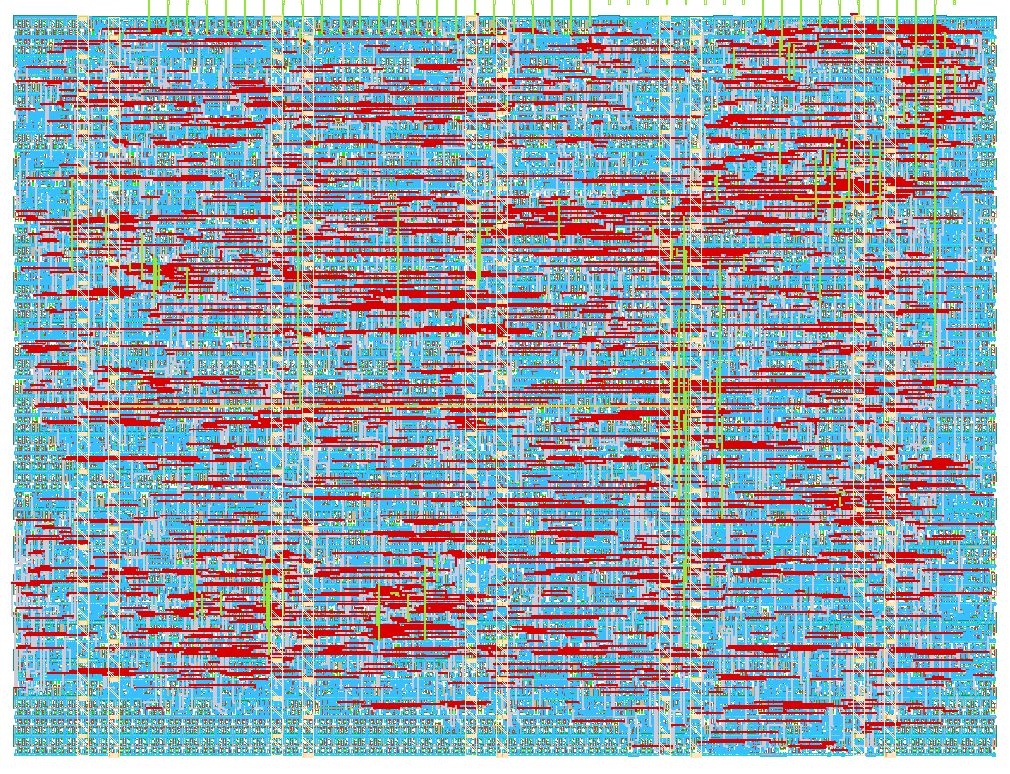
- Author: Benedikt Krimmel
- Description: Tiny digital synthesizer
- GitHub repository
- Open in 3D viewer
- Open in Tiny Tapeout Explorer
- Clock: 50000000 Hz
How it works
A monophonic synthesizer with three oscillators and an ADSR envelope.
Signal chain
- Phase accumulator — 16-bit register incremented every sample tick (50 kHz) by a note-dependent value. Wraps freely.
- Triangle wave — the phase is folded at the midpoint (
phase[15] ? ~phase : phase) and shifted to 11 bits. - Square wave — derived from
phase[13], giving a square at 4× the fundamental frequency. - LFO-detuned triangle — a second 16-bit phase accumulator runs at almost the same rate, offset by a ~4 Hz triangle LFO, producing a slow chorus/detune effect.
- Mix — the three oscillators are summed into a 12-bit audio sample.
- ADSR envelope — pulse-density amplitude control: a 7-bit counter (period 125) runs at the full 50 MHz clock. When the counter value is below the current volume level the raw audio is passed; otherwise the output is held at the midpoint (12'h800, silence). This gives a chopping frequency of 50 MHz / 125 = 400 kHz, well above the audio pmod RC filter cutoff, with no aliasing into the audio band.
- Sigma-delta modulator — a 12-bit first-order sigma-delta accumulator converts the envelope-controlled sample to a 1-bit PWM stream on
uo[7]at the full 50 MHz clock rate.
Note selection
The 7 input bits (ui[6:0]) select any of the 128 standard MIDI notes (MIDI 0–127, C-1 to G9, roughly 8 Hz–12.5 kHz).
Pitch lookup is compressed using the octave-doubling property of equal temperament: only 12 base increments (one octave, anchored at C2 for precision) are stored. The octave is determined by a comparison chain; for notes at or above C2 the base increment is left-shifted, for notes below C2 it is right-shifted.
ADSR envelope
ui[6] is the gate input. A rising edge triggers the attack phase; releasing the gate (falling edge) triggers release.
| Phase | Rate | Duration |
|---|---|---|
| Attack | vol++ every 8 samples | ~20 ms (0 → full) |
| Decay | vol-- every 32 samples | ~30 ms (full → sustain) |
| Sustain | held at ~62% volume | until gate released |
| Release | vol-- every 64 samples | ~100 ms (sustain → 0) |
Parameters
| Parameter | Value |
|---|---|
| Clock | 50 MHz |
| Sample rate | 50 kHz (÷1000) |
| Phase accumulator | 16-bit |
| Audio sample | 12-bit unsigned |
| Chop counter period | 125 (f_chop = 400 kHz) |
| Note range | MIDI 0–127 (C-1–G9) |
| Note resolution | 1 semitone (128 notes, 7 bits) |
How to test
Connect the Tiny Tapeout Audio Pmod to the output pin header. Drive ui[6:0] with a 7-bit MIDI note number (0 = C-1, 69 = A4, 127 = G9) and set ui[7] high to open the gate. The ADSR envelope will attack, decay, and sustain while the gate is held; releasing the gate triggers the release phase.
A Verilator simulation is included under verilator/. Build and run it with:
cd verilator
make
./synth
# Output written to audio.raw — play back with:
ffplay -f u16le -ar 50000 audio.raw
# Or convert using ffmpeg:
ffmpeg -f u16le -ar 50000 -i audio.raw audio.wav
This renders a chromatic sweep of 64 notes (MIDI 36–99, C2–Eb7), 0.8 s gate-on + 0.2 s release per note, to audio.raw as 16-bit unsigned PCM at 50 kHz mono.
External hardware
Tiny Tapeout Audio Pmod connected to the uo output header.
IO
| # | Input | Output | Bidirectional |
|---|---|---|---|
| 0 | MIDI note bit 0 | ||
| 1 | MIDI note bit 1 | ||
| 2 | MIDI note bit 2 | ||
| 3 | MIDI note bit 3 | ||
| 4 | MIDI note bit 4 | ||
| 5 | MIDI note bit 5 | ||
| 6 | MIDI note bit 6 | ||
| 7 | Gate (note on) | AudioPWM |