231 8-bit RISC-V Lite CPU
231 : 8-bit RISC-V Lite CPU
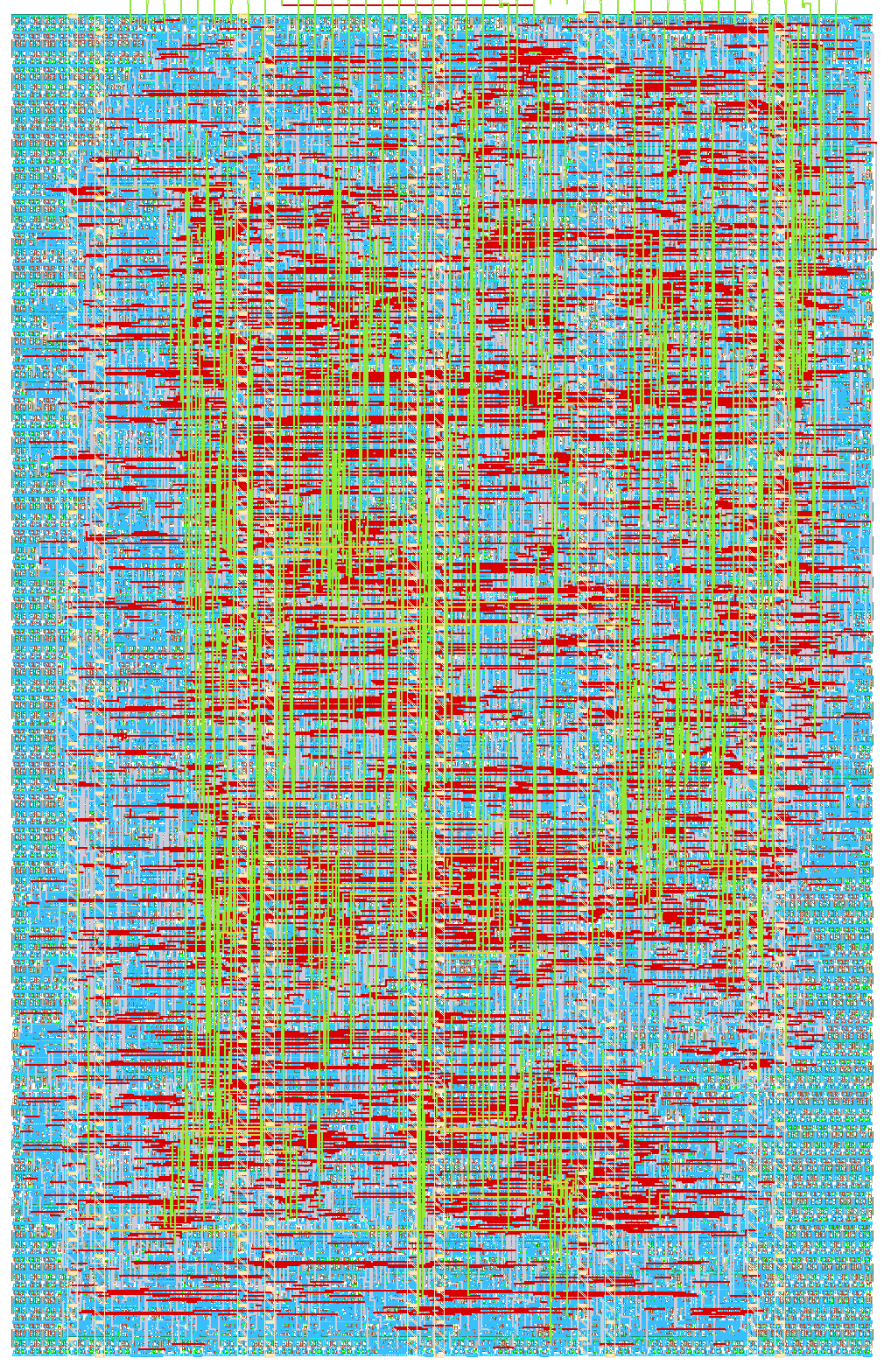
- Author: Wiwathana Son
- Description: 8-bit CPU with hardware multiplier, 32B RAM, and custom branching instructions.
- GitHub repository
- Open in 3D viewer
- Open in Tiny Tapeout Explorer
- Clock: 10000000 Hz
How it works
This project is a custom 8-bit RISC-V-inspired CPU optimized for high-density synthesis on the IHP26a process (TinyTapeout 1x2 tile). It utilizes a multi-cycle Finite State Machine (FSM) to handle fetching, decoding, and execution.
Architecture Features:
- Registers: 8 general-purpose 8-bit registers ($r_0$ to $r_7$). $r_0$ is hardwired to zero at the logic level to save area and ensure ISA compatibility.
- RAM: 24 bytes of internal storage, implemented as a flip-flop array for high-speed access.
- Hardware Multiplier: A dedicated 8-bit combinational multiplier allows for single-cycle multiplication during the
EXECUTEphase. - Safety: Includes bounds-checking to prevent out-of-range memory writes to the 24-byte RAM.
Instruction Set (16-bit):
Instructions are stored in Little-Endian format. The bit-fields are organized as follows:
[Opcode: 4 bits] [Unused: 2 bits] [rd: 3 bits] [rs1: 3 bits] [imm/rs2: 4 bits]
| Opcode | Mnemonic | Description |
|---|---|---|
| 0000 | ADD | rd = rs1 + rs2 |
| 0001 | ADDI | rd = rs1 + imm (4-bit) |
| 0010 | MUL | rd = rs1 * rs2 (8-bit result) |
| 0011 | LW | rd = RAM[rs1] |
| 0100 | SW | RAM[rs1] = rd |
| 0101 | BEQ | If rd == rs1, PC = PC + imm |
| 0110 | BNE | If rd != rs1, PC = PC + imm |
How to test
The CPU features a built-in bootloader mode. Follow these steps to load and run a program:
- Reset: Pull
rst_nLOW. This resets the Program Counter (PC) to 0 and entersLOADmode. - Program Loading:
- Keep
uio[7](Mode Select) LOW. - Set the target RAM address (0-23) on
uio[4:0]. - Set the instruction/data byte on
ui[7:0]. - Toggle the clock (
clk) to write the byte to RAM.
- Keep
- Execution: Set
uio[7]to HIGH. The CPU will exit theLOADstate and begin fetching instructions from RAM address 0. - Monitoring: *
uo[7:0]continuously outputs the value of the destination register (rd) of the current instruction.uio[4:0]outputs the current Program Counter (PC) for debugging.
External hardware
- Logic Analyzer/LEDs: Connect to
uo[7:0]to verify calculation results. - Clock Source: 10MHz recommended for IHP26a, though it can run at much lower speeds for manual step-through debugging.
IO
| # | Input | Output | Bidirectional |
|---|---|---|---|
| 0 | data_in[0] | reg_out[0] | addr[0] |
| 1 | data_in[1] | reg_out[1] | addr[1] |
| 2 | data_in[2] | reg_out[2] | addr[2] |
| 3 | data_in[3] | reg_out[3] | addr[3] |
| 4 | data_in[4] | reg_out[4] | addr[4] |
| 5 | data_in[5] | reg_out[5] | addr[5] |
| 6 | data_in[6] | reg_out[6] | addr[6] |
| 7 | data_in[7] | reg_out[7] | mode_sel |