524 Tiny_ECC
524 : Tiny_ECC
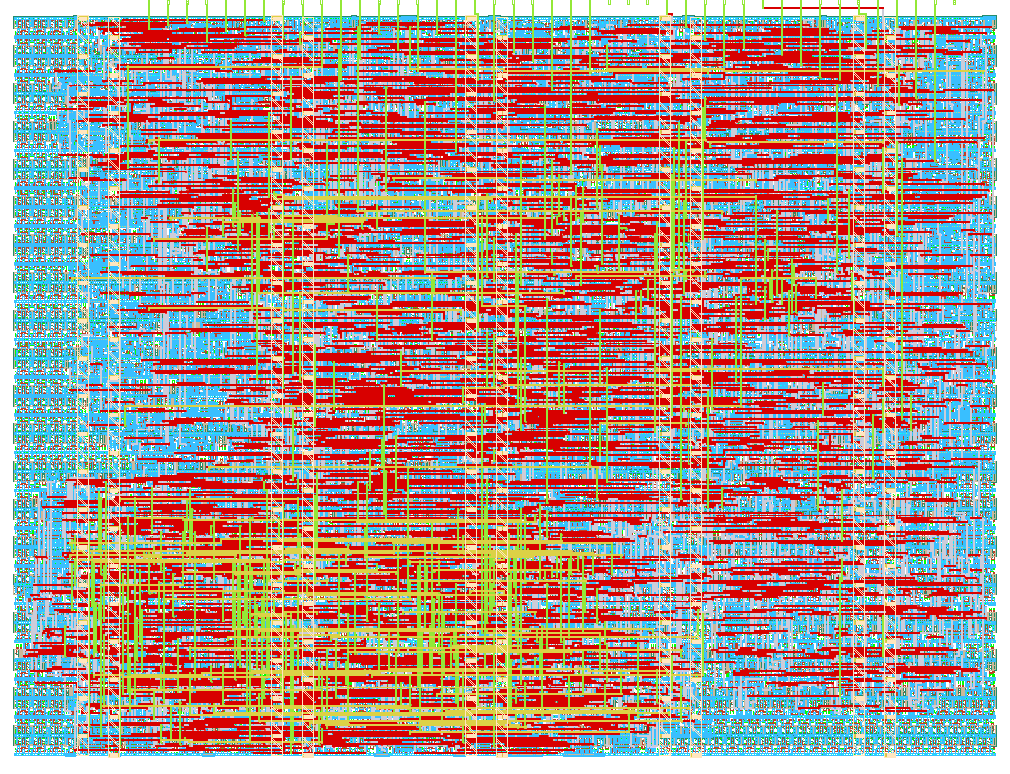
- Author: Prakhar Pranav , Vinay Kumar
- Description: private to public key for eliptical curve cryptography
- GitHub repository
- Open in 3D viewer
- Open in Tiny Tapeout Explorer
- Clock: 0 Hz
How it works
Tiny_ECC implements scalar point multiplication on a binary elliptic curve over GF(2^8), the core operation needed to derive a public key from a private key.
Curve Parameters
| Parameter | Value |
|---|---|
| Field | GF(2^8), irreducible poly 0x11B (AES) |
| Curve equation | y² + xy = x³ + 0x20·x² + 0x01 |
| Base point G | (0x8F, 0x29) i.e. (143, 41) |
| Group order n | 113 |
| Cofactor h | 2 |
Architecture
The design is split across three modules:
-
tt_um_ecc_gf2_8(project.v) — Top-level wrapper. Maps the 8-bitui_indata bus anduio_incontrol pins to the core. Muxesresult_x/result_ytouo_outviaread_sel. -
ecc_core_gf2_8— FSM-based scalar multiplier using the double-and-add algorithm. Iterates over bits ofkfrom MSB to LSB: for each bit it performs a point double, then conditionally a point add if the bit is 1. Point-at-infinity is tracked with ther_is_infflag. -
alu_gf2_8— Combinational GF(2^8) ALU with three operations:op=00: Addition (XOR)op=01: Squaring (a²)op=10: Multiplication (a·b), shift-and-XOR with poly reduction
-
inv_rom— 256-entry lookup table returning the multiplicative inverse of any GF(2^8) element. Used by both the doubling and addition formulas to compute λ.
Point Doubling (R ≠ O)
λ = xr + yr · xr⁻¹
x3 = λ² + λ + a
y3 = xr² + (λ)·x3 + x3        (where a = 0x20)
Point Addition (R ≠ G, R ≠ O)
λ = (yr + yg) · (xr + xg)⁻¹
x3 = λ² + λ + xr + xg + a
y3 = λ·(xr + x3) + x3 + yr
Each formula takes multiple clock cycles; intermediate values are stored in lam, temp, and x1_saved.
Latency
Each scalar multiplication takes roughly 30–60 clock cycles for 8-bit keys (k = 1..112), depending on the Hamming weight of k.
How to test
Loading inputs (serial byte protocol)
All data is loaded 8 bits at a time via ui_in. Assert the corresponding uio_in control line for one clock cycle while the data is present on ui_in:
| Signal | uio_in bit |
Action |
|---|---|---|
load_k |
0 | Loads private key k into register |
load_x |
1 | Loads base point X coordinate (Gx) |
load_y |
2 | Loads base point Y coordinate (Gy) |
start |
3 | Begins scalar multiplication |
Standard key generation sequence
1. Assert rst_n = 0 for ≥5 cycles, then rst_n = 1
2. ui_in = k,  uio_in = 0x01  → wait 1 cycle
3. ui_in = Gx, uio_in = 0x02  → wait 1 cycle
4. ui_in = Gy, uio_in = 0x04  → wait 1 cycle
5. uio_in = 0x08 (start)      → wait 1 cycle, then uio_in = 0
6. Poll `uio_out[6]` (`busy`) — wait for it to go **low**.
7. Set uio_in[4] = 0, read uo_out → public key X
8. Set uio_in[4] = 1, read uo_out → public key Y
Status flags (uio_out)
| Bit | Signal | Description |
|---|---|---|
| 5 | done |
Pulses high for one clock cycle when result is ready. Do not poll this pin from software — the pulse will be missed. |
| 6 | busy |
High while computation is in progress. Poll this pin instead — wait for it to go low, then read the result. |
| 7 | error |
High if k=0 or result is the point at infinity. Sample after busy goes low. |
Example: Generating a public key
Private key:  k  = 42  (0x2A)
Base point:   Gx = 143 (0x8F), Gy = 41 (0x29)
Expected public key: run scalar_mult(42, 143, 41) in the Python golden model
Diffie-Hellman shared secret
Because this is a general scalar multiplier, you can substitute any valid EC point as the base. Load Alice's public key as (Gx, Gy) and Bob's private key as k to derive the shared secret. The cocotb test test_diffie_hellman demonstrates this end-to-end.
Running the cocotb testbench
cd test
make          # RTL simulation
# Results and waveform saved to test/tb.fst and test/results.xml
Three tests are included:
test_k_zero— verifies error flag for invalid inputtest_exhaustive_scalar_mult— brute-forces all k = 1..112 against a Python golden modeltest_diffie_hellman— full ECDH key exchange between Alice (k=42) and Bob (k=37)test_peer_public_key_as_base— verifies using a peer's public key as the base point
External hardware
No external hardware required. All computation is on-chip.
For chip-level testing on the TT demo board, a logic analyser or microcontroller is needed to drive the serial byte-load protocol and poll the done flag.
IO
| # | Input | Output | Bidirectional |
|---|---|---|---|
| 0 | data_in[0] | data_out[0] | input: load_k |
| 1 | data_in[1] | data_out[1] | input: load_x |
| 2 | data_in[2] | data_out[2] | input: load_y |
| 3 | data_in[3] | data_out[3] | input: start |
| 4 | data_in[4] | data_out[4] | input: read_sel (0=X, 1=Y) |
| 5 | data_in[5] | data_out[5] | output: status_done |
| 6 | data_in[6] | data_out[6] | output: status_busy |
| 7 | data_in[7] | data_out[7] | output: status_error |