242 True(er) Random Number Generator (TRNG)
242 : True(er) Random Number Generator (TRNG)
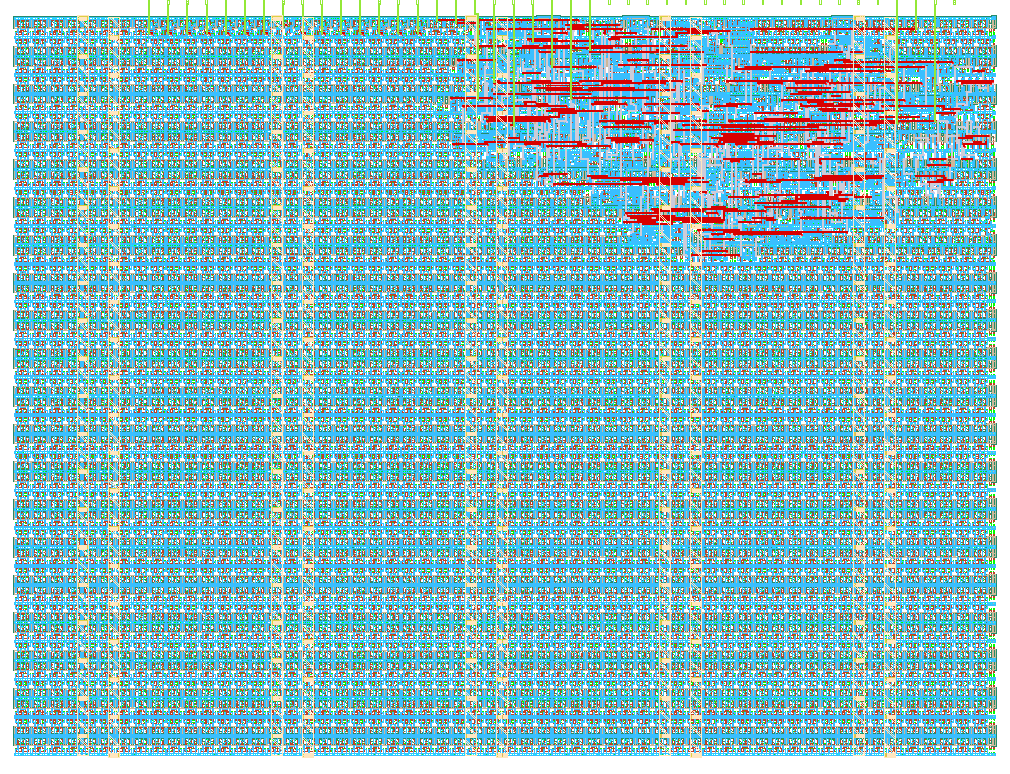
- Author: Angelo Nujic
- Description: Generates a random byte based on bits sampled from ring oscillators.
- GitHub repository
- Open in 3D viewer
- Open in Tiny Tapeout Explorer
- Clock: 50000000 Hz
True(er) Random Number Generator (TRNG)
How it works
This project implements a fully digital True Random Number Generator (TRNG) designed to fit within a single Tiny Tapeout tile. Since analog components are not available in a standard cell digital flow, this design harvests entropy from the phase noise (jitter) of free-running, unconstrained ring oscillators.
The raw, asynchronous bitstream is sampled by the synchronous system clock, whitened to remove systemic 0 or 1 biases, and shifted into a complete 8-bit word.
Architecture
IO: Top Level Interface
The module communicates using a standard valid/ready handshake protocol to ensure the receiving system only reads fully assembled, valid random bytes.
    input  logic [7:0] ui_in,    // ui_in[0] is used for ready_i signal, rest is UNUSED
    output logic [7:0] uo_out,   // 8-bit Random Byte payload
    input  logic [7:0] uio_in,   // UNUSED
    output logic [7:0] uio_out,  // uio_out[0] is used for valid_o signal, rest is UNUSED
    output logic [7:0] uio_oe,   // uio_oe[0] is 1'b1, rest is UNUSED
    input  logic       ena,      // always 1 when the design is powered, so you can ignore it
    input  logic       clk,      // clock
    input  logic       rst_n     // reset_n - low to reset
Ring Oscillator (Entropy Source)
To guarantee entropy, the source consists of multiple mutually prime length ring oscillators (e.g., lengths of 3, 5, and 7).
Each ring oscillator is built with 2*DEPTH + 1 standard IHP 130nm (sg13g2_inv_1) inverter cells. These standard cells are manually instantiated with (* keep = "true" *) attributes to prevent the synthesis tool (Yosys) from optimizing away the combinatorial loops.
The asynchronous outputs from these rings are XOR'd together into a single raw bitstream which is captured by D-Flip-Flops clocked by clk_i.
Von Neumann Whitener
Raw ring oscillators often exhibit a slight bias (e.g., naturally preferring 1s over 0s due to microscopic process variations). The Von Neumann extractor eliminates this bias by reading the raw bits in non-overlapping pairs.
Extraction Logic:
The whitener generates a bit according to the following truth table. Discarded bits yield no output (valid_o remains LOW).
| Bit 1 (Cycle N) | Bit 2 (Cycle N+1) | bit_o |
valid_o |
Action |
|---|---|---|---|---|
| 0 | 0 | 0 | 0 | Discard (No entropy) |
| 0 | 1 | 1 | 1 | Keep 1 |
| 1 | 0 | 0 | 1 | Keep 0 |
| 1 | 1 | 0 | 0 | Discard (No entropy) |
Watchdog Timer (Failsafe)
Because the Von Neumann extractor drops 00 and 11 pairs, there is a statistical possibility (especially if the oscillators lock up) that the process suffers from "entropy starvation" and fails to converge on a full 8-bit byte in a reasonable timeframe.
To prevent the system from hanging indefinitely:
- A Watchdog Timer increments on every
clk_icycle. - It resets to
0every time the whitener successfully outputs avalidbit. - Timeout: If the counter reaches 1024 clock cycles without seeing a valid bit, it triggers a timeout.
- Reset Mechanism: Upon timeout, the watchdog pulls an internal soft-reset line. This flushes the whitener's state machine and clears the current shift register progress, restarting the byte generation process from scratch to recover from the stall.
How to test
Testing the physical silicon requires observing the handshake protocol.
- Assert
rst_niLOW, then HIGH to reset the module. - Assert
ena_iHIGH to enable the oscillators and sampling logic. - Assert
ready_iHIGH from your receiving device to indicate you are ready to receive data. - Wait for
valid_oto go HIGH. - On the clock cycle where
valid_ois HIGH, read the 8-bit value onbyte_o. This is your true random byte. - To verify randomness, capture several megabytes of output data and process it using a statistical test suite like NIST SP 800-22 or Dieharder.
Design Verification (DV) Plan
Pre-silicon verification is handled via a Python-based Cocotb testbench. Because digital simulators cannot natively process analog phase noise, the RTL leverages a \ifdef SIM`block to model the oscillators using fractional#` delays.
The DV suite verifies the digital plumbing using two main tests:
- Continuous Generation Check: The testbench drives the
ready_isignal HIGH and loops 100 times, waiting for thevalid_oedge to capture sequential random bytes and confirming the handshake can operate continuously. - Statistical Sanity Checks (Variance): Validates the behavioral entropy by checking for output uniqueness. Out of the 100 sampled bytes, the test ensures that more than 5 unique values are generated, proving the simulated oscillators are drifting and the FSM is not stuck emitting a constant value.
Gate-Level Simulation (GLS) Limitations
Note: Simulating this design at the gate level (GLS) presents a fundamental EDA challenge. Synthesis tools generate a physical netlist for the combinatorial inverter loops without an initial value. Digital simulators evaluate this unknown initial state as X.
Because a pure combinatorial loop has no reset pin, the X state remains permanently locked, propagating through the synchronizer flip-flops and crashing the Von Neumann logic. Consequently, our Cocotb testbench actively monitors the output bus for unresolvable X states. If an X state is detected (indicating a GLS environment where the oscillator failed to initialize), the testbench logs the limitation and gracefully skips the remainder of the simulation to prevent CI pipeline failures.
External hardware
- Tiny Tapeout Demo Board: To provide the system clock, power, and physical pin breakouts.
- RP2040 Microcontroller (built into the demo board): Required to interface with the
valid/readyhandshake protocol and quickly stream the generated random bytes over USB to a host PC for statistical validation.
IO
| # | Input | Output | Bidirectional |
|---|---|---|---|
| 0 | ready_i | bit0_o | valid_o |
| 1 | bit1_o | ||
| 2 | bit2_o | ||
| 3 | bit3_o | ||
| 4 | bit4_o | ||
| 5 | bit5_o | ||
| 6 | bit6_o | ||
| 7 | bit7_o |