752 Programmable 8-BIT CPU
752 : Programmable 8-BIT CPU
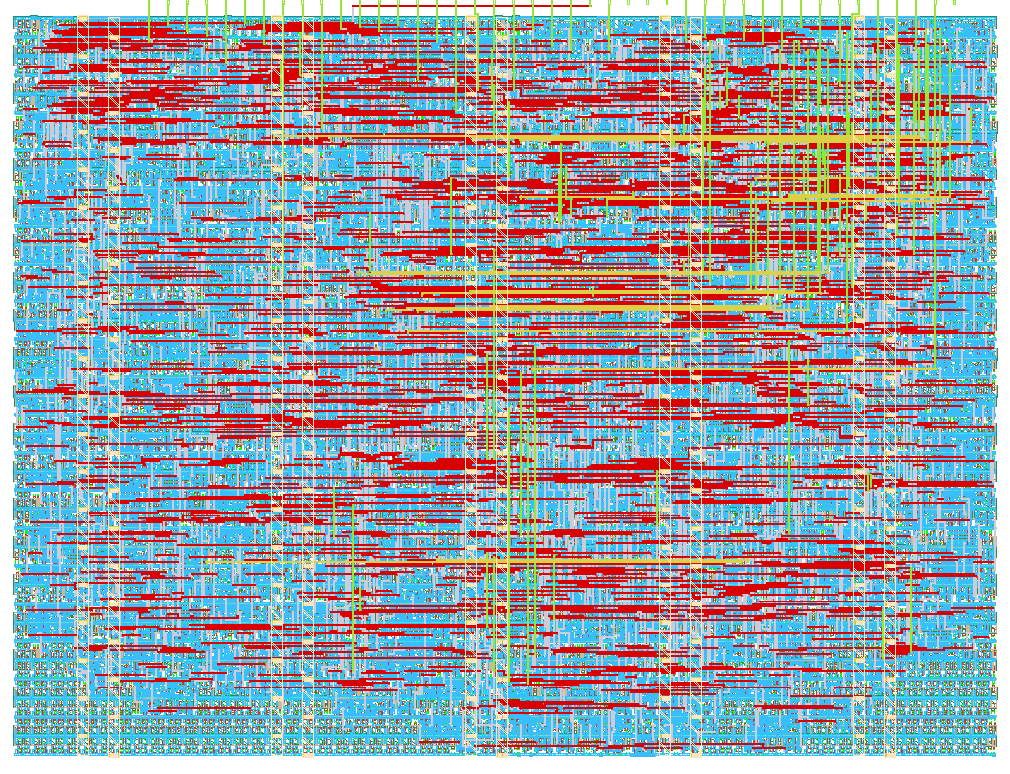
- Author: Leonard Finthammer
- Description: Programmable 8 Bit CPU based on the SAP Architecture
- GitHub repository
- Open in 3D viewer
- Open in Tiny Tapeout Explorer
- Clock: 9600 Hz
How it works
This project is a programmable 8-bit CPU based on the classic SAP-1 (Simple As Possible) architecture.
The CPU features an 8-bit architecture with a 4-bit address space, meaning it has 16 addressable RAM locations (0x0 to 0xF), where each location holds an 8-bit value (4 bits for the opcode, 4 bits for the operand/immediate).
Instruction Set Architecture (ISA)
The CPU interprets the upper 4 bits [7:4] of a memory byte as the opcode and the lower 4 bits [3:0] as the memory address or immediate value.
| Mnemonic | Opcode (Binary) | Hex | Description |
|---|---|---|---|
| LDA | 0001 |
1 |
Load Register A with the value from RAM at the given address. |
| ADD | 0010 |
2 |
Add the value from RAM at the given address to Register A. Updates Zero/Carry flags. |
| OUT | 0011 |
3 |
Output Register A to the dedicated output pins (uo_out) and trigger UART TX. |
| JMP | 0100 |
4 |
Unconditional jump to the given address. |
| STA | 0101 |
5 |
Store the value of Register A into RAM at the given address. |
| LDI | 0110 |
6 |
Load an immediate 4-bit value (the operand itself) into Register A. |
| SUB | 0111 |
7 |
Subtract the value from RAM at the given address from Register A. Updates Zero/Carry flags. |
| JMZ | 1000 |
8 |
Jump to the given address IF the the previous instruction by the ALU resulted in 0. |
| CMP | 1001 |
9 |
Compare Register A with RAM value (A - RAM). Updates flags but does not store the result. |
| JMC | 1010 |
A |
Jump to the given address IF the result of the ALU operation overflows (values >255) |
Built-in UART
The Design features a built-in UART transmitter. Whenever the OUT (0x3) instruction is executed, the CPU not only updates the output register but also serializes the 8-bit data and transmits it via the UART TX pin (uio[6]). For this to work you need to set the clock frequency to 9600Hz.
How to test
The CPU operates in two distinct modes: Programming Mode and Execution Mode.
1. Programming the RAM
Since the memory is volatile, you need to write your program into the RAM before running it:
- Hold
rst_nLOW (0) to keep the CPU in reset mode. - Set the
Progpin (uio[7]) HIGH (1) to enable programming mode. - For each byte of your program:
- Set the 4-bit target memory address on
uio[3:0]. - Set the 8-bit instruction/data on the input pins
ui[7:0]. - Pulse the clock (or wait for the next clock edge) to write the data into RAM.
- Set the 4-bit target memory address on
- Repeat step 3 until your code and data are loaded into memory.
- Initialize unused Registers with
00000000.
2. Executing the Program
- Set the
Progpin (uio[7]) LOW (0) to disable programming mode. - Set
rst_nHIGH (1) to release the reset state. - Provide a clock signal. The CPU will start fetching and executing instructions starting from memory address
0x0.
Note: Each instruction takes between 3 to 6 clock cycles to complete depending on its complexity (Fetch-Decode-Execute cycle).
External hardware
To fully interact with the CPU, the following external hardware is recommended:
- DIP Switches (12x): 8 switches connected to
ui[7:0]for data input, and 4 switches connected touio[3:0]for memory address selection during programming. - Toggle Switch (1x): Connected to
uio[7]to easily toggle between Programming and Execution mode. - LEDs (8x): Connected to the output pins
uo[7:0]to read the visual output of theOUTinstruction. - USB-to-Serial Adapter (FTDI/CH340): Connect the RX pin of the adapter to
uio[6](UART TX) to read the serial output of the CPU on your computer. Make sure to match the baud rate to your input clock frequency (e.g., 9600 baud). You'll need to convert the received ASCII Characters to Decimal Values.
IO
| # | Input | Output | Bidirectional |
|---|---|---|---|
| 0 | Programm_Input[0] | Output[0] | Address[0] |
| 1 | Programm_Input[1] | Output[1] | Address[1] |
| 2 | Programm_Input[2] | Output[2] | Address[2] |
| 3 | Programm_Input[3] | Output[3] | Address[3] |
| 4 | Programm_Input[4] | Output[4] | |
| 5 | Programm_Input[5] | Output[5] | |
| 6 | Programm_Input[6] | Output[6] | UART_TX |
| 7 | Programm_Input[7] | Output[7] | Prog |