497 2x2 Systolic array with DFT and bfloat16 - v2
497 : 2x2 Systolic array with DFT and bfloat16 - v2
- Author: Julia Desmazes
- Description: Second version of the 2x2 systollic array with DFT intrastructure, including bfloat16 floating point arithmetic and DFT scan chain.
- GitHub repository
- Open in 3D viewer
- Open in Tiny Tapeout Explorer
- Clock: 100000000 Hz
Multiply and accumulate matrix multiplier ASIC with design for test infrastructure
ASIC design for a 2x2 systolic matrix multiplier supporting multiply and accumulate operations on bfloat16 data alongside a design for test infrastructure to help debug both usage and diagnose design issues in silicon.
Pinout
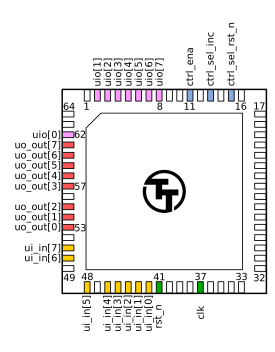
This accelerator uses the following pinout:
| ui (Inputs) | uo (Outputs) | uio (Bidirectional) |
|---|---|---|
| ui[0] = tck | uo[0] = result_o | uio[0] = data_i[7] |
| ui[1] = data_i[0] | uo[1] = result_o | uio[1] = data_valid_i |
| ui[2] = data_i[1] | uo[2] = result_o | uio[2] = data_mode_i[1] |
| ui[3] = data_i[2] | uo[3] = result_o | uio[3] = data_mode_i[0] |
| ui[4] = data_i[3] | uo[4] = result_o | uio[4] = tdi |
| ui[5] = data_i[4] | uo[5] = result_o | uio[5] = tms |
| ui[6] = data_i[5] | uo[6] = result_o | uio[6] = tdo |
| ui[7] = data_i[6] | uo[7] = result_o | uio[7] = result_v_o |
MAC
This MAC accelerator operates at up to 100MHz and is capable of reaching up to 100 MMAC/s or 200 MFLOPS/s.
:warning: The outgoing data path on IHP sg13g2 chips has only been proven upwards of 75MHz, so although we will using the maximum theoretical frequency in this discussion it might be necessary to drive this ASIC as a lower clock frequency in practice.
Background
The goal of the MAC accelerator is to perform a matrix matrix multiplication between the input data matrix $I$ and the weight matrix $W$.
\begin{gather}
I \times W = R \\
\begin{pmatrix}
i_{0,0} & i_{1,0} \\
 i_{0,1} & i_{1,1}
\end{pmatrix}

\times

\begin{pmatrix}
w_{0,0} & w_{1,0} \\
w_{0,1} & w_{1,1}
\end{pmatrix} =

\begin{pmatrix}
i_{0,0}w_{0,0}+i_{1,0}w_{0,1} & i_{0,0}w_{1,0}+i_{1,0}w_{1,1}\\
i_{0,1}w_{0,0}+i_{1,1}w_{0,1} & i_{0,1}w_{1,0}+i_{1,1}w_{1,1}\end{pmatrix}

=

\begin{pmatrix}
r_{0,0} & r_{1,0} \\
r_{0,1} & r_{1,1}
\end{pmatrix}
\end{gather}
This MAC accelerator has 4 units and from this point on, we will refer to each MAC unit according to their unique $(x,y)$ coordinates.
Each MAC unit calculates the MAC operation $c_{(t,x,y)}$, where :
- $w_{(x,y)}$ is the fixed weight configured for this unit; this value is fixed throughout a set of $I$ and $W$ input matrices.
- $i_{(t,y)}$ is a value from the $y$ row of the $I$ matrix that is circulated per timestep $t$ through a row of the matrix.
- $c_{(t-1,x,y-1)}$ is the result at the previous timestep $t-1$ of the MAC unit above this MAC unit, circulated downwards per column.
c_{(t,x,y)} = i_{(t,y)} \times w_{(x,y)} + c_{(t-1,x,y-1)}
Given this accelerator was designed to operate on 16-bit floating point numbers, there is no need for an additional clamping step.
Our final full MAC operation is as follows :
c_{(t,x,y)} = i_{(t,y)} \times w_{(x,y)} + c_{(t-1,x,y-1)}
At each MAC timestep $t+1$ :
- the result of a MAC unit $c_{(t,x,y)}$ is shifted downwards on the same column and becomes the input of the MAC unit $(x,y+1)$ below.
- $i_{(t,x)}$ is shifted rightwards and used as input to MAC unit $(x+1,y)$.
This data streaming allows such designs to make more efficient use of data, re-using it multiple times as the data circulates through the array, contributing to the final results without spending time on expensive data accesses, allowing us to dedicate more of our silicon area and cycles to compute.
Throughput
Assuming a pre-configured $W$ weight matrix is being reused and the accelerator is receiving a gapless stream of multiple $I$ input matrices, this MAC accelerator is capable of computing up to 100 MMAC/s or 200 MFLOPS/s.
IO Bottleneck
Accelerator operations are stalled if a MAC operation has a data dependency on data that has yet to arrive. For example, calculating $r_{(0,0)}$ depends on both $i_{(0,0)}$ and $i_{(1,0)}$. In practice, each operation depends on two pieces of input data, yet our input interface being only 8 bits wide allows us to transfer only a half of $i_{(x,y)}$ per cycle.
This limitation means our accelerator is actually operating at a quarter of the maximum capacity due to this IO bottleneck. If the IO interface were either (a) at least 32 bits wide, or (b) 8 bits wide but operating at 400 MHz, resolving this bottleneck, our maximum throughput would be 400 MMAC/s or 800 MFLOPS/s.
Usage
The typical sequence to offload matrix operations to the accelerator would go as follows:
- Reset the accelerator (necessary on init)
- Configure the weights $W$ (can be re-used once configured)
- Send the input data $I$
- Read the result $R$
This design doesn't feature on-chip SRAM and has limited on-chip memory. Given weights have high spatial and temporal locality, this design allows each weight to be configured per MAC unit. This configuration can be reused across multiple matrices. The input matrix, on the other hand, is expected to be provided on each usage.
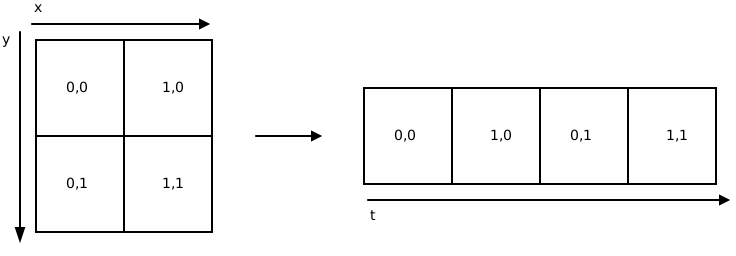
Given our input and output data buses are only 8 bits wide, for data transfers to and from the chip the matrices are flattened in the following order, with bytes transfered in little endian:
Notes:
- All references to
cyclesbelow are clocked according to theclkpin. - Empty cycles, as in one or more cycles where
data_v_iwould go low in the middle of the transfer of both the input matrix and the weights, are supported.
Resetting MAC
Given we are not sending an index alongside each data transfer to indicate which weight/data coordinates ( index ) each data corresponds to, the MAC accelerator keeps track of the next index internally. As such, if due to external reasons a partial transfer occurs, it becomes necessary to reset this index using the reset sequence described below.
The weights streaming indexes and the data streaming indexes can be reset independently, each requires a single data transfer cycle during which :
data_v_iis set to1data_mode_i[1:0]is set to0x3if we are resetting both the weight and the data indexesdata_i[7:0]is ignored
Example
In this example we are resetting both the data streaming index and the weight index back to back.
TODO rst_waves.png
Configure weights
Configuring the weights takes 8 data transfer cycles, during which :
data_v_iis set to1data_mode_i[1:0]is set to0x0indicating we are sendingweightsdata_i[7:0]contains the weights
Example
In this example we are configuring the weight matrix $W$ to :
W =
\begin{pmatrix}
0 & 1 \\
2 & 3
\end{pmatrix}
TODO wr_weights_waves.png
Debug
The implemented JTAG TAP can be used to easily debug the weight matrix configuration sequence as it allows the user using the USER_REG instruction to
read the currently configured weights for each MAC unit.
In the existing openocd helper scripts located at jtag/openocd.cfg the read_user_reg can be used to read the weights using openocd when used as follows :
set r 0
for {set u 0} {$u <= $USER_REG_UNIT_MAX} {incr u} {
    puts "read internal register $u : 0x[read_user_reg $_CHIPNAME $u $r] - [print_reg_id $r]"
}
For the $W$ weight matrix configured in the example above, the expected output should be :
read internal register 0:0 : 0x0000 - weight
read internal register 0:1 : 0x0000 - multiplicand ( input data )
read internal register 0:2 : 0x0000 - summand ( input data )
read internal register 0:3 : 0x0000 - multiplication result (internal computation)
Sending the input matrix
Sending the input matrix takes 8 data transfer cycles, during which :
data_v_iis set to1data_mode_i[1:0]is set to0x1indicating we are sending the input matrixdata_i[7:0]contains the input data
Example
In this example we are sending the input data matrix $I$ :
I =
\begin{pmatrix}
4 & 5 \\
6 & 7
\end{pmatrix}
TODO wr_data_waves.png
Receiving result
When receiving a result the asic will drive the following pins during 8 data transfer cycles. The transfer is guarantied to be gapeless :
res_v_ois set to1res_o[7:0]contains the result of the MAC operation for a single matrix coordinate
In order to start capture by the pio hardware on the raspberry pi silicon, res_v_o is asserted a cycle before the
data transfer starts. The two result streams occure back-to-back this will not occur.
Simple example
In this example the $W$ MAC weight matrix is being configured and the $I$ data is being streamed in, following which, the $R$ result starts being sent out.
R = I \times W =
\begin{pmatrix}
4 & 5 \\
6 & 7
\end{pmatrix}
\times
\begin{pmatrix}
0 & 1 \\
2 & 3
\end{pmatrix}
=
\begin{pmatrix}
10 & 19 \\
14 & 27
\end{pmatrix}
TODO rd_res_waves.png
Complex example
Internally, the accelerator takes at most 8 cycles to produce a result from incoming data. This accounts for incoming data latching, circulating the data through the entire systolic array, and output streaming. The accelerator moves the incoming data through the array as soon as it is available. Because of this, and since this accelerator supports gaps in the incoming data stream, if, for example, the last data transfer of $i_{(1,1)}$ is delayed by at least 2 cycles, then the accelerator result will start streaming out before all of the input matrix has finished streaming in.
This is why, in the firmware (firmware/main.c), we set up the DMA stream to receive the data before we start sending the input matrix, as the gap between sending and getting the result is too small for the controlling MCU to perform any type of compute.
TODO rd_res_complex_waves.png
DFT
This design embeds a JTAG for debugging the accelerator's usage by probing into internal registers and helping identify PCB issues using a boundary scan.
This JTAG TAP was designed to operate at 2 MHz, has idcode 0x2beef0d7.
Its instruction register length is 3, and implements the following instructions:
| Instruction | Opcode | Description |
|---|---|---|
EXTEST |
0x0 |
Boundary scan |
IDCODE |
0x1 |
Reads JTAG TAP identifier |
SAMPLE_PRELOAD |
0x2 |
Boundary scan |
USER_REG |
0x3 |
Probe internal registers |
SCAN_CHAIN |
0x4 |
Internal logic scan chain |
BYPASS |
0x7 |
Set the TAP in bypass mode |
All four standard instructions EXTEST, IDCODE, SAMPLE_PRELOAD, BYPASS conform to the standard behavior.
SCAN_CHAIN is a private JTAG instruction used for observing the systolic array's flops state. The order of the flop chain can be found at the end of the .def file in the definition of the chain_0 scan chain.
USER_REG
The USER_REG state was designed to probe into the data currently used by each of the 4 MAC units.
The data to be read is specified by loading its address in the data register during a previous DR_SHIFT stage. As such, two sequences of DR_SHIFTS might be necessary:
- Load the address of the next data
- Read the data off TDI
The address and data are both 16 bits wide, though only the bottom 4 bits of the address are used.
Address format
The address uses the following format:
[ unused 15:4 ][ mac unit 3:2 ][ register id 1:0 ]
Register id mapping for this MAC unit gives us the current:
| Register ID | Description |
|---|---|
0x0 |
Weight (multiplier) |
0x1 |
Multiplicand (circulated data) |
0x2 |
Summand (circulated data) |
0x3 |
Multiplication result (internal MAC unit data) |
Important considerations for usage
When using the USER_REG custom JTAG TAP instruction, the MAC logic is expected to be temporarily halted, as in no weight or data update operations and no matrix compute is expected to be ongoing. To this effect, there is no CDC protection when transferring data between the JTAG clock domain and the MAC domain. If the MAC isn't halted, the resulting metastability risks corrupting the sampled data.
This also applies when doing a boundary scan.
Quickstart
For quickly getting started, use the utilities provided in jtag/openocd.cfg.
Given this default config assumes you are using a jlink, and this might not be the adapter you are using, you may need to update the adapter sourcing your current probe:
source [find interface/jlink.cfg]
Usage
Run using :
openocd -f jtag/openocd.cfg
Expected output:
Open On-Chip Debugger 0.12.0+dev-02429-ge4c49d860 (2026-03-17-19:44)
Licensed under GNU GPL v2
For bug reports, read
	http://openocd.org/doc/doxygen/bugs.html
Info : J-Link V10 compiled Jan 30 2023 11:28:07
Info : Hardware version: 10.10
Info : VTarget = 3.348 V
Info : clock speed 2000 kHz
Info : JTAG tap: tpu.tap tap/device found: 0x2beef0d7 (mfg: 0x06b (Transwitch), part: 0xbeef, ver: 0x2)
Warn : gdb services need one or more targets defined
idcode : 2beef0d7
read internal register 0:0 : 0x0000 - weight
read internal register 0:1 : 0x0000 - multiplicand ( input data )
read internal register 0:2 : 0x0000 - summand ( input data )
read internal register 0:3 : 0x0000 - multiplication result (internal computation)
read internal register 1:0 : 0x0000 - weight
read internal register 1:1 : 0x0000 - multiplicand ( input data )
read internal register 1:2 : 0x0000 - summand ( input data )
read internal register 1:3 : 0x0000 - multiplication result (internal computation)
read internal register 2:0 : 0x0000 - weight
read internal register 2:1 : 0x0000 - multiplicand ( input data )
read internal register 2:2 : 0x0000 - summand ( input data )
read internal register 2:3 : 0x0000 - multiplication result (internal computation)
read internal register 3:0 : 0x0000 - weight
read internal register 3:1 : 0x0000 - multiplicand ( input data )
read internal register 3:2 : 0x0000 - summand ( input data )
read internal register 3:3 : 0x0000 - multiplication result (internal computation)
Info : Listening on port 6666 for tcl connections
Info : Listening on port 4444 for telnet connections
...
IO
| # | Input | Output | Bidirectional |
|---|---|---|---|
| 0 | tck | result_o | data_i[7] |
| 1 | data_i[0] | result_o | data_valid_i |
| 2 | data_i[1] | result_o | data_mode_i[1] |
| 3 | data_i[2] | result_o | data_mode_i[0] |
| 4 | data_i[3] | result_o | tdi |
| 5 | data_i[4] | result_o | tms |
| 6 | data_i[5] | result_o | tdo |
| 7 | data_i[6] | result_o | result_v_o |