864 TESVG Binary Counter and shif register
864 : TESVG Binary Counter and shif register
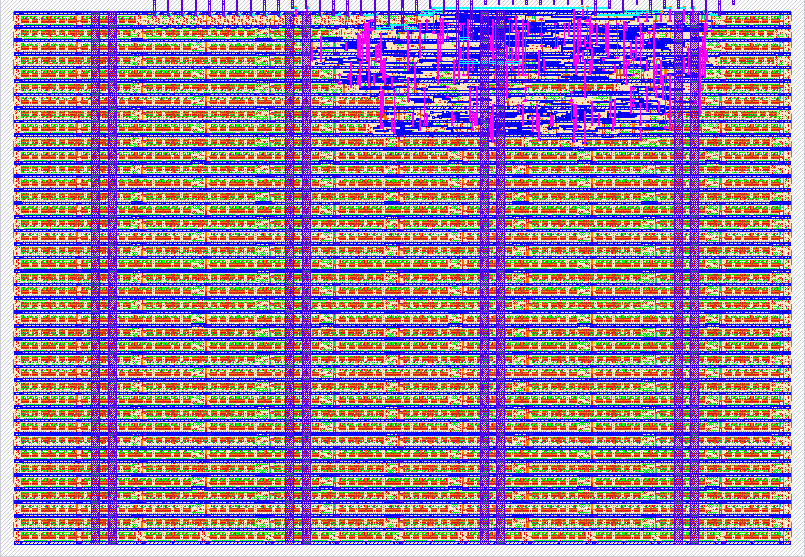
- Author: INGENIERIA ELECTRONICA TESVG
- Description: 8 binary counter and shift register with flipflops type D and one more versión with RS
- GitHub repository
- Open in 3D viewer
- Open in Tiny Tapeout Explorer
- View in Wokwi
- Clock: 1 Hz
How it works
The first flip-flop (LSB) toggles every time it receives a clock pulse.
This gives us the least significant bit (Q0).
Each following flip-flop toggles when the previous flip-flop’s output goes from 1 → 0 (falling edge).
So the second flip-flop toggles half as fast as the first.
The third toggles half as fast as the second, and so on.
This ripple effect continues through all 8 flip-flops.
So:
Q0 toggles on every clock (counts 0,1,0,1...).
Q1 toggles every 2 clocks.
Q2 toggles every 4 clocks.
…
Q7 toggles every 128 clocks.
Together, the 8 outputs represent an 8-bit binary number.
How to test
CLK (Default Pin) → Main clock signal that drives all flip-flops.
RESET (Default Pin) → Global reset input. When active, it clears all flip-flops to 0.
Now the control inputs:
IN0 (SET of Counter with RS Flip-Flop) → Works with IN1 as part of an RS (Reset–Set) latch behavior. If high, it can set the counter to a defined state.
IN1 (RESET of Counter with RS Flip-Flop) → Works with IN0. If high, it resets the counter (like a manual clear).
IN2 (Select RESET: IN1 or RESET DEFAULT) → Chooses which reset source is active:
If IN2 = 0 → Reset comes from RESET default pin.
If IN2 = 1 → Reset comes from IN1 (RS flip-flop reset).
IN3 (Select binary counter with Flip-Flop RS or D) → Selects the flip-flop type used for the counter:
IN3 = 0 → Use RS flip-flop behavior.
IN3 = 1 → Use D flip-flop behavior (often simpler for synchronous counters).
IN6 (DATA Shift Register) → Provides the serial data input for the shift register mode.
IN7 (Select Binary Counter or Shift Register) → Determines the circuit mode:
IN7 = 0 → Operate as binary counter (up counter using flip-flops).
IN7 = 1 → Operate as shift register (data shifted bit by bit through the 8 flip-flops).
External hardware
For test you can use the basics input and output, use LED and basic digital inputs. You can test with Basic CLOCK
IO
| # | Input | Output | Bidirectional |
|---|---|---|---|
| 0 | Set_Counter | LED0 | |
| 1 | Reset_Counter | LED1 | |
| 2 | Select_Reset_Counter | LED2 | |
| 3 | Select_Counter_D_RS | LED3 | |
| 4 | LED4 | ||
| 5 | out_salidas | LED5 | |
| 6 | D_Shift_Register | LED6 | |
| 7 | Select_Counter_ShiftRegister | LED7 |