775 mini_cpu
775 : mini_cpu

- Author: amarjay
- Description: a minimal 8-bit accumulator-based processor
- GitHub repository
- Open in 3D viewer
- Open in Tiny Tapeout Explorer
- Clock: 100000 Hz
How it works
miniCPU is a minimal 8-bit accumulator-based processor designed for Tiny Tapeout ASIC fabrication. It implements a compact custom ISA and executes a small program that generates a visually observable LED pattern (Knight Rider-style scanner).
The design emphasizes:
- Minimal area usage
- Clean synchronous architecture
- Simple, deterministic behavior
- Easy-to-understand instruction set
- Programmable via custom ROM instructions
Features
- 8-bit accumulator (
A) - 8-bit secondary register (
B) - 5-bit program counter (32 instructions)
- 8-bit output register (drives
uo_out) - 16-cycle clock divider for visible output timing
- Custom 8-bit instruction format
Instruction Set Architecture (ISA)
Instruction Format:

Core Instructions:
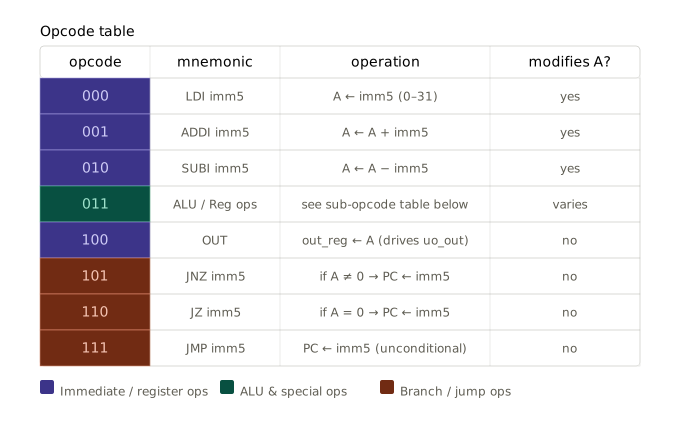
ALU Sub-operations (opcode 011):
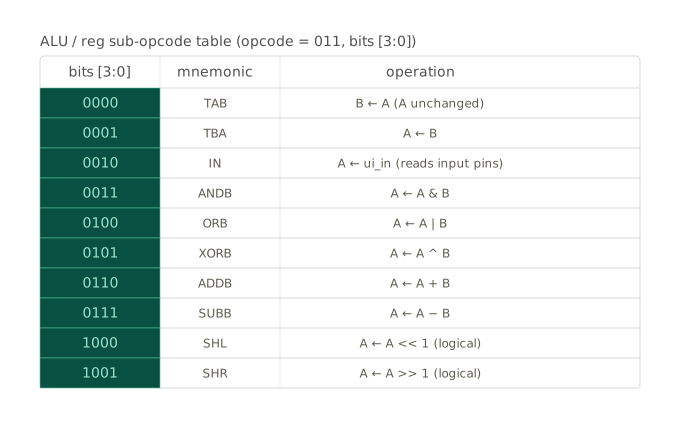
Architecture & Program Behavior
- Single-cycle FSM CPU with clock enable
- Combinational ALU producing
next_a - Synchronous register updates on enabled clock edges
- ROM implemented as combinational case statement
- 4-bit clock divider for human-visible timing (16x division)
- Designed for a 100 kHz clock, resulting in a smooth ~40 Hz LED update rate for the scanner program.
The included ROM program implements a bidirectional LED scanning pattern:
- Load value 1 into accumulator
- Shift left until overflow
- Reverse direction using shift right
- Repeat continuously
This creates a Knight Rider-style sweeping LED effect on uo_out[7:0].
I/O Mapping
ui_in: Input port (read via IN instruction)uo_out: Output LED pattern (from OUT instruction)uio_*: Disabled (not used)
How to test
- Apply a clock signal to
clk(e.g., 100 kHz or slower for visibility). - Apply reset (
rst_n = 0) for at least 10 clock cycles. - Release reset (
rst_n = 1). - Observe
uo_out[7:0].
Expected behavior
The output should show a shifting LED pattern:
- A single "1" bit moves from LSB → MSB
- Then reverses direction from MSB → LSB
- This repeats continuously
Example sequence on uo_out:
00000001
00000010
00000100
...
01000000
10000000
01000000
...
Optional input test
ui_in[0]is read by the CPU using the IN instruction. You can toggle it to verify input responsiveness (if enabled in program flow).
Cocotb simulation
Run the provided testbench:
make test
This verifies correct reset behavior, output sequence, and looping execution.
External hardware
No external hardware is required for this project.
The design is fully self-contained and operates entirely using the Tiny Tapeout standard I/O:
uo_out[7:0]: Drives external LEDs (recommended for visualization)ui_in[7:0]: Optional digital input switches (not required for basic operation)uio_*: Not used (bidirectional pins disabled)
Recommended optional setup: To observe behavior more clearly during bring-up, connect 8× LEDs to uo_out[7:0]. No PMODs, displays, or additional complex components are required.
IO
| # | Input | Output | Bidirectional |
|---|---|---|---|
| 0 | IN0 | LED0 | |
| 1 | IN1 | LED1 | |
| 2 | IN2 | LED2 | |
| 3 | IN3 | LED3 | |
| 4 | IN4 | LED4 | |
| 5 | IN5 | LED5 | |
| 6 | IN6 | LED6 | |
| 7 | IN7 | LED7 |