131 Tiny Galton
131 : Tiny Galton
- Author: Ken Pettit
- Description: A VGA Demo of A Galton Peg board with falling paint balls that go splat
- GitHub repository
- Open in 3D viewer
- Open in Tiny Tapeout Explorer
- Open in VGA Playground
- Clock: 25175000 Hz
How it works
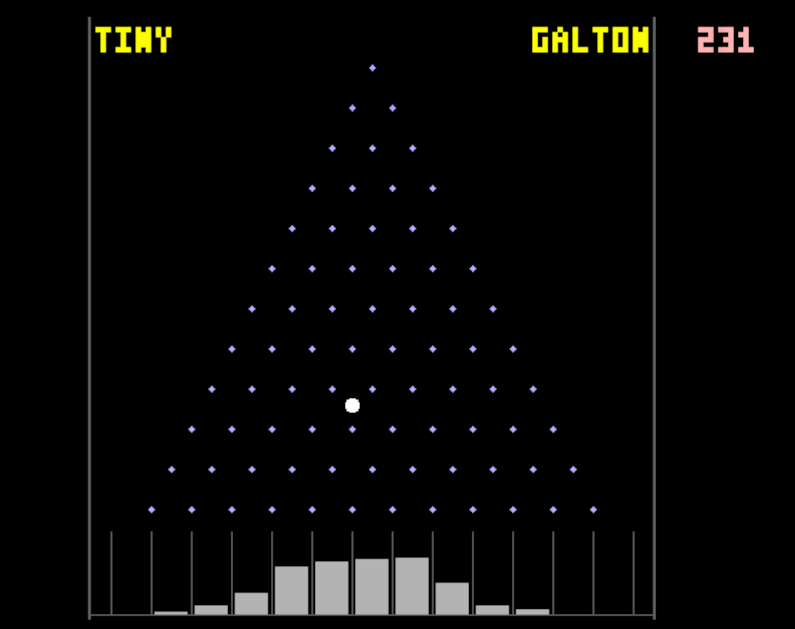
This is a VGA Demo that draws a Galton peg board and "drops" soft paint balls (they "squish" at the bottom) onto the pegboard.
It supports the gamepad PMOD and also has audio output when the balls hit the pegs if the Audio PMOD is connected (output on uio_out[7]).
It uses three prime LFSR sequences with a single bit from each XOR'ed together to create a random "left/right" decision per peg that the falling ball encounters. When it exits the bottom of the playing field, it will hit the bottom and "pop" or flatten out. This will form a historgram of where the balls land most. Each bin counts up to 64 "balls". When it gets full, it changes color and then begins showing the number of times it has filled up. So the actual number will be the number displayed times 64 (plus whatever extra is in the grey bar).
Since 3 LFSRs are used with fixed seeds, the sequence is pre-determined (i.e. would always be the same). The user can add randomization though. If no gamepad is present, holding uio_in[0] high will "hold" the ball at the top of the screen for it to be dropped. But it will also allow the LFSRs to continue to update, changing the sequence. For gamepad users, use the A button.
How to test
Connect the VGA Pmod and watch as the balls come tumbling down. Optionally connect audio PMOD to hear sounds effects as the balls bounce off the pegs in the Galton board.
If you connect a gamepad PMOD, you can us the following buttons:
- A: Hold the ball at the top of the board prior to releaseing (this will also add randomization, not that it is really needed).
- B: Toggles full histogram display mode.
- Left: You can coerce the topmost two left/right decisions to go left.
- Right: You can coerce the topmost two left/right decisions to go right.
- Up: Increase the ball drop speed. It can get pretty fast.
- Down: Reduce the ball drop speed.
- Start: When the board fills (i.e. when one of the bins receives 958 balls) start will reset for it to begin again.
- X: This is the FAR OUT button! Pressing it forces a single ball to one of the two extreme bins.
When no gamepad PMOD is connected, the speed can be controlled via rising-edge detections on ui_in[1] and ui_in[2], plus the histogram toggled via rising-edge detec on ui_in[3]:
- ui_in[0]: Hold Ball at top.
- ui_in[1]: Edge detect increases ball speed.
- ui_in[2]: Edge detect decreases ball speed.
- ui_in[3]: Edge detect toggles histogram view mode.
External hardware
VGA Pmod. Optional gamepad PMOD. Optional Audio PMOD (output is on uio_out[7]
IO
| # | Input | Output | Bidirectional |
|---|---|---|---|
| 0 | Hold Ball | R1 | |
| 1 | Faster | G1 | |
| 2 | Slower | B1 | |
| 3 | Histogram | VSync | |
| 4 | PMOD LATCH | R0 | |
| 5 | PMOD CLOCK | G0 | |
| 6 | PMOD DATA | B0 | |
| 7 | Audio Toggle | HSync | Audio out |