259 bfCPU

259 : bfCPU
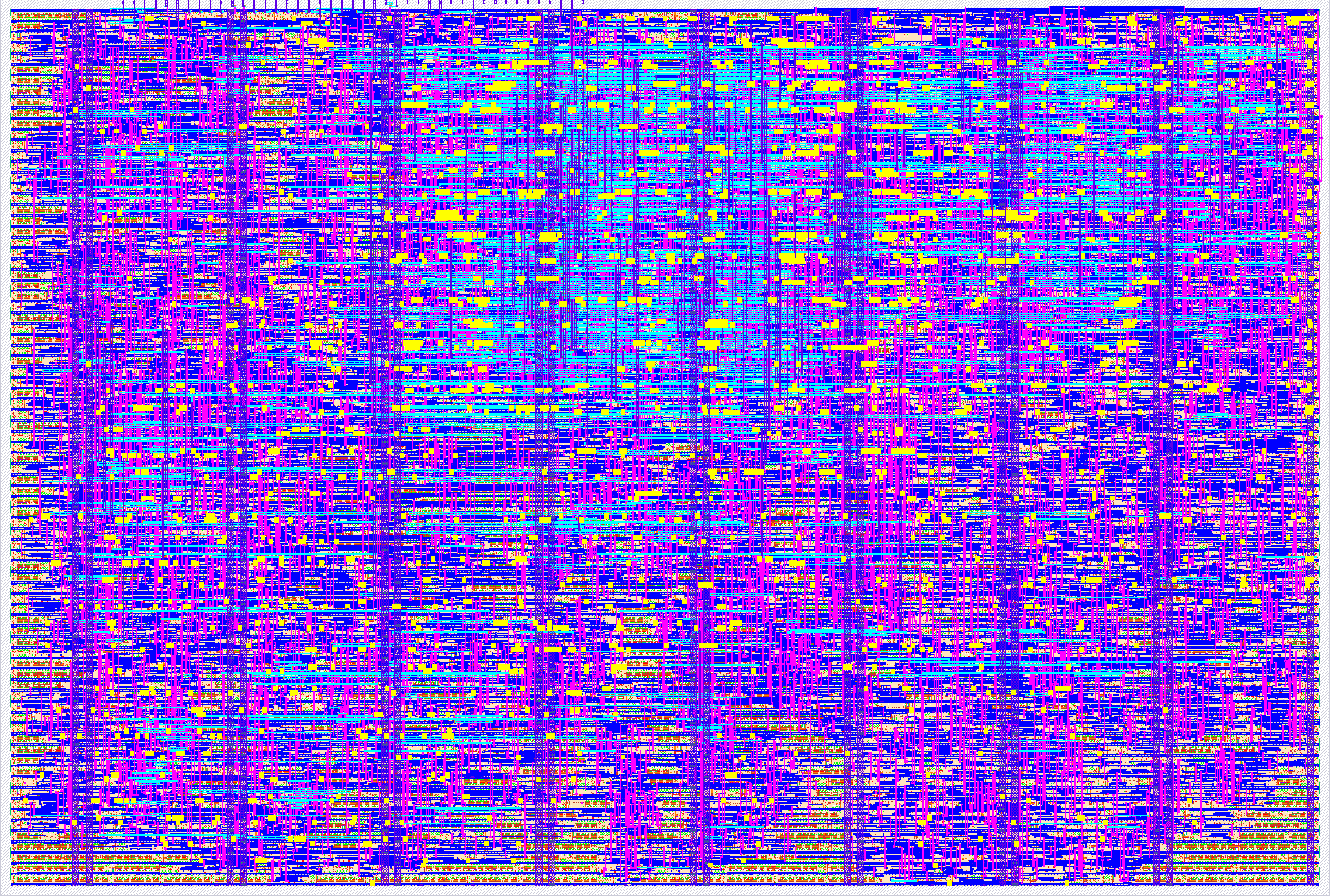
Design render

bfCPU, a Turing-complete machine

The objective of this project is to design a Turing-complete machine for Tiny Tapeout. You can find detail information of bfCPU in [bfCPU].

Building the Turing-Complete bfCPU

One of the most famous examples of a simple, yet fully Turing-complete machine is the architecture proposed in 1993 by Urban Müller of Switzerland, known as Brainf*ck (where * is 'u') [Wiki bfCPU]. I have obscured one letter due to the somewhat indelicate nature of the name; in this project, I will refer to this CPU architecture as "bfCPU." The bfCPU is an 8-bit CPU with only eight commands. Remarkably, these few commands are sufficient to implement any arbitrary algorithm. We will actually design this CPU, implement it on an FPGA, and ultimately enjoy the process of turning it into silicon via Tiny Tapeout.

The bfCPU Architecture

The Profundity of bfCPU

Programs written for bfCPU have extremely low readability and writability, earning it a spot among "esoteric programming languages" (esolangs). Even performing a simple addition feels like solving a complex puzzle. When we write a program for bfCPU, we find ourselves inadvertently and mischievously grinning. Indeed, I found myself grinning as well when I first encountered bfCPU.

Basic Architecture of bfCPU

The basic architecture of the bfCPU is shown in below.

<img src="image/bfcpu_architecture.png" alt="Basic architecture of bfCPU" width="50%">

The internal resources of the bfCPU consist solely of a Program Counter (PC) and a Data Memory Pointer (PTR). The PC indicates the address of the instruction stored in the program memory. The CPU fetches the instruction from the program memory at the address pointed to by the PC, and according to that instruction, it either manipulates the Data Memory Pointer (PTR) or accesses the data at the address in the data memory pointed to by the PTR. Each address in the data memory stores 8-bit (byte-sized) data.

Furthermore, there is an I/O mechanism for interfacing with the outside world. In the bfCPU designed for this project, external input is handled as received data via a UART (Universal Asynchronous Receiver/Transmitter), and external output is handled as transmitted data from the UART. The structure of the bfCPU is as simple as that.

bfCPU Instruction Set

The list of the bfCPU instruction set is shown in table below. The bfCPU originally features only eight instructions with opcodes (binary) from 0000 to 0111. While 3 bits would suffice for eight instructions, the bfCPU designed here includes two additional instructions (reset and nop), resulting in a 4-bit instruction code length. All of these instruction codes consist only of an opcode indicating the operation; they have a simple structure with no operands to specify targets.

The original instruction notation for bfCPU consists of single characters shown in the "Symbol" column of the table below (<, >, +, -, etc.). A program is formed by lining up these characters without gaps, or with occasional spaces and line breaks, which is why it is called an esoteric language. As described later, I have developed an assembler and instruction simulator called bfTool for bfCPU program development. This assembler accepts the original single-character bfCPU instructions, allowing the use of the vast number of publicly available bfCPU programs. However, it also supports the "Mnemonic" descriptions to improve readability. The "C-Equivalent" column represents the operation of each instruction in the C language. Note that while the original bfCPU uses ASCII characters directly as the program, the bfCPU designed in this article replaces each instruction with a 4-bit instruction code.

Table: bfCPU Instruction Set

Instruction Code (Hex) Mnemonic Symbol C-Equivalent Description
0x0 INC_PTR > ++ptr; Increment the data pointer.
0x1 DEC_PTR < --ptr; Decrement the data pointer.
0x2 INC_DATA + ++*ptr; Increment the byte at the data pointer.
0x3 DEC_DATA - --*ptr; Decrement the byte at the data pointer.
0x4 OUTPUT . putchar(*ptr); Output the byte at the data pointer.
0x5 INPUT , *ptr = getchar(); Input a byte and store it at the data pointer.
0x6 JMP_FWD [ while (*ptr) { Jump forward past ] if the byte at the pointer is 0.
0x7 JMP_BACK ] } Jump back to the command after [ if the byte at the pointer is non-zero.
0x8 NOP - - No operation.
0xF RESET - - Reset the CPU state.
Important Notes on bfCPU Programs

The begin ([) and end (]) instructions can be nested to any depth, but they must always be correctly paired. Additionally, while the data width of each cell in the data memory is 8 bits (one byte), the values wrap around: adding 1 to 0xFF results in 0x00, and subtracting 1 from 0x00 results in 0xFF. There are no flags to indicate the occurrence of a carry, borrow, or overflow.

bfCPU Assembler and Simulator: bfTool

I have developed bfTool, a development utility for creating bfCPU programs and simulating instruction behavior on a PC. It is located in the bfCPU/bfTool directory within the repository. Please refer to [bfTool] for the details.

bfCPU Program Examples

Some sample programs are stored in the [Sample Programs].

  • addition.asm: Addition
  • multiplication.asm: Multiplication
  • inputdec.asm: Receives a decimal ASCII string via UART and converts it to a binary value.
  • printdec.asm: Converts a binary value to a decimal ASCII string and transmits it via UART.
  • tictactoe.asm: Tic-Tac-Toe game.
  • life.asm: Conway's Game of Life.

I believe each of these programs is a high-effort masterpiece. Many other programs for the bfCPU (Brainfuck) architecture are also available online: [esolangs].

The bfCPU is recognized as a Turing-complete machine, meaning it is capable of performing any computational task possible for a computer. However, programs tend to become highly cryptic, and execution times can be quite long. Nevertheless, the process of solving these "puzzles" is profound and offers the ultimate form of intellectual entertainment.

Design of the bfCPU System

The overall configuration of the bfCPU system is shown in the block diagram below. The interior of the chip or FPGA (bfCPU chip) incorporates the bfCPU core, cache memory, a QSPI SRAM interface, and a UART. For external memory, a single 512Kbit (64Kbyte) QSPI SRAM 23LC512 (Microchip) is connected.

<img src="image/bfcpu_system_block_diagram.png" alt="Block Diagram of bfCPU" width="100%">

All RTL files and simulation stuffs are stored in [bfCPU].

Implementing the bfCPU System on an FPGA

FPGA Board to be Used

The designed bfCPU system will be implemented on an FPGA. The board used is the DE10-Lite (Official Website) from Terasic (Taiwan). The FPGA design resources can be found in [bfCPU].

<img src="image/fpga_system.png" alt="FPGA System of bfCPU" width="100%"> <img src="image/fpga_system_connection.png" alt="FPGA System Connection" width="100%">

Setting Up the bfCPU Development Environments bfTool and bfRun on Raspberry Pi 5

Detail information how to setup and use the tools are described in [bfCPU].

  • bfTool : You can build the bfCPU Assembler and Simulator: bfTool on RasPi5.
  • bfRun : The RasPi5 is responsible for writing programs to the QSPI SRAM and booting the bfCPU. The utility for this task is bfRun. You can also build it on RasPi5.

Implementing the bfCPU System on Tiny Tapeout Chip

The top level RTL is tt_um_bfcpu.sv, and the I/O signals are summarized in the table shown below.

Table: bfCPU I/O Signals

Pin name Direction Function Description
ui[0] input - -
ui[1] input - -
ui[2] input - -
ui[3] input - -
ui[4] input - -
ui[5] input - -
ui[6] input - -
ui[7] input UART_RXD UART Receive Data
uo[0] output UART_TXD UART Transmit Data
uo[1] output - -
uo[2] output - -
uo[3] output - -
uo[4] output - -
uo[5] output - -
uo[6] output - -
uo[7] output - -
uio[0] inout - -
uio[1] inout - -
uio[2] inout QSPI_SIO2 QSPI Memory Data bit2 (Open Drain)
uio[3] inout QSPI_SIO3 QSPI Memory Data bit3 (Open Drain)
uio[4] inout QSPI_CS_N QSPI Chip Select (Open Drain)
uio[5] inout QSPI_SCK QSPI Clock (Open Drain)
uio[6] inout QSPI_SIO0 QSPI Memory Data bit0 (Open Drain)
uio[7] inout QSPI_SIO1 QSPI Memory Data bit1 (Open Drain)

Have Fun!

IO

#InputOutputBidirectional
0UART_TXD
1
2QSPI_SIO2
3QSPI_SIO3
4QSPI_CS_N
5QSPI_SCK
6QSPI_SIO0
7UART_RXDQSPI_SIO1

Chip location

Controller Mux Mux Mux Mux Mux Mux Mux Mux Mux Mux Analog Mux Mux Mux Mux Mux Mux Mux Mux Mux Mux Analog Mux Mux Mux Mux Analog Mux Mux Mux Mux Mux Mux tt_um_chip_rom (Chip ROM) tt_um_factory_test (Tiny Tapeout Factory Test) tt_um_oscillating_bones (Oscillating Bones) tt_um_wokwi_457142813149930497 (TinyTapeOut workshop) tt_um_wokwi_457311688017142785 (tiny tapeout test gates) tt_um_bfcpu (bfCPU) tt_um_rebeccargb_universal_decoder (Universal Binary to Segment Decoder) tt_um_rebeccargb_hardware_utf8 (Hardware UTF Encoder/Decoder) tt_um_rebeccargb_intercal_alu (INTERCAL ALU) tt_um_rebeccargb_vga_pride (VGA Pride) tt_um_wokwi_457215959798165505 (4-bit N frequency divider) tt_um_ppu_aebarthyi (simple_ppu) tt_um_riscyv02 (RISCY-V02) tt_um_pong (Pong) tt_um_LH_TapeoutMultiplier (tt_um_LH_TapeoutMultiplier) tt_um_wokwi_457571222315471873 (7 Seg C) tt_um_wokwi_457571216758012929 (Mikes Second) tt_um_wokwi_457569452934172673 (FirstTinyTapeoutWokwiProject) tt_um_wokwi_457571159626309633 (Tiny Tapeout V1) tt_um_wokwi_457577038845586433 (TinyTapeOut) tt_um_wokwi_457571280506256385 (Tiny tapeouts test gates) tt_um_wokwi_457576742418338817 (calculator) tt_um_wokwi_457571219715001345 (Ami's TT Logic Gates) tt_um_wokwi_457571067547656193 (Mikes First Wokwi design) tt_um_wokwi_457571453314827265 (Tiny tapeout one hot to seven segment display 1-8) tt_um_wokwi_457572218833202177 (4bit adder and hex converter) tt_um_wokwi_463741407580251137 (Lady's First Tapeout) tt_um_wokwi_457571138696714241 (jdisplayer) tt_um_wokwi_457570687900145665 (Tiny Tapeout Test Gates) tt_um_wokwi_457577511431565313 (Tiny Tapeout Test Gates) tt_um_wokwi_457571262875481089 (Tiny Tapeout) tt_um_wokwi_457571417674762241 (TamTries Tiny Tapeout) tt_um_wokwi_457571366985520129 (georgies wokwi design) tt_um_wokwi_457571701752981505 (WilfTT) tt_um_wokwi_457572875733692417 (First WOKWI Design) tt_um_wokwi_457571571887847425 (tiny tapeout gate test) tt_um_wokwi_457571352249873409 (First Wokwi design) tt_um_wokwi_457571405919170561 (Namo's first tapeout) tt_um_wokwi_457571339952163841 (OR Gate with NAND) tt_um_wokwi_457571188658258945 (Abishag's first Wokwi Design) tt_um_wokwi_457571426719781889 (Tiny) tt_um_wokwi_457571268900604929 (tiny tape GDS) tt_um_wokwi_457571949070179329 (Tom Haley Tiny Tape Out Design ) tt_um_alex_ha_192 (alex_ha_192) tt_um_wokwi_457577241913913345 (tiny tapeout test gates ) tt_um_wokwi_457571297367365633 (First Wokwi Attempt) tt_um_wokwi_457571363309211649 (idk yet) tt_um_wokwi_457571305740256257 (Work In progress title) tt_um_wokwi_457579594627462145 (TinyTapeoutProjectDefne) tt_um_wokwi_457571274041781249 (Tiny Tapeout Workshop by Kirsty Tan) tt_um_wokwi_457571233499594753 (Tiny Tapeout Workshop) tt_um_wokwi_457570205537212417 (Tiny Tapeout Test Project) tt_um_ojas_sharma_imperial_ttcpu (ttcpu 4-bit RISC microprocessor) tt_um_wokwi_457571271419289601 (chip one) tt_um_wokwi_457573490746716161 (Name Serial Printer) tt_um_wokwi_457569507958215681 (Tiny tapeout proj) tt_um_wokwi_457577929607958529 (Random 1st Attempt) tt_um_wokwi_457571438667259905 (PD+PFD+FreqDiv) tt_um_wokwi_457571602706552833 (Joe's first Wokwi design) tt_um_wokwi_457571471659666433 (Nicolas' first Wokwi design) tt_um_wokwi_457571148733696001 (Tiny Tapeout Workshop 1) tt_um_wokwi_457572520479222785 (Tiny Tapeout: Buenos días Mundo! ) tt_um_wokwi_457571494688497665 (First Chip) tt_um_wokwi_457571341266031617 (D-Type Flip Flop) tt_um_wokwi_457581344351934465 (WOKWI) tt_um_wokwi_457571462196267009 (Tiny Tapeout) tt_um_wokwi_457571359410603009 (TinyTapeout) tt_um_Terdoo_Osu (Spiking Pattern Recognition Core) tt_um_wokwi_457571319408448513 (Mani TinyTapeout) tt_um_wokwi_457571298662360065 (Tiny Tapeout Test Gates) tt_um_wokwi_457573015156590593 (Lil tapeout) tt_um_wokwi_457576363047649281 (Inverter) tt_um_wokwi_457571216488527873 (Tiny Tapeout Template Copy Paul 1) tt_um_wokwi_457571472208072705 (Tiny Tapeout Test design) tt_um_wokwi_457571381968631809 (Tiny tapeout test) tt_um_wokwi_457571314694049793 (Tiny Tapeout Test) tt_um_wokwi_457571368009979905 (Tiny Tapeout Test Gates) tt_um_wokwi_457571389542502401 (First thing) tt_um_wokwi_457570267471381505 (Tiny Tapeout) tt_um_wokwi_457571563051492353 (CS First Wokwi design) tt_um_wokwi_457577392775721985 ( tiny Tapeout Test Gate) tt_um_wokwi_457570279596067841 (Tiny Tapeout Workshop - AJJ) tt_um_wokwi_457571180646081537 (Alins Password) tt_um_wokwi_457572360568198145 (Tiny Tapeout) tt_um_wokwi_457571270578328577 (Tiny tapeout workshop) tt_um_wokwi_457581625098771457 (Tiny Tapeout First Test Run) tt_um_wokwi_442342513281875969 (First Design) tt_um_wokwi_457581848269362177 (Tiny Tapeout Brainf*ck?) tt_um_sap_alexanderholden (sap1) tt_um_wokwi_457571752214675457 (3bit_ALU) tt_um_wokwi_457571542558115841 (Tiny Tapeout") tt_um_wokwi_457573095390500865 (Tiny Tapeout Workshop Counter) tt_um_wokwi_457571511812802561 (Akash's first Wokwi design) tt_um_wokwi_457577563633889281 (Tiny Tapeouts gate tests) tt_um_wokwi_457576950671858689 (Hymns_GDS) tt_um_wokwi_457571371384299521 (Digital digit display circuit - TINYTAPEOUT) tt_um_rowantylerr_RC_TDC (Resistor Capacitor TDC) tt_um_wokwi_463662181299058689 (2 bit ALU) tt_um_chinghey (Hey FlexCompute-130) tt_um_8b10 (serdes8b10) tt_um_rom_vga_screensaver (VGA Screensaver with embedded bitmap ROM) tt_um_mayamelon_top (Tiny PI Controller) tt_um_JAIMEPRYOR0_VGA_YAY (VGA_YAY) tt_um_2048_vga_game (2048 sliding tile puzzle game (VGA)) tt_um_mng2_2ncos (A Tale of Two NCOs) tt_um_shimmydee_checkers (One-tile ADC) tt_um_urish_simon (Simon Says memory game) tt_um_dheeeraaj_sine_chirp_beacon (DDS Sine Chirp Beacon) tt_um_nicholas_ls194a (Universal Shift Register (SN74LS194A compatible)) tt_um_BellaB05_Hearts (Pink Hearts) tt_um_scottshuynh_ad_astra (ASIC Ad Astra) tt_um_liamolucko_vga (VGA demo) tt_um_lledoux_s3fdp_seqcomb (S3FDP Seq+Comb Stream Core) tt_um_5482582_cat_vga (Cat VGA) tt_um_vga_example_directional_toggle (Directional toggle of VGA playground example) tt_um_jimbok_ro_puf (Ring Oscillator PUF) tt_um_xxsahanaxx_hwsec_glitch (Hardware Security Glitching Attack) tt_um_NguyenHuuHenry_vga_project (VGA_Project) tt_um_irfantekin_analog (tt_um_irfantekin_analog) tt_um_chicagojones_sky26a_trng (Sky26a Advanced TRNG) tt_um_yen (YEN) tt_um_pedometer (Ultra Low Power Pedometer ASIC) tt_um_analog_atenfyr1 (Configurable Self-biasing Miller-compensated OTA) tt_um_aes_sbox (Formally-Verified Constant-Time AES S-Box) tt_um_tcpu_alienflip (tcpu) tt_um_nebula (Sierpinski Fractal Starfield) tt_um_zenith_tx26 (Zenith TX26) tt_um_odgrip_demoscene_ttsky26a (My first demoscene) tt_um_vighnesh_sawant_plane (Plane with a banner) tt_um_glyph_mode_hd (Glyph Mode HD) tt_um_TSARKA_TinyQV (TinyQV Wishbone SoC) tt_um_SimpleCounter (Simple Counter) tt_um_cfar_nobuzzer (CFAR Detector without Buzzer) tt_um_present (Present) tt_um_top (Approximate Logic Unit) tt_um_goose (OIIA-goose) tt_um_riscv_core (Tiny RISC-V) tt_um_dac_test3v3 (Design and Implementation of R-2R Ladder DAC for GPR Application) tt_um_tadc_its (Time Domain ADC) tt_um_algofoogle_vga_matrix_dac (Analog VGA CSDAC experiments) tt_um_jyblue1001_pll (Analog-PLL) tt_um_axi4lite2x2_top (AXI4-Lite 2M-2S Interconnect) tt_um_systolic_top (4x4 Systolic Matrix MAC Accelerator) tt_um_goose_game (Goose Game) tt_um_rongbin99_happyredmapleleaf_audio_chip (Audio Wave Generator Chip) tt_um_fp_id (FinSec-1: AS-68M Fingerprint Verification ASIC) tt_um_game_of_life (Demoscene: Game of Life) tt_um_ds_missile_command (Missile Command) tt_um_cmos_inverter (Reactive Plasma: CMOS Inverter) tt_um_nightplumeaki_tinypipcore (tinypipcore) tt_um_immrudul_w7khan (Mrudul and Wahhaj Demoscene F2025) tt_um_sohamgovande_transformer (Transformer) tt_um_isa084_uart_servo (UART Positioning PWM Interface) tt_um_wokwi_461265571826974721 (Bias Correction Filter) tt_um_8_bit_cpu (8-bit CPU) tt_um_richad (ADPPLS) tt_um_algofoogle_dottee (DOTTEE VGA demo) tt_um_sar_fms (SAR FSM) tt_um_kolontsov_journey (Journey) tt_um_fft_adityaamehra (64 Sample FFT ASIC) tt_um_lambda_clock (Lambda Clock) tt_um_ece298A_analog (ECE298A analog tile) tt_um_toivoh_demo (Orion Iron Ion [TTSKY26a demo competition]) tt_um_kilian_interference (Wave Lattice) tt_um_fabulous_sky_26a (Tiny FABulous FPGA) tt_um_Rats2012_WobblyBits (WobblyBits - A probabilistic computing chip) tt_um_rebelmike_asic_odyssey (2026: An ASIC Odyssey) tt_um_huyatieo_tinyqv_speck (Speck-V SoC) tt_um_mosbius (mini mosbius) tt_um_remedy_cpu (FFD16 cpu 16-bit) tt_um_vga_ocarina (Ocarina on VGA) tt_um_TinyGPU_v3 (Tiniest GPU V3) tt_um_santhosh_ring_osc (Ring Oscillator PVT Sensor & TRNG) tt_um_santhosh_xbar_ctrl (Memristive Crossbar Peripheral Controller) tt_um_santhosh_stdp_ctrl (Digital STDP Learning Controller) tt_um_santhosh_stoch_neuron (LFSR-Based Stochastic Neuron) tt_um_anweiteck_ldo (1V-LDO) tt_um_sriaxi4lite_top (Axi4_Lite) tt_um_bch_code_15_7_2 (Bose-Chaudhuri-Hocquenghem Code) tt_um_mastensg_ttsky26a_demo (Luz) tt_um_pakesson_vga_rocket (VGA Rocket) tt_um_adpll (ADPLL - All-Digital Phase-Locked Loop) tt_um_Bingyao_FCOTA (Self biased Single Ended Folded Cascoded OTA) tt_um_spacewar_top (Spacewar) tt_um_microlane_demo (microlane demo project) tt_um_NE567Mixer28 (ECG Front End) tt_um_wakita_mux8onehot_cap (Mux8onehot Pulldown Mosfet) tt_um_johshoff_metaballs (Metaballs v2) tt_um_tomvdsch_cyclonerunner (CycloneRunner) tt_um_lowprocess_wildcamping (PicoMIPS CPU) tt_um_canvas (Tiny Canvas) tt_um_snrlxd1068_MACs (Linear and Logarithmic MACs) tt_um_pakesson_simon64_128 (SIMON64/128) tt_um_AmitChen1415 (Tiny Blackjack) tt_um_ole_moller_double_dabble_SV (double_dabble_SV) tt_um_toivoh_demo_1tile (Single tile demo [TTSKY26a demo competition]) tt_um_shiho_space_invaders (Tiny Space Invaders) tt_um_analog_RO (Analog RO) tt_um_electron65_vga (VGA Clock Demo) tt_um_wokwi_457571266840151041 (3-Bit ALU) tt_um_katomata (Katomata - 1D Cellular Automata) tt_um_shimomi_analog (analog circuit) tt_um_toivoh_demo_4tile (Four tile demo [TTSKY26a demo competition]) tt_um_IEEE_open_silicon_FOSSEE (Ring oscillator VCO and Differential Amplifier) tt_um_lm_chip_top (Project Long Man: A Delay-Insensitive Interconnect) tt_um_AlephNaNsea_space_time_waves_and_filaments (Space-Time Waves and Filaments) tt_um_spacelizard_apu (Spacelizard APU) tt_um_wokwi_457569490272926721 (Letter S) tt_um_mau_top_4b (SIMD2 Math Accelerator Unit) tt_um_maze (Maze) tt_um_demoscenettsky (Algorithmic Pattern Generator) tt_um_wokwi_457572141968369665 (Arran's tinytapeout project) tt_um_maxluppe_ttsky26a_analog (Standard Digital Logic Cells Analog Comparator) tt_um_grammartile (GrammarTile) tt_um_bubble_sort (IEEE Bubble Sort Engine) tt_um_ahmed_nematallah_12_bit_adc (12-bit ADC) tt_um_bad_ode_plotter_vga (Bad VGA ODE Plotter) tt_um_wokwi_463706339714973697 (Demo 4-bit ALU 74181 variant) tt_um_wokwi_457569853853115393 (Jasper Tiny Tape Out Workshop) tt_um_wokwi_457560507752701953 (Osian Tiny Tapeout) tt_um_wokwi_457571501325987841 (Rola_Tiny Tapeout Template Workshop4Mar26) tt_um_wokwi_457571903121572865 (TT-wokwi-template) tt_um_wokwi_463380823859050497 (My_Name_on_7_Seg_display) tt_um_wokwi_457569584731832321 (Tiny Tapeout 9 Template Copy) tt_um_wokwi_457571826952995841 (Tiny Tapeout Novomorphic Design 1) tt_um_wokwi_457571349142937601 (Tiny Tapeout Secret First Letter Code) tt_um_wokwi_457571261877235713 (Tiny Tapeout Test) tt_um_wokwi_457582867322921985 (Tiny Tapeout Test GDS) tt_um_wokwi_457571135132600321 (Tiny Tapeout Test Gates) tt_um_wokwi_457571331577181185 (Tinytapeout_IA) tt_um_wokwi_457576779101727745 (tiny tapeout test gates) tt_um_wokwi_457571577702202369 (tj wowki) tt_um_wokwi_457572953060951041 (wokwi) tt_um_pettit_galton (Tiny Galton) tt_um_fountaincoder_top_abc (ABC Temporal Coincidence Detector) tt_um_prime_quine (Prime Quine) tt_um_ghtag_trinity_gf16 (Trinity GF16 Dot Product Accelerator) tt_um_LFSR (Configurable Galois LFSR) tt_um_Acrazt05_titan_proccesing_unit (Titan Proccesing Unit (TPU)) tt_um_essen (Digital) tt_um_alu_bns (6-bit Multi-Functional ALU) tt_um_gerardvt_spade_poc (Interactive XOR Plasma (Spade HDL)) tt_um_gerardvt_clash_poc (Interactive Triangle-Wave Plasma (Clash HDL)) tt_um_jackthoene_frogger (Frogger) tt_um_wokwi_463698873100105729 (IEEE Open Silicon 2026: UTB Logic Trivia Challenge: 8-bit Digital Lock) tt_um_wokwi_463666635153364993 (IEEE - Hex Counter and Logic Gate Validator) tt_um_ChristmasTree_MaligayangPasko (ChristmasTree_MaligayangPasko) tt_um_wokwi_463711763041599489 (IEEE Open Silicon 2026: UTB UART Transmitter basic) tt_um_tinytensorcore (TinyTensorCore) tt_um_uwasic_crypto (UWASIC Crypto) tt_um_topadi (time) tt_um_siliconimist (Siliconimist Demoscene) tt_um_neutern_0 (tt_um_neutern_0) tt_um_htfab_hsxo (HSXO) tt_um_madech_8bit_processor_vga (8-Bit Processor with VGA) tt_um_vga_clock (VGA clock) tt_um_usu_AXIS_MVMul (AXI-Stream Matrix Vector Multiplier) tt_um_weird_numbers (Weird Numbers) tt_um_bovi_cable_tester (Cable Tester) tt_um_libokuohai_asap_cpu_v2 (ASAP CPU v2) tt_um_LinusSkucas_pio (Tiny PIO) tt_um_thomas_ep_sensor (EP Sensor v7 (symmetric in-place thicken, Zhao-compliant)) tt_um_rakhanaufm_truerandom (Current-Starved Ring Oscillator Based True Random Number Generator) tt_um_parakeet (parakeet) tt_um_mcml_vco (MCML experiments) tt_um_tpu ( Tensor Processing Unit) tt_um_strasti (8-Bit ALU) tt_um_zed_analog (Analog design) tt_um_axi4lite_top (Axi4_Lite) tt_um_c4m_spsram_direct (TTSKY-SPSRAM-direct) tt_um_Onchip_Folded_Cascode_N_with_Bias (Folded Cascode N Type with Bias from Onchip Research Group) tt_um_htfab_hybrid (Telephone hybrid) tt_um_ilamparuthi_cfar (CFAR Radar Detector) tt_um_pakesson_glitcher (Glitcher) tt_um_advaittej_stopwatch (V-SPACE Demo: Command & Control Chronograph) tt_um_william_pll (Smartcard PLL Clock Generator) tt_um_Melody_Generator_JLANordhal (Melody Generator based on Markov Chains) tt_um_d_monteiro (Neuromorphic Processor (SNN)) tt_um_jacob_kebaso_4bit_cpu (Nibble - 4-bit CPU) tt_um_signal_detector (Signal_Detection_Processor) tt_um_catalinlazar_tinycore8 (TinyCore8) tt_um_chidam_secengine (Tiny Secure Telemetry Engine) tt_um_urish_usb_cdc (USB CDC (Serial) Device) tt_um_josenbm (9-Channel Frequency Counter with I2C + SPI DAC & ADC) tt_um_shalindra_vga_rings (Variable Speed and Colour Select VGA Rings) tt_um_dinukuk_MYVGA_GLIDER (DKTT01 - VGA Glider) tt_um_fibonacci_JoaoBortolace (Fibonacci Counter) tt_um_wokwi_461639934990157825 (4 bit unlock (IEEE)) tt_um_ctw_ldo (LDO Regulator Skywater 130nm)