544 Proof
544 : Proof
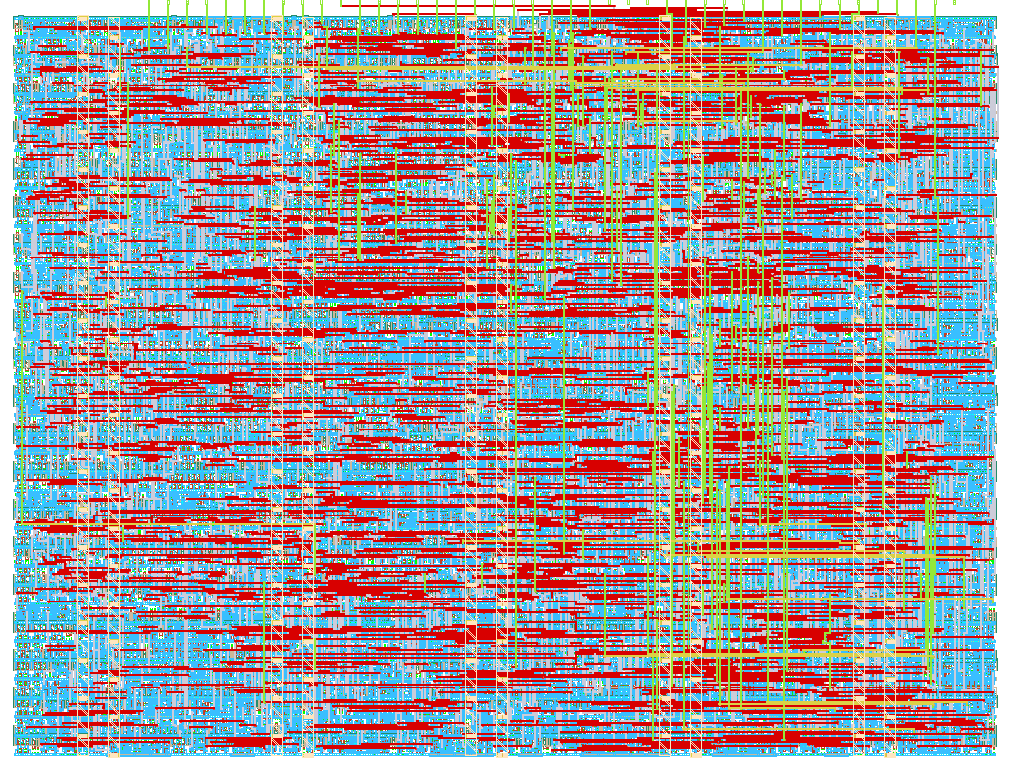
- Author: Kush Shah
- Description: Fixed-point dot-product engine that estimates the glycemic response of a meal
- GitHub repository
- Open in 3D viewer
- Open in Tiny Tapeout Explorer
- Clock: 1000000 Hz
How it works
Proof is a fixed-point dot-product engine that estimates how much a meal will
raise blood sugar. It runs two modes over one datapath, selected by MODE.
- Mode A — glycemic load. A single weighted sum over recipe ingredients,
GL = sum(grams_i * w_i), where the host precomputesw_i = available_carb_per_gram_i * GI_i / 100and available carbohydrate is total carbohydrate minus dietary fibre. Needs no per-user data, so it works the moment the chip powers on. The chip also reports the standard per-serving category: low ≤ 10, medium 11–19, high ≥ 20. - Mode B — personalised response. A two-layer quantised MLP,
h = ReLU((W1·x + b1) >> s1)theny = (W2·h + b2) >> s2, over meal macronutrients and user context. Shift amounts are powers of two, so requantisation costs a shift rather than a second multiplier.
Every neuron of both layers is the same dot product. Only two things differ: where the activations come from, and what happens to the result. That is why this is one machine with a mode bit rather than two designs.
Weights are streamed in, not stored on chip. That began as an area decision — the parameters do not fit alongside the datapath in one tile — but it is also what makes the design personalisable: same silicon, different patient.
x is not buffered on chip either; the host re-streams it for each hidden
neuron, which costs 48 bytes instead of 6 and saves 48 flip-flops. At meal
timescales bandwidth is free and flip-flops are not. The hidden layer h is
buffered, as a rotating shift register, because only the chip can produce it.
Biases need no bias-specific logic anywhere. In layer 1 they are ordinary extra
terms. In layer 2 the chip supplies the constants 127 and 1 after the eight
hidden values, so a bias is v8·127 + v9·1 — exact to the unit for any 15-bit
value.
The chip checks its own safety precondition
The monotonicity property below holds if the streamed weights satisfy
W1[j][carb] · W2[j] ≥ 0 for every hidden unit. That is a property of the
weights, not of the design — and since the host streams a different weight set
per patient, trusting it is not good enough. Refitting an unconstrained network
per person violates the condition in 44 of 44 cases measured on CGMacros.
So the chip checks. Both operands already pass through the pins: the first
weight byte of hidden neuron j is W1[j][carb], and layer-2 weight byte k
is W2[k]. Their signs ride a register that rotates in lockstep with the
hidden-activation register, and a disagreement raises UNTRUSTED. A unit is
free to oppose carbohydrate twice — negative on both sides is a non-negative
product — and a zero weight can never trigger it, which is why a non-zero bit
is carried alongside each sign.
Everything saturates
The accumulator clamps instead of wrapping and raises the same sticky
UNTRUSTED flag, and so do the output fields. One pin covers both: a numeric
overflow and a void guarantee mean the same thing to a caller — do not act on
this output — and the host holds the weights, so it can always tell which. This is not only about producing a sensible
number: a saturating sum is monotone and a wrapping one is not.
That matters because the design's headline property is
holding every other input fixed, increasing carbohydrate must never decrease the predicted response.
Saturating sums, arithmetic shifts, ReLU and clamps are each monotone, so the
composition is too, provided every hidden unit satisfies
W1[j][carb] · W2[j] ≥ 0. During development the property held internally but
failed at the pins, because the output fields truncated — a one-count rise in
carbohydrate could make the reported response fall from 31,293 to −31,209.
Truncation wraps. The fields now saturate, and the property survives all the way
to what the host reads.
This is not a medical device. It is an educational and research artifact, and every output is an estimate.
How to test
The host drives a byte stream on DATA_IN, qualified by VALID, with each
byte tagged by IS_WEIGHT. Do not present a byte while BUSY is high; bytes
offered then are ignored, not queued.
A neuron is a shift byte, then its terms, with LAST on the final one:
Mode A / Mode B layer 1   [s|wt] [w0|wt] [a0] [w1|wt] [a1] ... [aN|last]
Mode B layer 2            [s|wt] [v0|wt] [v1|wt] ...      [v9|wt,last]
The shift byte carries the requantisation shift, so the host sends s1 for
hidden neurons and s2 for output neurons. In layer 2 there are no activation
bytes at all — each weight multiplies the next value the chip supplies: h[0..7],
then 127, then 1.
LAST asserted on the shift byte — otherwise a don't-care — means "this is a
new inference", which resets the neuron counter and clears the sticky overflow
flag. Mode A ignores it, since every Mode A stream is its own inference.
UNTRUSTED marks the result unsafe to act on. DONE marks a neuron complete and its result readable. RD_SEL selects which
byte appears on RESULT:
RD_SEL = 0 |
RD_SEL = 1 |
|
|---|---|---|
| Mode A | GL[7:0] |
{category[1:0], GL[13:8]} |
| Mode B | value[7:0] |
value[15:8] |
Eight output pins and a one-bit select give 16 bits, so rather than spend a whole byte on a 2-bit category it is packed above a 14-bit figure. "High" starts at 20, so a 14-bit field is orders of magnitude more than any real meal needs.
rst_n always recovers the chip, including from a truncated, stuck or
mis-tagged stream.
The number of inputs is not fixed in silicon — a neuron ends when the host
says LAST — and neither is the number of outputs, since the host simply stops
streaming. Only the hidden-layer width is structural, being the depth of the
h shift register.
There is no host MCU. The protocol is exercised by the cocotb testbench in
test/, against both the RTL and the post-layout gate-level netlist, and every
functional test is compared bit-exactly against an integer reference model.
The gate-level run is done twice: once with no timing, and once with the
post-route SDF back-annotated at all three corners, so the netlist is exercised
with real cell and interconnect delays. Setup and hold are still checked by
static timing analysis alone — the simulator implements no timing checks.
The monotonicity argument above is partly machine-checked rather than only
reasoned: formal/ proves the saturating accumulator monotone by k-induction
(unbounded), and proves the value the host reads monotone through the whole
core for a single-term Mode A inference. Reverting the fix for the truncation
defect makes that second proof fail, so the historical bug is reproduced by a
solver. Composition across a whole Mode B network is still the hand argument.
VERIFICATION.md records what is verified and what is not; BUGS.md records
every defect found, including the ones found in the testbench itself.
External hardware
None.
IO
| # | Input | Output | Bidirectional |
|---|---|---|---|
| 0 | DATA_IN[0] | RESULT[0] | VALID (in) |
| 1 | DATA_IN[1] | RESULT[1] | IS_WEIGHT (in) |
| 2 | DATA_IN[2] | RESULT[2] | LAST (in) |
| 3 | DATA_IN[3] | RESULT[3] | MODE (in) |
| 4 | DATA_IN[4] | RESULT[4] | RD_SEL (in) |
| 5 | DATA_IN[5] | RESULT[5] | DONE (out) |
| 6 | DATA_IN[6] | RESULT[6] | UNTRUSTED (out) |
| 7 | DATA_IN[7] | RESULT[7] | BUSY (out) |