128 iTALU: Interactive Testable Arithmetic Logic Unit
128 : iTALU: Interactive Testable Arithmetic Logic Unit
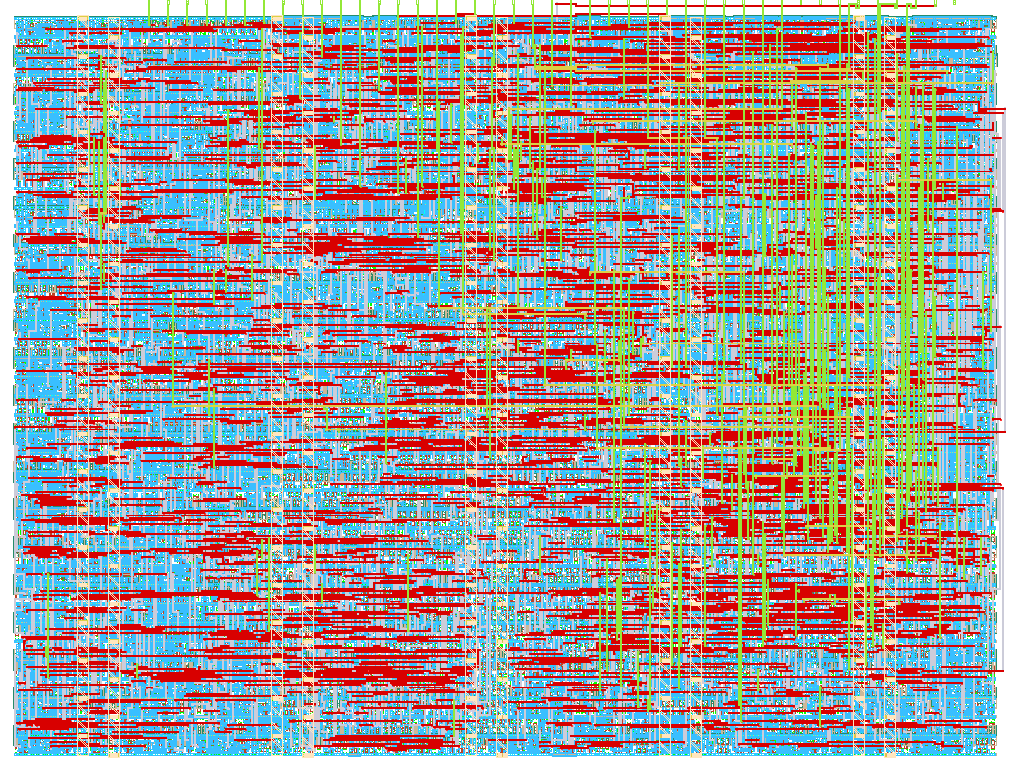
- Author: Your Name
- Description: 8-bit ALU with DFT features including BIST and scan chain
- GitHub repository
- Open in 3D viewer
- Open in Tiny Tapeout Explorer
- Clock: 50000000 Hz
iTALU: Interactive Testable Arithmetic Logic Unit
Project Overview
iTALU is an 8-bit Arithmetic Logic Unit (ALU) with comprehensive Design-for-Testability (DFT) features, designed for Tiny Tapeout using the IHP SG13G2 (130nm) technology. The project demonstrates industry-standard testing techniques — scan chain, LFSR/MISR-based BIST, and fault injection — with a simple serial user interface.
Key Features
- 8-bit ALU with 16 operations (arithmetic, logic, shifts/rotates, compare, min/max, saturating arithmetic)
- 4 status flags (Zero, Carry, Negative, Overflow)
- 20-bit serial instruction interface (LSB first)
- 64-bit scan chain covering all internal state
- Built-In Self-Test (BIST) with 8-bit LFSR pattern generator and 8-bit MISR response compactor (256 patterns per run)
- User-controlled fault injection: stuck-at-0/1, inversion, coupling
- Status readback mux: flags/BIST status, MISR signature, fault counter, cycle counter
Specifications
| Parameter | Value |
|---|---|
| Technology | IHP SG13G2 (130nm) |
| Tile Size | 1x1 |
| Clock Frequency | 50 MHz (tested), no hard requirement |
| Top Module | tt_um_italu |
| I/O Pins | 8 input, 8 output, 8 bidirectional |
Architecture
                    +---------------------------------------------+
                    |                  tt_um_italu                |
                    |                                             |
 ui_in[0] DATA ---->| +------------------+   +-----------------+   |
 ui_in[1] LOAD ---->| | Serial           |   | Normal ALU      |   |
 ui_in[2] EXEC ---->| | Instruction Reg  |-->| + Result/Flags  |-->| uo_out = result
                    | | (20b, LSB first) |   +-----------------+   |
                    | +--------+---------+                         |
                    |          |                                   |
                    |          v   +-----------------+             |
                    | +------->|   | Direct Exec ALU |             |
                    | |        |   +-----------------+             |
                    | |  +-----+---------+                         |
                    | |  | Fault Injector|--+ (SA0/SA1/invert/couple)
                    | |  +---------------+                         |
 uio_in fault cfg ->| |                                            |
                    | v                                            |
                    | +------------------+   +-----------------+   |
 ui_in[7] START --->| | BIST FSM         |   | LFSR -> MISR    |   |
                    | | IDLE/LOAD/EXEC/  |<->| 256 patterns    |   |
                    | | DONE             |   | golden sig 0x93 |   |
                    | +------------------+   +-----------------+   |
                    |                                              |
 ui_in[3] CAPTURE ->| +------------------+   +-----------------+   |
 ui_in[6] SHIFT --->| | 64-bit Scan Chain|   | Status Mux      |-->| uio_out
                    | +------------------+   +-----------------+   |
                    +---------------------------------------------+
ALU Operations
| Code | Operation | Description |
|---|---|---|
| 0x0 | ADD | A + B with carry out |
| 0x1 | SUB | A - B (carry = no borrow) |
| 0x2 | AND | Bitwise AND |
| 0x3 | OR | Bitwise OR |
| 0x4 | XOR | Bitwise XOR |
| 0x5 | NOT | Bitwise NOT of A |
| 0x6 | SHL | Logical shift A left by 1 |
| 0x7 | SHR | Logical shift A right by 1 |
| 0x8 | SAR | Arithmetic shift A right by 1 |
| 0x9 | ROL | Rotate A left by 1 |
| 0xA | ROR | Rotate A right by 1 |
| 0xB | SLT | Signed less-than: 1 if A < B else 0 |
| 0xC | MIN | Unsigned minimum of A and B |
| 0xD | MAX | Unsigned maximum of A and B |
| 0xE | SATADD | Saturating signed add (clamps at 0x7F / 0x80) |
| 0xF | SATSUB | Saturating signed subtract (clamps at 0x7F / 0x80) |
Status Flags
With STATUS_SEL = 00, uio_out[3:0] shows:
| Flag | Bit Position | Description |
|---|---|---|
| Zero (Z) | bit 0 | Result is 0x00 |
| Carry (C) | bit 1 | Carry out (ADD) or no borrow (SUB) |
| Negative (N) | bit 2 | MSB of result is 1 |
| Overflow (O) | bit 3 | Signed arithmetic overflow |
The same select also reports [4] = BIST done, [5] = BIST pass and
[6] = scan out.
Design-for-Testability (DFT) Implementation
1. Serial Instruction Interface
A 20-bit shift register is filled LSB first while LOAD_EN is high:
[19:16] opcode
[15:8]  operand B
[7:0]   operand A
Pulsing EXECUTE latches the operands/op into the normal ALU registers and
stores the (possibly fault-injected) result and flags.
2. Scan Chain
A single 64-bit chain captures all internal state:
operand_a(8) -> operand_b(8) -> operation(4) -> alu_result(8) ->
flags Z/C/N/O(4) -> misr(8) -> bist_done(1) -> test_pass(1) ->
fault_counter(8) -> cycle_counter(8) -> padding(6)
SCAN_CAPTURE(ui_in[3]) loads the chain from live state in one clockSCAN_SHIFT(ui_in[6]) shifts one bit per clock ontoSCAN_OUT(uio_out[6]), LSB first
3. Built-In Self-Test (BIST)
+-----------+    +----------------+    +-----------+
|   LFSR    |--->|      ALU       |--->|   MISR    |
|  Pattern  |    |  (Under Test)  |    | Response  |
| Generator |    |  Reference     |    | Compactor |
+-----------+    +-------+--------+    +-----------+
                         |
                   +-----v-----+
                   | Comparator|----> pass/fail + fault counter
                   +-----------+
- 8-bit LFSR generates operand A; operand B is a nibble-swap of A; the opcode comes from the low nibble of the LFSR value
- 256 patterns run automatically (IDLE → LOAD → EXEC → DONE FSM)
- Responses are compacted into an 8-bit MISR
- Fault-free golden MISR signature: 0x93
- On completion
BIST_DONE(uio_out[4]) asserts and stays asserted until the nextBIST_START, so it can be polled reliably TEST_PASS(uio_out[5]) is high on a fault-free run, low when any mismatch or active fault injection was observed- Detected faults increment an 8-bit fault counter (
STATUS_SEL = 10)
4. Fault Injection
Configured via uio_in while the status output is driven:
| Field | Pins | Values |
|---|---|---|
| Enable | uio_in[0] |
1 = inject |
| Type | uio_in[2:1] |
00 = stuck-at-0, 01 = stuck-at-1, 10 = inversion, 11 = coupling |
| Bit | uio_in[5:3] |
Result bit 0–7 the fault applies to |
The injected fault affects the normal ALU path, the serial-execution path and the BIST comparison simultaneously — so a faulted chip fails its own self-test, which is the core demonstration of the DFT flow.
5. Status Readback Multiplexer
STATUS_SEL (uio_in[7:6]) |
uio_out content |
|---|---|
| 00 | Flags + BIST done/pass + scan out |
| 01 | MISR signature |
| 10 | Fault counter |
| 11 | Free-running cycle counter |
Pin Configuration
Input Pins (ui_in)
| Pin | Name | Description |
|---|---|---|
| ui_in[0] | DATA_IN | Serial data input for instruction loading |
| ui_in[1] | LOAD_EN | Shift one bit into the instruction register |
| ui_in[2] | EXECUTE | Execute the loaded instruction |
| ui_in[3] | SCAN_CAPTURE | Capture state into the scan chain |
| ui_in[4] | — | Unused |
| ui_in[5] | — | Unused |
| ui_in[6] | SCAN_SHIFT | Shift the scan chain one bit per clock |
| ui_in[7] | BIST_START | Start a BIST run |
Output Pins (uo_out)
| Pin | Name | Description |
|---|---|---|
| uo_out[7:0] | RESULT | 8-bit ALU result |
Bidirectional Pins (uio)
Inputs (fault configuration / status select):
| Pin | Name | Description |
|---|---|---|
| uio[0] | FAULT_ENABLE | Fault injection enable |
| uio[2:1] | FAULT_TYPE | Fault type selection |
| uio[5:3] | FAULT_BIT | Faulted result bit |
| uio[7:6] | STATUS_SEL | Status output select |
Outputs (status, selected by STATUS_SEL):
| Pin | Select 00 | Select 01 | Select 10 | Select 11 |
|---|---|---|---|---|
| uio[7:0] | Flags/BIST/scan-out | MISR | Fault counter | Cycle counter |
How to Test
RTL Simulation
Requires cocotb and Icarus Verilog:
cd test
make -B
This runs the full 11-test regression against src/project.v, producing
results.xml and an FST waveform. See test/README.md
for gate-level simulation and waveform viewing.
Regression Coverage
| # | Test | What it verifies |
|---|---|---|
| 1 | test_add |
Basic ADD: 0x0F + 0x03 = 0x12 |
| 2 | test_sub |
Basic SUB: 0x0A - 0x05 = 0x05 |
| 3 | test_all_alu_operations |
All 16 opcodes vs a Python reference model |
| 4 | test_alu_flags |
Zero/Carry/Negative/Overflow flag generation |
| 5 | test_normal_fault_injection |
Injected fault changes the ALU result |
| 6 | test_bist_pass |
Fault-free BIST completes, passes, MISR = 0x93 |
| 7 | test_bist_fault_detection |
All 4 fault types detected by the BIST |
| 8 | test_fault_counter |
Fault counter increments on detected faults |
| 9 | test_scan_chain |
Capture + shift returns operands correctly |
| 10 | test_cycle_counter |
Cycle counter advances with the clock |
| 11 | test_complete_system |
End-to-end: ALU, clean BIST, fault detection |
Status: 11/11 passing, GDS hardened successfully with LibreLane.
Manual Testing on Hardware
Basic operation:
- Reset the chip (
rst_n = 0, then release). - Shift a 20-bit instruction in LSB first via
DATA_IN/LOAD_EN. - Pulse
EXECUTE; read the result onuo_outand the flags onuio_out.
Self-test:
- Pulse
BIST_START. - Poll
uio_outuntil bit 4 (BIST done) is high. - Check bit 5 (pass/fail) and optionally read the MISR via
STATUS_SEL = 01.
Fault demonstration:
- Set
FAULT_ENABLEwith a type/bit combination onuio_in. - Re-run the BIST;
TEST_PASSnow goes low and the fault counter (STATUS_SEL = 10) increments.
Scan:
- Pulse
SCAN_CAPTURE, then clockSCAN_SHIFT64 times readingSCAN_OUT.
External Hardware
No external hardware is strictly required — everything can be driven by a
microcontroller or FPGA over the serial interface. For standalone bench use:
push buttons/DIP switches for ui_in, LEDs or a logic analyzer on uio_out,
and an LED bus or MCU reading uo_out.
License
This project is licensed under Apache-2.0.
Acknowledgments
- Tiny Tapeout for providing the platform
- IHP for the SG13G2 PDK
- Open source EDA community
IO
| # | Input | Output | Bidirectional |
|---|---|---|---|
| 0 | DATA_IN | RESULT_0 | ZERO_FLAG |
| 1 | LOAD_EN | RESULT_1 | CARRY_FLAG |
| 2 | EXECUTE | RESULT_2 | NEG_FLAG |
| 3 | RESULT_3 | OVF_FLAG | |
| 4 | RESULT_4 | BIST_DONE | |
| 5 | RESULT_5 | TEST_PASS | |
| 6 | SCAN_EN | RESULT_6 | SCAN_OUT |
| 7 | BIST_START | RESULT_7 |