519 Sine Wave Synthesizer
519 : Sine Wave Synthesizer
- Author: Alberto Beccari
- Description: This tile synthesizes sine waves in the audio frequency range by means of a CORDIC engine and pulse-density modulation.
- GitHub repository
- Open in 3D viewer
- Open in Tiny Tapeout Explorer
- Clock: 12288000 Hz
How it works
tt_um_abeccari_swsynth is a CORDIC sine-wave synthesizer: it plays an equal-tempered musical note as an audio tone. You choose the pitch on the input pins, and the tone comes out three ways — a parallel digital sample bus and two 1-bit pulse-density-modulated (PDM) streams.
Signal chain:
- Note select —
ui[3:0]picks a semitone (see the table below) andui[7:4]an octave above A0 = 27.5 Hz. The output frequency isf = 27.5 · 2^(note/12) · 2^octaveHz, with the octave clamped to ≤ 8 so the tone stays below the Nyquist rate. - NCO — a frequency map turns the note into a phase increment that drives a 20-bit phase accumulator, stepped at the 48 kHz sample rate (
clk / 256). - CORDIC — a rotation-mode CORDIC converts the phase into signed sine and cosine samples (~8-bit accurate).
- Outputs —
uo[6:0]— 7-bit parallel sine, offset-binary (0x40= zero crossing), refreshed once per 48 kHz sample.uio[0](SAMPLE_EN) pulses high for one clock at each new sample.uo[7]— PDM_I, a 1-bit sigma-delta stream of the sine at the full clock rate; low-pass filtered, it reconstructs the analog sine.uio[7]— PDM_Q, the same for the cosine (90° out of phase with PDM_I) — an I/Q pair.uio[6]— SQR, a 1-bit square wave at the tone frequency (the sign of the sine); a clean digital output that needs no filter.uio[5]— SAW, a 1-bit sigma-delta sawtooth at the tone frequency (the raw phase ramp); low-pass filter to reconstruct.uio[4]— NOISE, a 1-bit pseudo-random bitstream from a maximal-length 20-bit LFSR, advanced one step per 48 kHz sample. Unlike the PDM outputs this is a baseband signal, not a density-coded one — its 0–24 kHz band already is audio-band white noise, so no demodulation is needed. Being a zero-order-hold at 48 kHz it carries spectral images above f_s/2; a gentle low-pass at ≈ 20–24 kHz rejects those ultrasonic images (anti-imaging / reconstruction) for clean band-limited noise and to spare the amplifier ultrasonic switching energy. The sequence is deterministic and repeats every 2²⁰−1 samples (≈ 21.8 s).
Semitone codes on ui[3:0] (codes 12–15 have no distinct note and fold back to A):
ui[3:0] |
0 | 1 | 2 | 3 | 4 | 5 | 6 | 7 | 8 | 9 | 10 | 11 | 12–15 |
|---|---|---|---|---|---|---|---|---|---|---|---|---|---|
| Note | A | A# | B | C | C# | D | D# | E | F | F# | G | G# | A |
The clock is 12.288 MHz = 256 × 48 kHz.
<img src="note4_oct8.png" width="360" alt="Parallel 7-bit sine output (top) and its spectrum (bottom), note C#, octave 8 ≈ 8.87 kHz">
How to test
- Clock — drive
clkat the 12.288 MHz design point; the pitch and 48 kHz sample rate scale with it (f_s = clk / 256), and being fully synchronous it also runs correctly at lower rates. Clocks up to ~60 MHz are within the process corners (worst-case Fmax ≈ 66 MHz at the slow corner, from signoff STA); the demo board's on-board clock tops out at 50 MHz, which the design meets with margin, so driveclkexternally to go higher. - Reset — hold
rst_nlow for a few clock cycles, then release it high. - Pick a note — set
ui[7:4]= octave andui[3:0]= semitone. For exampleui_in = 0x40→ octave 4, note 0 (A) → 440 Hz (concert A);ui_in = 0x80→ note A, octave 8 → 7040 Hz. - Monitor —
- Put a logic analyzer on
uo[6:0](the 7-bit sine) and useuio[0](SAMPLE_EN, 48 kHz) as the sample clock / scope trigger. The value traces a sine centered on0x40. - Scope
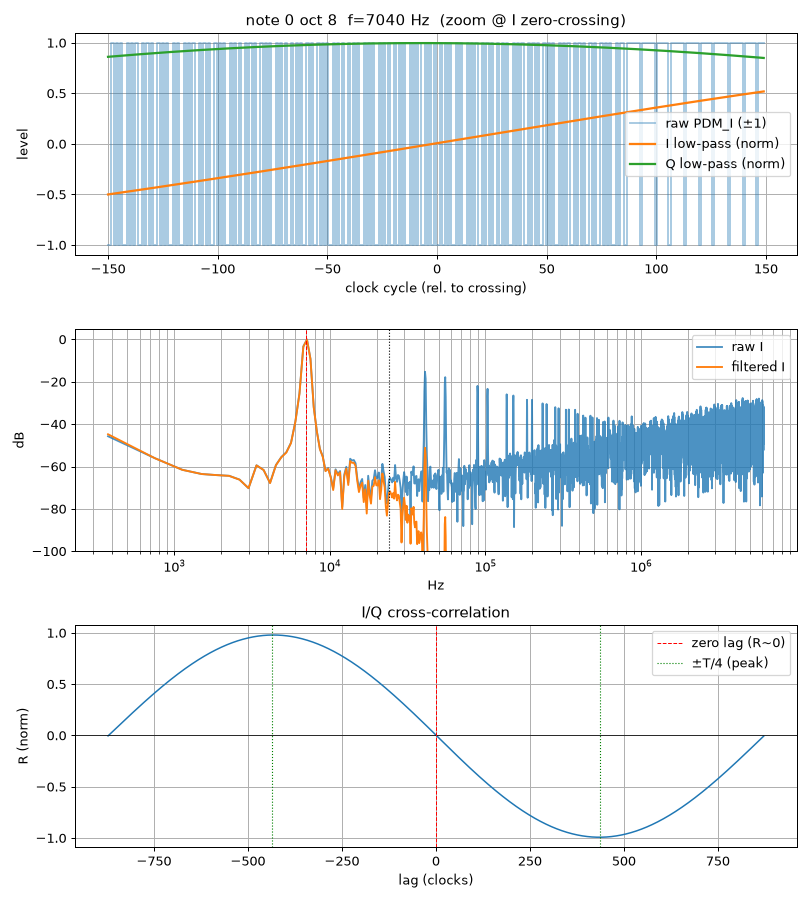
uo[7](PDM_I) anduio[7](PDM_Q): fast 1-bit streams whose pulse density follows the sine and cosine.
- Put a logic analyzer on
- Change the note on
ui_inat any time; the tone follows on the next samples.
External hardware
On the TinyTapeout demo board the on-board RP2040 selects the design, supplies the clock, drives ui_in, and reads the outputs — so you can set the note from the on-board DIP switches or a MicroPython script and capture the 48 kHz parallel-sine samples in software, with no extra parts. All I/O is also broken out on the Pmod and SIL headers for the analog add-ons below.
- Hear it: low-pass filter
uo[7](PDM_I) with a simple RC and drive a powered speaker or amplifier. The Audio Pmod does exactly this (RC reconstruction filter + amplifier + jack) and takes its input onuo[7], so it plugs straight into the output Pmod. - Quadrature (I/Q): filter
uio[7](PDM_Q) the same way for a second channel 90° out of phase — useful for demodulation experiments. - Parallel DAC: feed
uo[6:0](offset-binary, midscale0x40) into a 7-bit R-2R resistor-ladder DAC on the output Pmod or a SIL header, latched by SAMPLE_EN (uio[0]), for an analog staircase sine; add a gentle RC afterward to smooth the sampling images.
IO
| # | Input | Output | Bidirectional |
|---|---|---|---|
| 0 | NOTE0 (semitone LSB) | SINE0 (sine LSB, offset-binary) | SAMPLE_EN (48 kHz sample strobe) |
| 1 | NOTE1 | SINE1 | unused |
| 2 | NOTE2 | SINE2 | unused |
| 3 | NOTE3 (semitone MSB; 0=A..11=G#) | SINE3 | unused |
| 4 | OCT0 (octave LSB) | SINE4 | NOISE (1-bit white noise, maximal-length LFSR PRBS) |
| 5 | OCT1 | SINE5 | SAW (1-bit sigma-delta sawtooth at the tone frequency) |
| 6 | OCT2 | SINE6 (sine MSB) | SQR (1-bit square wave at the tone frequency) |
| 7 | OCT3 (octave MSB; above A0=27.5Hz) | PDM_I (1-bit sigma-delta audio out) | PDM_Q (1-bit sigma-delta audio out - 90 degrees out of phase from PDM_I) |