491 IEEE Acoustic Drone Detector
491 : IEEE Acoustic Drone Detector
- Author: Jędrzej Hasiura, Grzegorz Pawelski
- Description: Self-contained acoustic drone detector: PDM microphone in, detection signal out.
- GitHub repository
- Open in 3D viewer
- Open in Tiny Tapeout Explorer
- Clock: 50000000 Hz
How it works
This project is a self-contained acoustic drone detector. A one-bit PDM
microphone stream enters on ui[0]; an active-high detection signal appears on
uo[1], uo[2], and uo[3]. The complete model is fixed in the logic, with
no processor, firmware, RAM, or external weight storage.
The multiplier-free integer pipeline is:
- Divide the 50 MHz input clock by 32 and output the resulting 1.5625 MHz PDM
microphone clock on
uo[0]. - Feed microphone samples through a nine-stage dyadic one-pole cascade. One shared subtract/shift/add datapath services the rotating state ring.
- Difference adjacent stages to obtain five octave bands, then encode their magnitudes as four-bit logarithmic features.
- Keep each band's maximum over a 41.9 ms frame. Sixteen frames form a 671 ms classifier window.
- Accumulate four 16×5 ternary templates in signed six-bit saturating accumulators. Two staggered windows reduce boundary sensitivity.
- Requantize the hidden activations, apply the ternary output layer, compare against the trimmed threshold, and hold a detection for one 41.9 ms frame. The hold is deliberately short: a drone is a steady source that is still there on the next window, so the output tracks it instead of latching. An earlier build held for 629 ms, which lagged the aircraft and ran two passes together into one.
The shipped drone_dads_lvl12_s4 weights were trained on DADS with every clip
re-levelled across a −12…0 dB span, so the template is not tied to one
recording level. Scored with the bit-exact chip model they reach 99.15 % AUC on
the validation split and 98.98 % on the held-out test split; the seed was chosen
on validation only. The RTL subtracts the header's own feature centre
(FEAT_OFF = WW_CENTRE = 8) and asserts the equality at elaboration, and the
classifier dot product is computed exactly before the six-bit saturation --
both are fixes to the earlier drone_4 build, which ran a different model from
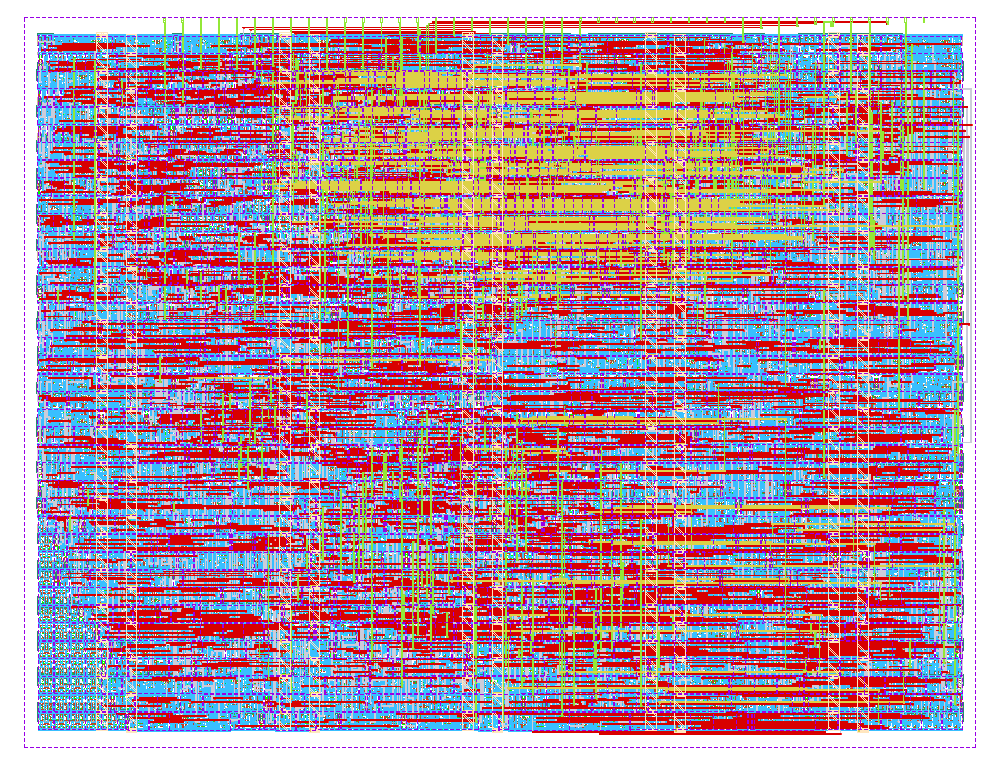
the one it was measured on. Hardening of this build completed in one IHP
sg13g2 1×1 tile at 93.78% final core utilization with zero DRC, LVS, antenna,
max-fanout, setup and hold violations at all three corners.
How to test
- Connect a compatible PDM microphone's data pin to
ui[0]and clock pin touo[0], together with the appropriate board power and ground. - Apply the specified 50 MHz system clock and release reset.
- Start with the neutral threshold trim
ui[7:1] = 7'd64, which gives the shipped threshold of 5, the validation max-accuracy point. Detection appears onuo[3:1]. - For fewer false triggers, use trim 65 (threshold 9). For higher recall, use trim 63 (threshold 1).
- Check
uo[7:4]for a changing band-level value to confirm that microphone data is reaching the front end.
Each trim increment changes the decision threshold by four score units. On the held-out test split the operating points were 96.6% recall / 4.4% negative clips firing at threshold 5 (trim 64), 74.8% / 1.1% at threshold 9 (trim 65) and 99.7% / 13.9% at threshold 1 (trim 63). Synthetic room tone never fires at threshold 5. These clip-level figures do not predict alarms per hour in a real deployment.
External hardware
- One PDM MEMS microphone compatible with the TinyTapeout board's I/O voltage.
- Two signal connections: microphone data to
ui[0]and microphone clock fromuo[0]. - DIP switches or another seven-bit source on
ui[7:1]for threshold trim. - An LED or logic input on any of
uo[1],uo[2], oruo[3].
All uio pins are debug outputs: uio[3:0] is the frame index, uio[4] is
detection, uio[6:5] is the internal FSM state, and uio[7] is the microphone
tick.
Limitations
The detector was evaluated on DADS clips, not long-duration recordings at a deployed site. Detection range is unknown. Rotorcraft, engines, lawn equipment, and other sustained low-frequency sounds are plausible confusers. Treat the output as a sensor indication that requires deployment-specific validation, not as an authenticated identification of an aircraft.
IO
| # | Input | Output | Bidirectional |
|---|---|---|---|
| 0 | PDM microphone data input | PDM microphone clock (1.5625 MHz) | Frame index bit 0 |
| 1 | Threshold trim bit 0 (LSB) | Drone detected | Frame index bit 1 |
| 2 | Threshold trim bit 1 | Drone detected (mirror) | Frame index bit 2 |
| 3 | Threshold trim bit 2 | Drone detected (mirror) | Frame index bit 3 |
| 4 | Threshold trim bit 3 | Band level bit 0 | Drone detected (debug) |
| 5 | Threshold trim bit 4 | Band level bit 1 | FSM state bit 0 |
| 6 | Threshold trim bit 5 | Band level bit 2 | FSM state bit 1 |
| 7 | Threshold trim bit 6 (MSB) | Band level bit 3 | Microphone tick |