610 8-bit educational SAP-style CPU
610 : 8-bit educational SAP-style CPU
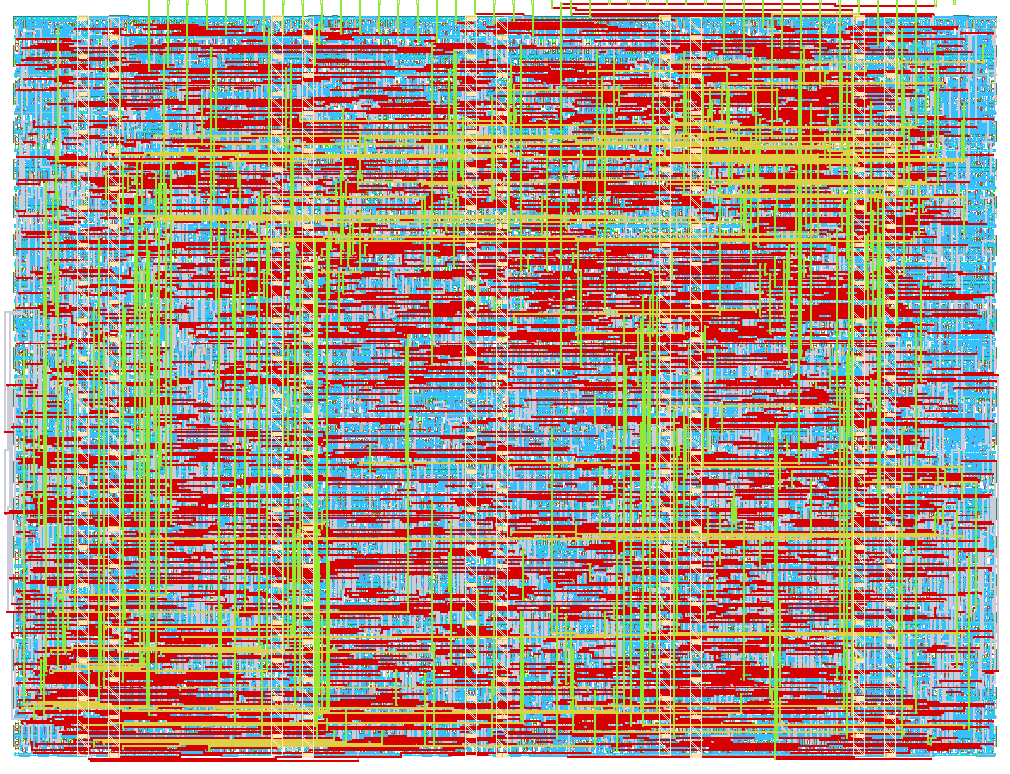
- Author: University of La Frontera
- Description: A small 8-bit CPU (5 general-purpose registers, ALU, conditional jumps) with a shared bus and byte-programmable memory
- GitHub repository
- Open in 3D viewer
- Open in Tiny Tapeout Explorer
- Clock: 0 Hz
How it works
An 8-bit SAP-style (Simple-As-Possible) CPU: one shared 8-bit bus, 5 general-purpose registers (A–E), an 8-operation ALU, conditional jumps, and 14 bytes of byte-addressable program/data memory (Von Neumann — program and data share the same address space).
Every instruction executes in up to 4 cycles:
- FETCH1 — reads the opcode from memory at the current program counter, and advances the program counter.
- FETCH2 — only for 2-byte instructions (loads, stores, jumps): reads the operand byte.
- EXECUTE — decodes the opcode and drives the ALU or control signals it needs.
- STORE — writes the result to memory or to a register, if the opcode produces one.
The instruction set covers memory load/store, all 8 ALU operations against the accumulator (register A), 7 conditional jump variants (zero/carry/negative/overflow and their inverses), input/output through the chip's pins, and halt. See the full opcode table in the repository README.
How to test
- Hold
rst_nlow for at least 2 clock cycles, then release it. - Flash a program: set
uio_in[0]high (program_mode), then for each byte of the program, setui_into that byte's value and pulseuio_in[1](program_wr) for one clock cycle. - Drop
program_modelow and pulserst_nagain so the program counter returns to0before execution starts. - Watch
uo_outfor results written by anOUTinstruction, or driveui_inwith the value an upcomingINinstruction should capture.
A minimal example program (LD A, LD B, ADD B, OUT A, HLT) loads two values from
memory, adds them, and outputs the sum. A working, fully-worked example driving these exact
steps through cocotb is in
test/test.py
in this repository, including load/store, conditional jumps, halt, and external I/O.
External hardware
None required. ui[0:7] and uo[0:7] are general-purpose 8-bit input/output buses driven
by the IN/OUT instructions — connect switches, LEDs, or any other digital I/O you like.
IO
| # | Input | Output | Bidirectional |
|---|---|---|---|
| 0 | external_input[0] | external_output[0] | program_mode |
| 1 | external_input[1] | external_output[1] | program_wr |
| 2 | external_input[2] | external_output[2] | |
| 3 | external_input[3] | external_output[3] | |
| 4 | external_input[4] | external_output[4] | |
| 5 | external_input[5] | external_output[5] | |
| 6 | external_input[6] | external_output[6] | |
| 7 | external_input[7] | external_output[7] |