513 Low-Power LFSR-Based Test Pattern Generator
513 : Low-Power LFSR-Based Test Pattern Generator
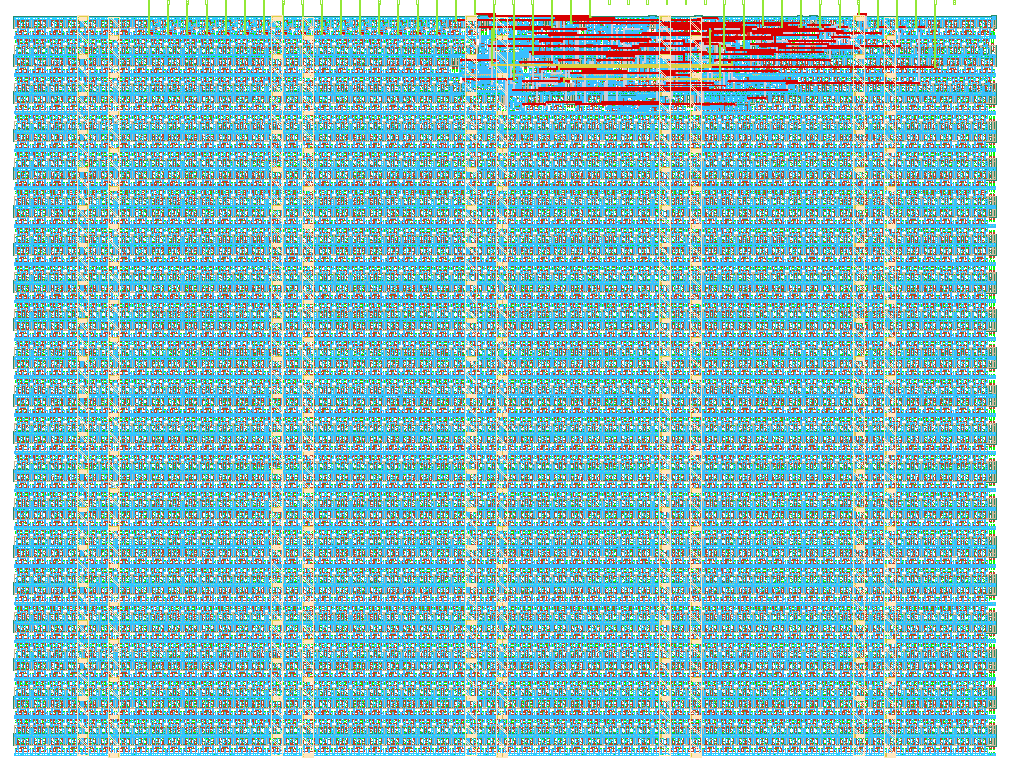
- Author: Umamaheswari Ramalingam
- Description: An 8-bit LFSR-based pseudo-random test pattern generator for VLSI testing.
- GitHub repository
- Open in 3D viewer
- Open in Tiny Tapeout Explorer
- Clock: 10000000 Hz
Low-Power LFSR-Based Test Pattern Generator
How it works
This project implements an 8-bit Linear Feedback Shift Register (LFSR) for pseudo-random test-pattern generation for VLSI testing.
The LFSR uses the polynomial:
x^8 + x^6 + x^5 + x^4 + 1
The 8-bit seed is provided through the dedicated input pins.
The control signals are:
uio_in[0]– Load seeduio_in[1]– Enable LFSR
When reset is asserted, the LFSR is initialized to a non-zero value. When LOAD_SEED is enabled, the input seed is loaded into the LFSR. When ENABLE is asserted, the LFSR advances by one state on every rising clock edge.
The generated pseudo-random test pattern is available at
uo_out[7:0].
The all-zero state is prevented because an LFSR would remain locked in the zero state.
How to test
- Apply reset.
- Provide a non-zero 8-bit seed through
ui_in[7:0]. - Assert
uio_in[0]to load the seed. - Deassert
uio_in[0]. - Assert
uio_in[1]to enable LFSR operation. - Apply clock pulses.
- Observe the pseudo-random sequence at
uo_out[7:0].
The project includes an automated Cocotb testbench that verifies reset, seed loading and multiple consecutive LFSR states.
External hardware
No external hardware is required for RTL verification.
For physical silicon testing, the generated output can be observed using the Tiny Tapeout demonstration PCB and suitable digital test equipment.
IO
| # | Input | Output | Bidirectional |
|---|---|---|---|
| 0 | Seed[0] | LFSR[0] | LOAD_SEED |
| 1 | Seed[1] | LFSR[1] | ENABLE |
| 2 | Seed[2] | LFSR[2] | |
| 3 | Seed[3] | LFSR[3] | |
| 4 | Seed[4] | LFSR[4] | |
| 5 | Seed[5] | LFSR[5] | |
| 6 | Seed[6] | LFSR[6] | |
| 7 | Seed[7] | LFSR[7] |