612 BOOTCAMP
612 : BOOTCAMP
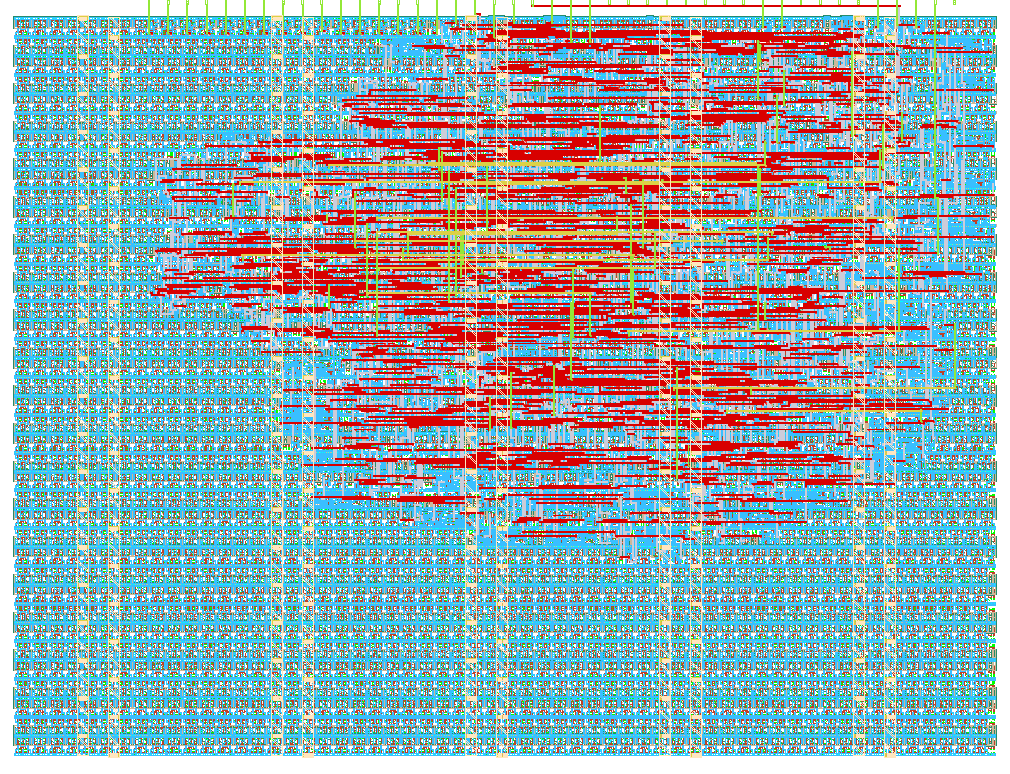
- Author: ELI
- Description: HATSUNE MIKU
- GitHub repository
- Open in 3D viewer
- Open in Tiny Tapeout Explorer
- Open in VGA Playground
- Clock: 25175000 Hz
How it works
This project implements a hardware-based VGA pattern generator that renders an animated Hatsune Miku visual motif at standard 640×480 @ 60 Hz resolution. The design operates purely in combinational and sequential digital logic without an external framebuffer, microprocessor, or video RAM.
Scanline & Timing Engine: Generates active-low horizontal sync (hsync) and vertical sync (vsync) pulses alongside horizontal (hpos, 0–799) and vertical (vpos, 0–524) pixel counters driven by a ~25.175 MHz pixel clock.
Character & Silhouette Renderer: Uses geometric bounding-box and coordinate decoders to draw Hatsune Miku's iconic aesthetic—featuring her signature twin-tails in teal/cyan (#39C5BB), dark gray/black silhouette framing, and magenta/pink hair-tie and accessory accents.
Animation & Rhythm Control: Utilizes a vertical sync frame strobe to cycle dance movements, swaying twin-tails, and bounce offsets synchronously with the display refresh rate.
Blanking Guard: Forces all color signals to black during horizontal and vertical blanking/porch intervals to maintain standard VESA voltage compliance.
Output Mapping: Formats the video stream into standard 6-bit color (2-bit Red, 2-bit Green, 2-bit Blue) along with sync pulses configured for the standard TinyVGA PMOD pinout.
How to test
- Browser Simulation (VGA Playground) You can test the design directly in your browser without hardware:
Navigate to https://vga-playground.com/?repo=https://github.com/<your-username>/<your-repo-name>
VGA Playground compiles the Verilog code using Verilator in WebAssembly and displays the real-time 60 Hz monitor output.
- Automated Simulation (cocotb) Run the test suite locally to verify pixel timing, reset behavior, and sync pulse polarity:
Bash cd test make To run gate-level netlist simulation against the synthesized standard cells:
Bash make GATES=yes 3. Silicon / Carrier Board Setup Plug a standard TinyVGA PMOD into the dedicated output header (uo_out).
Connect a VGA cable from the PMOD to a 640×480 @ 60 Hz capable monitor.
Supply a 25.175 MHz clock to the clk pin (25.0 MHz is also supported by most modern monitors).
Assert active-low reset (rst_n = 0), then release (rst_n = 1) to start the frame counters.
Select this design's address on the carrier board DIP switches to display Hatsune Miku on screen.
External hardware TinyVGA PMOD: 6-bit R2G2B2 resistor-ladder DAC providing analog RGB, HSYNC, and VSYNC outputs.
VGA Monitor: Standard display supporting 640×480 @ 60 Hz (31.468 kHz horizontal frequency).
VGA Cable: Standard 15-pin D-sub male-to-male cable.
Clock Source: 25.175 MHz oscillator or carrier board clock generator.
IO
| # | Input | Output | Bidirectional |
|---|---|---|---|
| 0 | R1 | ||
| 1 | G1 | ||
| 2 | B1 | ||
| 3 | VSync | ||
| 4 | R0 | ||
| 5 | G0 | ||
| 6 | B0 | ||
| 7 | HSync |