194 SPI-Configurable Watchdog Timer
194 : SPI-Configurable Watchdog Timer
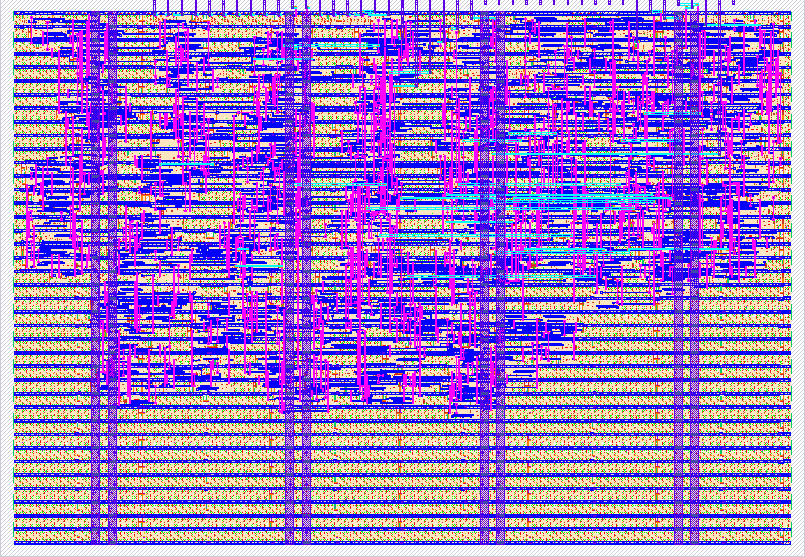
- Author: Jing-Jer Yen
- Description: A SPI-configurable watchdog timer implementation
- GitHub repository
- Open in 3D viewer
- Open in Tiny Tapeout Explorer
- Clock: 50000000 Hz
How it works
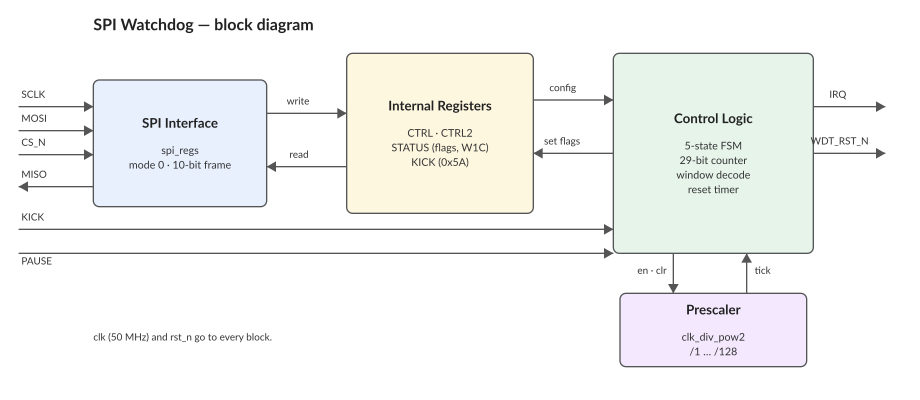
A watchdog timer for an external MCU, configured over SPI.
The MCU sets a timeout, then feeds ("kicks") the watchdog periodically, by an
SPI write or by a rising edge on a dedicated pin. If the kicks stop, the
watchdog raises IRQ as a warning. If the MCU still does not react, the
watchdog pulls the WDT_RST_N pin low to reset the MCU.
Main features:
- Eight timeouts from 5.24 ms to 5.37 s (at 50 MHz), and a prescaler that stretches them by up to 128x.
- Window mode: a kick that comes too early is treated as a fault. This catches firmware stuck in a loop that kicks faster than it should.
- Two-stage response: first an
IRQwarning with a 1.3 ms grace period, then a 10.5 ms active-low reset pulse. During the grace period the MCU gets one last chance to cancel the reset (see "Second chance" below). - After a watchdog reset, the MCU can read back why it was reset: the fault flags survive the reset pulse.
- A
LOCKbit freezes the configuration, so software cannot switch the watchdog off until the next hardware reset. - The FSM state is visible on three output pins, which makes silicon bring-up easier.
How to test
Interface
| Signal | Dir | Description |
|---|---|---|
ui_in[0] |
In | SCLK — SPI clock from the master |
ui_in[1] |
In | MOSI — SPI data in (master -> this chip) |
ui_in[2] |
In | CS_N — SPI chip select, active low |
ui_in[3] |
In | PAUSE — freeze the watchdog window while high |
ui_in[4] |
In | KICK — feed the dog on a rising edge |
ui_in[7:5] |
In | Unused |
uo_out[0] |
Out | MISO — SPI data out (this chip -> master) |
uo_out[1] |
Out | IRQ — fault interrupt, active high |
uo_out[2] |
Out | WDT_RST_N — reset output, active LOW. Idles high |
uo_out[5:3] |
Out | STATE — current FSM state, for debug (encoding below) |
uo_out[7:6] |
Out | Unused, driven low |
uio[7:0] |
— | Unused |
clk |
In | System clock. Timings below assume 50 MHz |
rst_n |
In | Active low synchronous reset |
rst_n clears everything: registers, counters, flags, MISO and IRQ.
WDT_RST_N idles high, also during and right after rst_n, so the MCU is
not reset by accident at power-up.
SPI frame
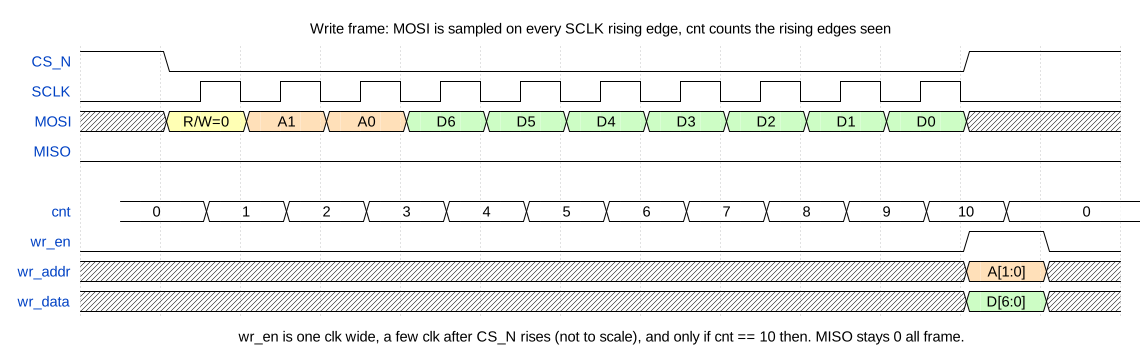
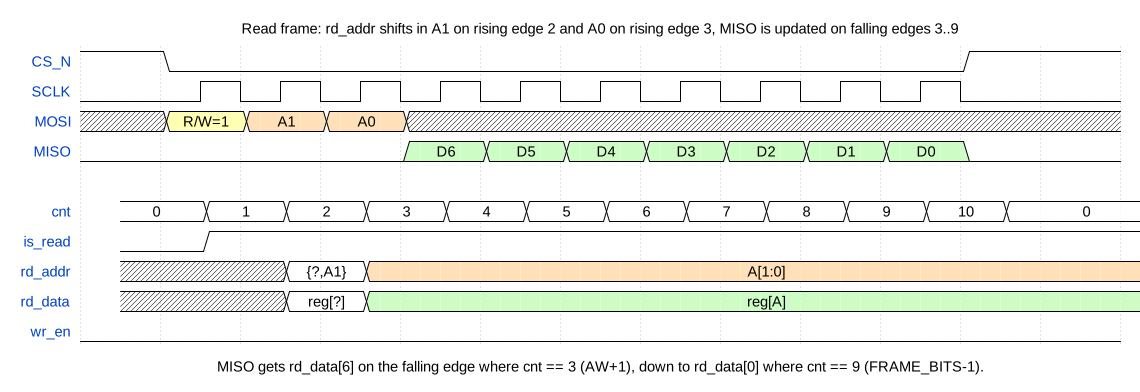
SPI mode 0 (CPOL=0, CPHA=0). MOSI is sampled on the rising edge of SCLK,
MISO changes on the falling edge. A frame is 10 bits, MSB first, and is only
valid while CS_N is low:
  bit   9    8  7    6  5  4  3  2  1  0
       [R/W][ ADDR ][       DATA       ]
R/W— 1 = read, 0 = writeADDR— 2-bit register addressDATA— 7 bits. On a write, the value to store. On a read, MOSI is ignored and the register value comes back on MISO in these 7 bit positions; MISO is 0 during theR/WandADDRbits.
SCLK is not used as a real clock. It is sampled by clk, so each SCLK
level must be held for at least two clk periods. Keep SCLK at or below
about clk / 4 (12 MHz at 50 MHz; 5–10 MHz is safer). CS_N must be stable
for a few clk periods before the first and after the last SCLK edge.
A frame takes effect only if exactly 10 bits were clocked in while CS_N
was low. Frames of any other length are discarded.
SPI register map
| Addr | Name | R/W | Description |
|---|---|---|---|
| 0 | CTRL |
RW | Enable, interrupt enable, timeout and window |
| 1 | KICK |
W | Write 0x5A to feed the dog. Other values ignored |
| 2 | STATUS |
R/W1C | Status flags, write 1 to clear |
| 3 | CTRL2 |
RW | Prescaler and reset enable |
KICK is write-only and reads back 0.
CTRL (addr 0)
| Bit | Name | Reset | Description |
|---|---|---|---|
| 0 | EN |
0 | 1 = watchdog armed. Writing 0 stops it at once |
| 1 | IRQ_EN |
0 | 1 = flags are allowed to drive the IRQ pin |
| 4:2 | TIMEOUT |
000 | Timeout selection, see table |
| 6:5 | WINDOW |
00 | Early-window selection, see table |
TIMEOUT |
Clocks | Timeout @ 50 MHz |
|---|---|---|
| 000 | 2^18 | 5.24 ms |
| 001 | 2^19 | 10.5 ms |
| 010 | 2^20 | 21.0 ms |
| 011 | 2^21 | 41.9 ms |
| 100 | 2^22 | 83.9 ms |
| 101 | 2^24 | 336 ms |
| 110 | 2^26 | 1.34 s |
| 111 | 2^28 | 5.37 s |
The low selections step by one exponent for fine control; the top three step
by two so the range reaches ~5 s. Every PRESCALER step doubles all times.
WINDOW sets how much of the start of each timeout window is the "early"
part. A KICK inside the early part is a fault.
WINDOW |
Early part | Meaning |
|---|---|---|
| 00 | None | Disabled: any KICK feeds the dog |
| 01 | First T/2 |
A KICK in the first half is early |
| 10 | First T/4 |
A KICK in the first quarter is early |
| 11 | First T/8 |
A KICK in the first eighth is early |
T is the timeout selected by TIMEOUT.
STATUS (addr 2)
| Bit | Name | R/W | Description |
|---|---|---|---|
| 0 | IRQ_FLAG |
W1C | A timeout happened |
| 1 | ARMED |
R | 1 = a window is running. Read-only |
| 2 | EARLY_FLAG |
W1C | A KICK arrived inside the early part |
Both flags are sticky: only a W1C write or rst_n clears them. A KICK
does not. Both drive the IRQ pin, so reading STATUS tells a timeout
apart from an early kick. The flags also survive the WDT_RST_N pulse, so
after a watchdog reset the MCU can read why it was reset.
CTRL2 (addr 3)
| Bit | Name | Reset | Description |
|---|---|---|---|
| 2:0 | PRESCALER |
000 | Window clock divider, /1 .. /128 (2^value) |
| 3 | RST_EN |
0 | 1 = a fault leads to a WDT_RST_N pulse |
| 4 | LOCK |
0 | 1 = freeze CTRL and CTRL2 until rst_n |
| 6:5 | — | 00 | Unimplemented, reads as 0 |
PRESCALER divides the clock that feeds the window counter, so it scales
every TIMEOUT setting by the same factor (up to 687 s at /128). It does
NOT change the grace period or the reset pulse width. With RST_EN = 0 the
watchdog is IRQ-only: a fault raises IRQ but never pulses WDT_RST_N.
LOCK turns this into a watchdog that software cannot switch off. Once
set, every write to CTRL and CTRL2 is ignored — including EN = 0 —
until the next rst_n. A fault still returns the FSM to IDLE with EN
still 1, so the next KICK re-arms the dog. LOCK only takes effect while
EN is already 1: a locked, disarmed watchdog could never be started
again, so such a write is refused. The W1C second chance (below) still
works while locked.
Watchdog behavior
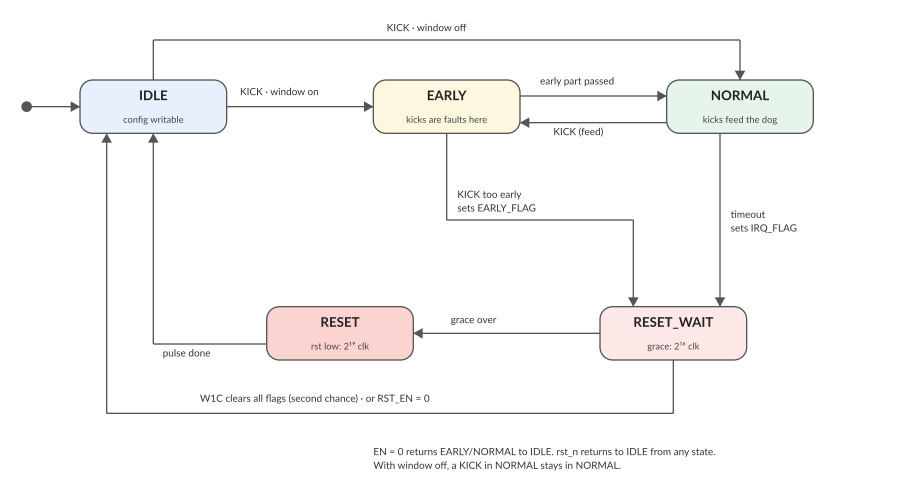
| State | Meaning | Length |
|---|---|---|
IDLE |
Not counting. Config is writable | until KICK with EN = 1 |
EARLY |
Window running, kicks are early here | first part of T (WINDOW) |
NORMAL |
Window running, kicks feed the dog | rest of T |
RESET_WAIT |
Fault declared, grace period | 2^16 clocks (1.31 ms) |
RESET |
WDT_RST_N driven low |
2^19 clocks (10.5 ms) |
Writing EN = 0 returns to IDLE at once from EARLY or NORMAL
(ignored while LOCK is set). rst_n returns to IDLE from any state,
including RESET.
The current state is visible on uo_out[5:3] (IDLE = 0, EARLY = 1,
NORMAL = 2, RESET_WAIT = 3, RESET = 4), so on real hardware a scope
on these pins shows where the machine is without any SPI traffic.
Kick
A KICK event is a rising edge on the KICK pin (synchronised, edge
detected) or an SPI write of 0x5A to the KICK register.
| State | Effect of KICK |
|---|---|
IDLE, EN = 1 |
Arms: starts a fresh window |
IDLE, EN = 0 |
Ignored |
EARLY |
Fault: sets EARLY_FLAG, goes to RESET_WAIT |
NORMAL |
Feeds: restarts the window (at EARLY if on) |
RESET_WAIT/RESET |
Ignored — a kick cannot cancel a declared fault |
The first KICK out of IDLE is never early. If KICK and the timeout
happen on the same clock, the KICK wins.
Fault path and the second chance
A fault (timeout, or early kick) raises the flag, asserts IRQ (if
IRQ_EN), and enters RESET_WAIT:

RESET_WAIT— a fixed grace period of 2^16 clocks (1.31 ms at 50 MHz).WDT_RST_Nis still high. During this time the MCU may cancel the reset by clearing all set flags with one W1C write toSTATUS(e.g. write0x05). If it does, the machine returns toIDLEand no reset happens. This must be a deliberate SPI write — aKICKdoes not work, so runaway code that still kicks cannot save itself. WithRST_EN= 0 the machine goes straight back toIDLE.RESET— if the grace period expires,WDT_RST_Ngoes low for 2^19 clocks (10.5 ms). This pulse cannot be stopped (only byrst_n). Then the machine returns toIDLE.
Both lengths are fixed in clk cycles: the prescaler and PAUSE have no
effect on them. To use the second chance, run with IRQ_EN = 1 and clear
the flags inside the IRQ handler.
After the fault the watchdog sits in IDLE disarmed-by-event: EN is
still 1, and the next KICK starts a fresh, full-length window.
Configuration locking
CTRL (except EN) and CTRL2 are writable only in IDLE. While a window
is running, a CTRL write updates EN alone, and a CTRL2 write is
discarded. To reconfigure: write EN = 0, write the new settings, write
EN = 1, then KICK.
With LOCK set, both registers are frozen entirely and reconfiguring is
impossible until rst_n. The intended arming sequence for a locked
watchdog is: write CTRL with the final settings and EN = 1, write
CTRL2 with the final settings and LOCK = 1, then KICK.
PAUSE
PAUSE (ui_in[3]) high freezes the window: the counter and the prescaler
hold their values, and continue where they stopped when PAUSE drops.
KICK still works during PAUSE (a feed clears the counter). PAUSE does
not stretch the grace period or the reset pulse, and SPI access is
unaffected.
External hardware
- Connect
WDT_RST_N(uo_out[2]) to the MCU's active-low reset input. - Connect
IRQ(uo_out[1]) to an MCU interrupt pin (optional, but needed for the second-chance cancel). - Connect the SPI pins and, optionally, a GPIO to
KICKfor pin-based feeding.
IO
| # | Input | Output | Bidirectional |
|---|---|---|---|
| 0 | SCLK | MISO | |
| 1 | MOSI | IRQ | |
| 2 | CS_N | WDT_RST_N | |
| 3 | PAUSE | STATE[0] | |
| 4 | KICK | STATE[1] | |
| 5 | STATE[2] | ||
| 6 | |||
| 7 |