771 snn_lif_neurons
771 : snn_lif_neurons
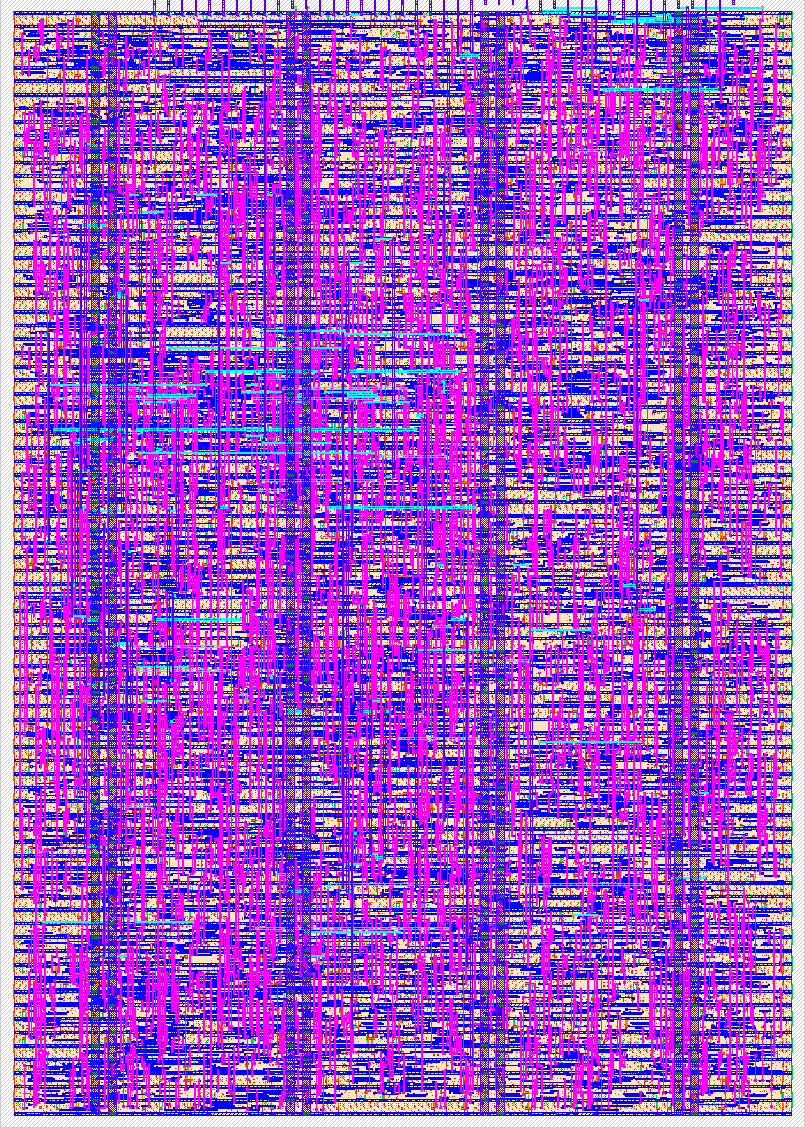
- Author: david
- Description: SNN heart-monitor classifier using banded LIF neurons
- GitHub repository
- Open in 3D viewer
- Open in Tiny Tapeout Explorer
- Clock: 50000000 Hz
Tiny Tapeout SNN Heart Monitor
Architecture: ARCHITECTURE.md ·
Component datasheet: DATASHEET.md ·
User manual (demoboard / HIL): USER_MANUAL.md ·
Companion ADC manual: ADC USER_MANUAL
(heart_monitor_adc_art_ttsky26c — fabrication companion)
How it works
This design is a compact spiking neural network (SNN) heart-beat classifier for Tiny Tapeout.
- A 12-bit ADC sample is presented on
ui_in[7:0]+uio_in[3:0]. - Pulsing
uio_in[4](sample_en) feeds the sample into:- Heartbeat_Segmenter — detects an R-peak (>= 2200) and opens a fixed evaluation window.
- Delta_Encoder — emits gentle vs steep up/down spikes plus direction-flip events.
- A 5-neuron Parallel_SNN_Matrix (one neuron per AAMI-style class) integrates those spikes with class-specific weights and leaks.
- MultiClass_SNN_Voter picks the winning class when the window ends.
- An alarm counter asserts
alarmonly after 3 consecutive anomaly classifications (classes 1, 2, or 4). Classes 0 (Normal) and 3 (Fusion) clear the streak.
| Class | Meaning | Typical stimulus |
|---|---|---|
| 0 | Normal | Gentle rising slope |
| 1 | Supra-ventricular | Gentle falling slope |
| 2 | Ventricular | Steep rising slope |
| 3 | Fusion | Steep falling slope |
| 4 | Unknown / noise | Zigzag / alternating edges |
How to test
From the test/ directory:
pip install -r requirements.txt
make -B
The cocotb suite checks:
- gentle rise → class 0
- steep rise → class 2
- zigzag → class 4
- alarm quiet for 2 ventricular beats, fires on the 3rd, clears on Normal
- MIT-BIH stream — plays
test/data/mitbih_100_excerpt.csvinto the ADC pins, requires severaldiag_validdetections, and logs a class histogram plus optional annotation agreement (informational; not a hard accuracy gate)
See test/data/README.md for PhysioNet citation and scaling.
On hardware / FPGA:
- Hold baseline ADC ~150.
- Drive an R-peak (>= 2200), then a morphology slope for ~100
sample_enpulses. - Read
uo_out[2:0]whenuo_out[3](diag_valid) pulses. - Observe
uo_out[4](alarm) after three consecutive anomaly beats.
External hardware
- Optional: external ADC or microcontroller streaming 12-bit samples into the pin-mapped ADC bus, with a sample strobe on
uio[4]. Setup and test: USER_MANUAL.md §4. - Optional: companion Tiny Tapeout SAR ADC
heart_monitor_adc_art_ttsky26c(12-bit ~500 SPS + decorative met4 art; electrically same as the pristine ADC); wire per itsdocs/INTEGRATION.md. - Optional: LED on
uo[4]for the anomaly alarm.
IO
| # | Input | Output | Bidirectional |
|---|---|---|---|
| 0 | adc[0] | class[0] | adc[8] |
| 1 | adc[1] | class[1] | adc[9] |
| 2 | adc[2] | class[2] | adc[10] |
| 3 | adc[3] | diag_valid | adc[11] |
| 4 | adc[4] | alarm | sample_en |
| 5 | adc[5] | ||
| 6 | adc[6] | ||
| 7 | adc[7] |