202 Montenegro SecureKey
202 : Montenegro SecureKey
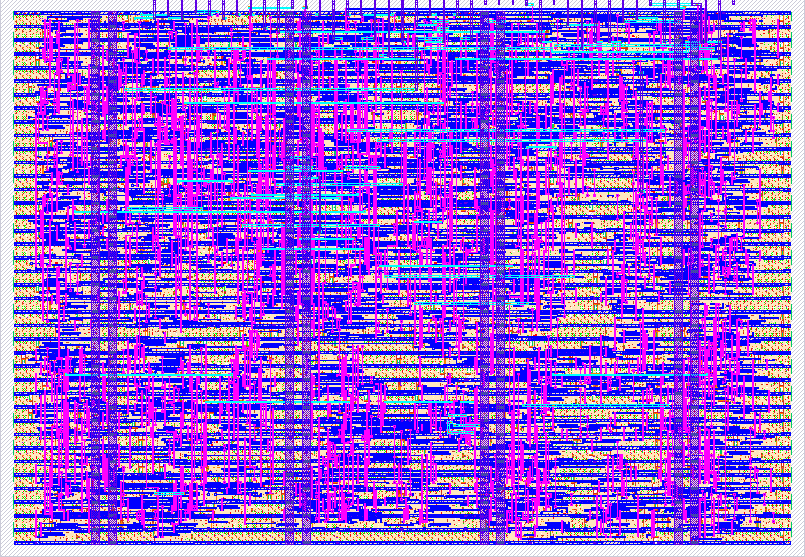
- Author: Armin
- Description: 64-bit challenge-response and Montenegro melody demo ASIC
- GitHub repository
- Open in 3D viewer
- Open in Tiny Tapeout Explorer
- Clock: 10000000 Hz
How it works
Montenegro SecureKey contains two independent synchronous engines.
The authentication engine receives a 64-bit challenge as eight bytes on
ui_in[7:0]. Bytes are loaded most-significant first by rising edges on
uio[0]. After exactly eight bytes, a rising edge on uio[1] starts a compact
keyed nonlinear feedback transform over 128 clocks. A fixed 32-bit device ID
and 64-bit key define its round schedule in the public RTL. uio[7] is high
during calculation. When finished,
uio[2] and uio[6] go high and the first response byte appears on
uo_out[7:0]. Further rising
edges on uio[0] advance through the remaining seven response bytes; one final
edge acknowledges byte 7 and clears uio[2].
The melody engine contains a 40-entry note/duration ROM with two opening
refrain phrases from Oj, svijetla majska zoro. It follows the published
F-major, 2/4 score at 80 BPM. A programmable
divider converts the nominal 10 MHz clock into articulated musical square waves
on uio[5]. uio[3] starts or restarts playback and uio[4] stops and mutes
it. Authentication and music can run concurrently.
This is an educational proof of concept. The public key and device ID are not
secrets or unique per die, and AUTH_OK only reports that a complete local
transaction was processed. The host must compare the response. The design is
not suitable as a production secure element.
How to test
Use a 10 MHz clock and hold rst_n low for at least two rising clock edges.
After releasing reset, verify uio_oe == 0xE4 and all status outputs are low.
For the published authentication vector, load the bytes 27 91 A2 18 44 73 10 CB in that order. Hold each byte on ui_in, pulse uio[0] high for one clock,
then pulse uio[1]. uio[7] must be high for the calculation. When uio[2]
goes high, read the first response byte and pulse uio[0] to advance each
following byte. The eight bytes must be 9E 16 92 66 A9 82 79 2B. Pulse
uio[0] once more after the last byte to clear uio[2].
To test the demo mode, pulse uio[3]. Observe a square wave on uio[5] with
an oscilloscope or through a properly buffered piezo driver. Pulse uio[4] and
verify that uio[5] immediately stays low. Do not attach a speaker or other
low-impedance load directly to the ASIC pin.
The automated Cocotb suite in test/test.py covers reset, I/O directions,
invalid frames, the known-answer vector, byte handshaking, and music start/stop.
Run it with cd test && make clean && make after installing Icarus Verilog and
the packages in test/requirements.txt.
External hardware
Authentication testing needs a controller or logic analyzer capable of driving the synchronous byte/control protocol. Audible playback needs a piezo element and an appropriate transistor/MOSFET driver stage; the Tiny Tapeout output pin must not supply the transducer current directly.
IO
| # | Input | Output | Bidirectional |
|---|---|---|---|
| 0 | DATA[0] - challenge byte bit 0 | RESPONSE[0] - response byte bit 0 | DATA_LOAD / RESPONSE_NEXT (input) |
| 1 | DATA[1] - challenge byte bit 1 | RESPONSE[1] - response byte bit 1 | AUTH_START (input) |
| 2 | DATA[2] - challenge byte bit 2 | RESPONSE[2] - response byte bit 2 | RESPONSE_VALID (output) |
| 3 | DATA[3] - challenge byte bit 3 | RESPONSE[3] - response byte bit 3 | MUSIC_START (input) |
| 4 | DATA[4] - challenge byte bit 4 | RESPONSE[4] - response byte bit 4 | MUSIC_STOP (input) |
| 5 | DATA[5] - challenge byte bit 5 | RESPONSE[5] - response byte bit 5 | AUDIO_OUT (output) |
| 6 | DATA[6] - challenge byte bit 6 | RESPONSE[6] - response byte bit 6 | AUTH_OK (output) |
| 7 | DATA[7] - challenge byte bit 7 | RESPONSE[7] - response byte bit 7 | AUTH_BUSY (output) |