289 LIF Neuron SNN
289 : LIF Neuron SNN
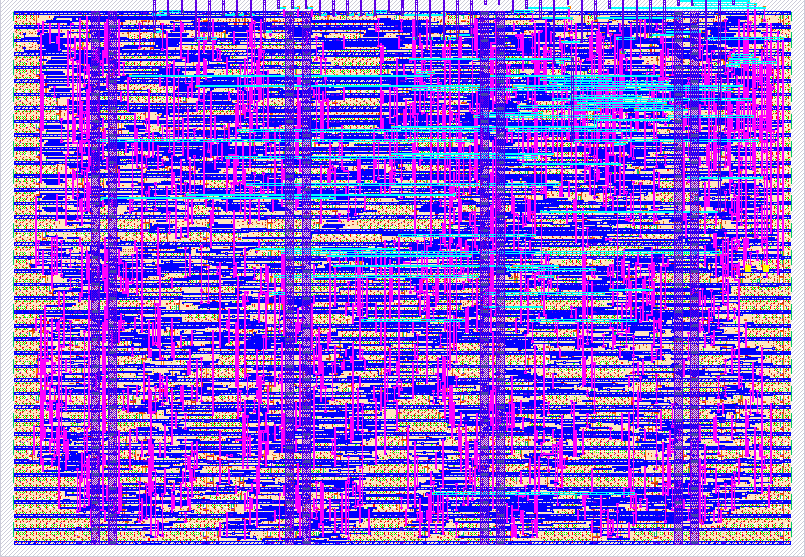
- Author: Virginia
- Description: Two neuron leaky integrate and fire SNN accelerator
- GitHub repository
- Open in 3D viewer
- Open in Tiny Tapeout Explorer
- Clock: 100000000 Hz
How it works
This LIF-Neuron are two neurons that coexsist on a single tile using spiking neural networking on a synchronus design as shown below.
<img src="FinalDesign4.png" alt="Final Design 4 architecture" width="600">
This is done by each neuron having its own hardware but with a shared input and weight data leading to ultimatly have its own spike.
This LIF-Neuron design uses a 8-bit ui_in bus for input data and the uio_in pins as control signals.
-
To load the lower 8 bits of the neuron input, place the value on
ui_in [7:0]and setuio_in [0]high for one clock cycle -
To load the upper 8 bits of the neuron input, place the value on
ui_in [7:0]and setuio_in [0]high for one clock cycle -
To write a weight, place the weight address on a
ui_in[7:4]and the 4 bit wight onui_in[3:0]. Setupuio_in[2]high to enable the write. -
To read a wight, place the read address on
ui_in[3:0]and setuio_in[3]high. -
To preform a neuron step, set
uio_in[4]high. This will send the stored 16-bit input to the LIF neuron core. -
Use
uio_in[5]to select the output neurons:0selects neuron 11selects neuron 2
the selected neurons output is provided on
uo_out:uo_out[3:0]= 4 bit membrane potentialuo_out[4]= spike outputuo_out[7:5]= unused and set to 0
- this design uses an active-low reset through
rst_n
How to test
This design is functionaly verified with Cocotb testbench that drives TinyTapeout pins and checks neuron outputs.
If a test passes you should see TEST=1 PASS=1 FAIL=0
External hardware
No external hardware is needed for this design.
IO
| # | Input | Output | Bidirectional |
|---|---|---|---|
| 0 | data[0] | v_mem_bit[0] | load_x_low |
| 1 | data[1] | v_mem_bit[1] | load_x_high |
| 2 | data[2] | v_mem_bit[2] | write_weight |
| 3 | data[3] | v_mem_bit[3] | read_weight |
| 4 | data[4] | step | |
| 5 | data[5] | neuron_select | |
| 6 | data[6] | ||
| 7 | data[7] |