802 MNIST Digit Recognition
802 : MNIST Digit Recognition
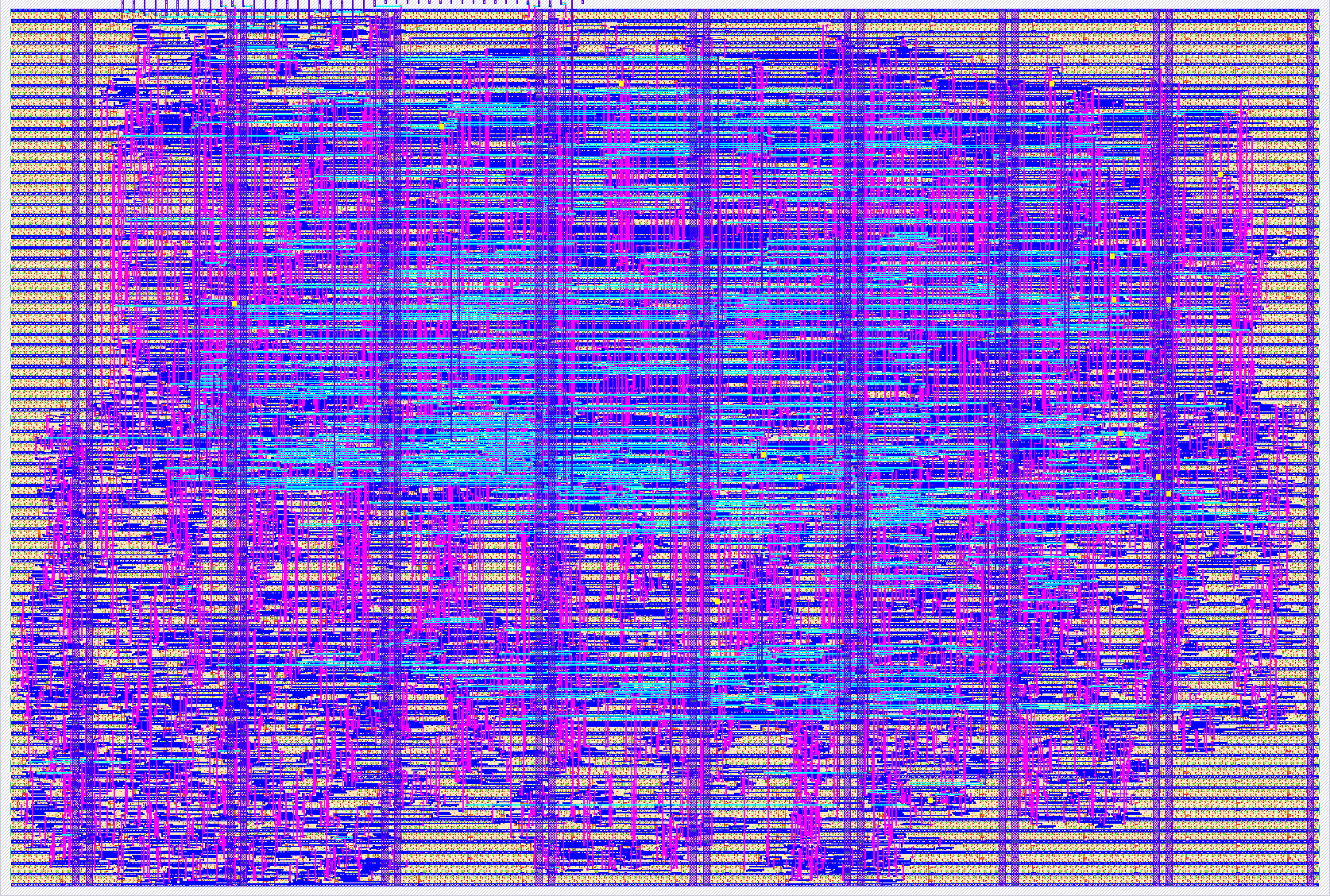
- Author: kenchangh
- Description: Self-contained MNIST digit classifier: ternary-weight MLP with all weights on-chip as hardwired constants
- GitHub repository
- Open in 3D viewer
- Open in Tiny Tapeout Explorer
- Clock: 10000000 Hz
How it works
This project is a fully self-contained MNIST handwritten-digit classifier. All neural-network weights live on-chip: they are ternary ({-1, 0, +1}) and are baked into the netlist as Verilog constants, so synthesis constant-folds them into plain logic — no RAM, no ROM macros, no weight loading.
The network is an MLP 64 -> 32 -> 10 with binary {0,1} hidden activations
(a linear 64 -> 10 and an MLP 64 -> 16 -> 10 are selectable at synthesis
time via the MLP / HIDDEN parameters). It was trained with
quantization-aware training (straight-through estimators for the ternary
weights and binary activations) on MNIST images that were average-pooled from
28×28 to 8×8 and binarized at a fixed threshold (0.15 of full scale).
Test-set accuracy of the exact integer model (10,000 images):
| Variant | Accuracy |
|---|---|
| MLP 64→32→10 (default, this submission) | 80.3 % |
| linear 64→10 | 78.3 % |
| MLP 64→16→10 | 76.0 % |
The default variant hardens to ~31 % utilization of a 2×2 tile (sky130A).
Operation is bit-serial and takes about 24 µs per digit at 10 MHz:
- Load — the host strobes START, then shifts 64 pixel bits in through
ui[0]/ui[1](pixel 0 = top-left, row-major, LSB first). The bits land in a 64-bit shift register. - Layer 1 — 64 cycles: the input register rotates; each pixel bit add/sub/skips into 16 parallel 8-bit accumulators (the 32-hidden-unit default runs two 16-lane passes). Biases are preloaded so the hidden activation is simply the accumulator sign bit.
- Layer 2 — hidden bits are binarized, then fed serially (one per cycle) into 10 class accumulators.
- Argmax — a 10-cycle sequential scan finds the best class (ties go to
the lower digit). DONE rises; the digit appears on
uio[3:0]and on the 7-segment display, with the decimal point lit.
Compute starts automatically after the 64th bit; DONE rises 172 clock cycles later (74 for the linear variant, 91 for the 16-hidden MLP). A new START strobe — or a hardware reset — cleanly abandons any load or result in progress.
How to test
Serial protocol on ui_in (all signals sampled on the rising edge of clk;
clk may run continuously, up to 10 MHz):
ui[0]DATA — pixel bitui[1]SHIFT_EN — when high, DATA is shifted in on this clock edgeui[2]START — one-cycle strobe: clear the bit counter, begin a new image
            ┌─┐ ┌─┐ ┌─┐ ┌─┐ ┌─┐ ┌─┐   ┌─┐ ┌─┐ ┌─┐ ┌─┐
clk       ──┘ └─┘ └─┘ └─┘ └─┘ └─┘ └───┘ └─┘ └─┘ └─┘ └──
            ┌───┐
START     ──┘   └───────────────────────────────────────
                    ┌───────────┐     ┌───┐        (64 bits total)
SHIFT_EN  ──────────┘           └─────┘   └─────────────
                    ╔═══╗╔══════╗     ╔═══╗
DATA      ──────────╣p0 ╠╣ p1   ╠─────╣p2 ╠─────────────
                    ╚═══╝╚══════╝     ╚═══╝
                     bit0  bit1        bit2  ... gaps are fine:
                                             DATA only sampled when SHIFT_EN=1
After the 64th bit the chip computes on its own; poll DONE (uio[4] or
uo[7]). DONE stays high, and the digit stays valid, until the next START.
              ... last bit          compute (~172 cycles)
SHIFT_EN  ────────┐┌──┐
                  └┘  └─────────────────────────────────
DONE      ──────────────────────────────┌───────────────
                                        └→ read uio[3:0]
Outputs:
uio[3:0]— predicted digit, binary 0–9 (uio pins are always outputs)uio[4]— DONE,uio[5]— BUSY (high while computing)uo[6:0]— 7-segment a–g (matches the TT demo board display),uo[7]— DONE / decimal point. The display is blank after reset until the first result.
Image preprocessing (host side): average-pool the 28×28 grayscale image to
8×8 (bin r spans rows ⌊r·28/8⌋ to ⌈(r+1)·28/8⌉−1, same for columns), then
set each pixel to 1 if its mean is greater than 0.15 (pixel range 0–1). Send
row-major, top-left pixel first. See demo/rp2040_demo.py in the project
repo for a ready-made MicroPython demo, and test/test.py for the cocotb
testbench that verified 200 MNIST images bit-exact against the training
pipeline.
To reproduce training / regenerate weights: train/train.py (PyTorch QAT)
then train/gen_weights.py (emits src/weights.v).
External hardware
None required — the on-board 7-segment display shows the digit. Drive the
inputs from the TT demo board's RP2040 (see demo/rp2040_demo.py) or any
microcontroller.
IO
| # | Input | Output | Bidirectional |
|---|---|---|---|
| 0 | DATA (serial pixel bit) | SEG_A | DIGIT[0] (output) |
| 1 | SHIFT_EN (sample DATA on rising clk) | SEG_B | DIGIT[1] (output) |
| 2 | START (begin new image) | SEG_C | DIGIT[2] (output) |
| 3 | SEG_D | DIGIT[3] (output) | |
| 4 | SEG_E | DONE (output) | |
| 5 | SEG_F | BUSY (output) | |
| 6 | SEG_G | ||
| 7 | DONE (7-seg decimal point) |