206 Hardware Audio Tempo Detector
206 : Hardware Audio Tempo Detector
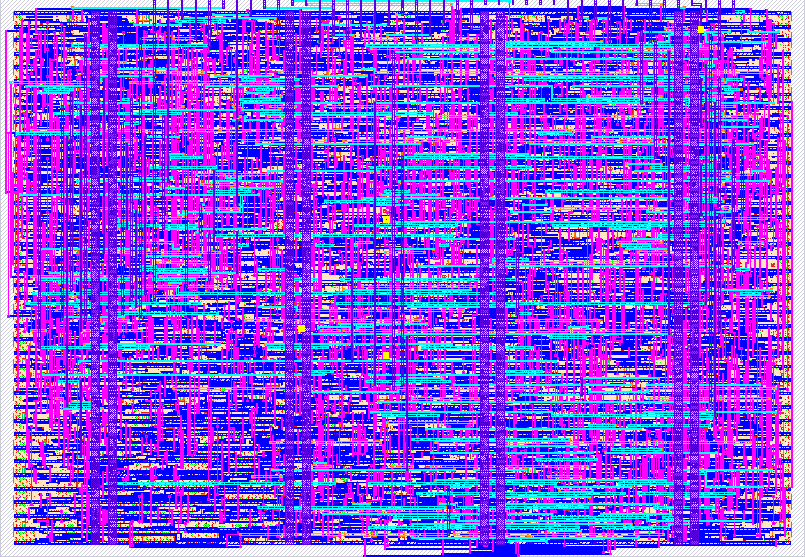
- Author: Taiwo Opesade
- Description: Detects the tempo (BPM) of a live audio stream entirely in hardware, using onset detection and a bit-serial divider - no CPU, no multiplier.
- GitHub repository
- Open in 3D viewer
- Open in Tiny Tapeout Explorer
- Clock: 50000000 Hz
Hardware Audio Tempo Detector — Interface
How it works
The chip receives a stream of 8-bit unsigned audio amplitude samples (one
per sample_valid pulse) and outputs a live BPM estimate, entirely in
hardware:
-
Onset Detector — tracks a slow-moving envelope of the signal using a shift-based single-pole IIR filter (no multiplier: the envelope moves 1/16th of the way toward each new sample). A "beat onset" is flagged the instant a sample jumps more than
ONSET_THRESHOLD(20) above that envelope. A 5-sample refractory window stops one loud beat from being counted more than once. -
Interval Counter — counts samples between consecutive onsets. If no onset arrives for 1023 samples, the counter saturates and raises
overflow_flaginstead of wrapping (silence / very slow tempo). -
Tempo Estimator — keeps the last 4 measured intervals in a shift register. Once 4 are collected, it averages them (a free
>> 2, since 4 is a power of two) and checks how far apart the max and min are: tightly clustered intervals raiseconfidenceandtempo_locked; scattered ones don't. An interval close to the 1023-sample ceiling (a long gap) is treated as "song changed" and discards the history rather than corrupting the average. -
BPM Divider — converts the averaged interval into BPM using
bpm = 6000 / interval_samples(equivalent to60 * assumed 100 Hz sample rate / interval), via a small bit-serial restoring divider — 13 cycles, one dividend bit consumed per cycle, no combinational divider needed. -
Result Latch — registers every output on the clock so pin values are always glitch-free;
bpm_estimateonly updates when the divider finishes.
All logic is either combinational comparators/adders or simple registered counters and shift registers — the only iterative element is the small 13-cycle divider.
Pin mapping
| Pin | Direction | Signal | Description |
|---|---|---|---|
ui_in[7:0] |
in | audio_sample |
Streaming unsigned 8-bit amplitude sample |
uio_in[0] |
in | sample_valid |
Strobe: a new audio_sample is present this cycle |
uio_in[1] |
in | frame_reset |
Restart tempo tracking (new track/song) |
uio_in[7:2] |
in | — | Unused, tri-stated |
uo_out[7:0] |
out | bpm_estimate |
Latched BPM estimate (0-255, clamped) |
uio_out[2] |
out | beat_pulse |
One-cycle pulse on each detected beat |
uio_out[3] |
out | tempo_locked |
High once recent intervals are stable |
uio_out[4] |
out | onset_active |
Raw pre-refractory onset flag (debug/scope) |
uio_out[5] |
out | overflow_flag |
No beat seen for a long time (silence) |
uio_out[7:6] |
out | confidence[1:0] |
2-bit stability score, 11 = tightest lock |
Assumptions & limits
- Assumes audio amplitude samples arrive at roughly 100 Hz (a
pre-processing stage — see INTEGRATION.md — should
decimate/rectify raw audio down to this envelope rate before feeding
it in). Changing the sample rate requires resynthesizing with a new
NUMERATORinbpm_divider— see CALIBRATION.md. - Single dominant tempo per stream — polyrhythms or overlapping tracks will confuse the interval history.
bpm_estimateis clamped to 255; anything faster than that (a false double-trigger, for example) reads as 255 rather than wrapping.ONSET_THRESHOLDandREFRACTORY_CYCLESare synthesis-time parameters, not runtime-tunable — see the calibration guide.
IO
| # | Input | Output | Bidirectional |
|---|---|---|---|
| 0 | audio_sample[0] - streaming amplitude sample bit 0 (LSB) | bpm_estimate[0] - latched BPM estimate, bit 0 (LSB) | sample_valid - strobe: a new audio_sample is present this cycle |
| 1 | audio_sample[1] | bpm_estimate[1] | frame_reset - restart tempo tracking (new track/song) |
| 2 | audio_sample[2] | bpm_estimate[2] | beat_pulse - one-cycle pulse on each detected beat onset |
| 3 | audio_sample[3] | bpm_estimate[3] | tempo_locked - high once recent intervals are stable |
| 4 | audio_sample[4] | bpm_estimate[4] | onset_active - raw pre-refractory onset flag (debug) |
| 5 | audio_sample[5] | bpm_estimate[5] | overflow_flag - no beat seen recently (silence / very slow) |
| 6 | audio_sample[6] | bpm_estimate[6] | confidence[0] - stability score, bit 0 (2'b11 = tightest lock) |
| 7 | audio_sample[7] - streaming amplitude sample bit 7 (MSB) | bpm_estimate[7] - latched BPM estimate, bit 7 (MSB) | confidence[1] - stability score, bit 1 |