299 OLAF-8: Bounded-Memory Online Adaptive Fuzzy Inference
299 : OLAF-8: Bounded-Memory Online Adaptive Fuzzy Inference
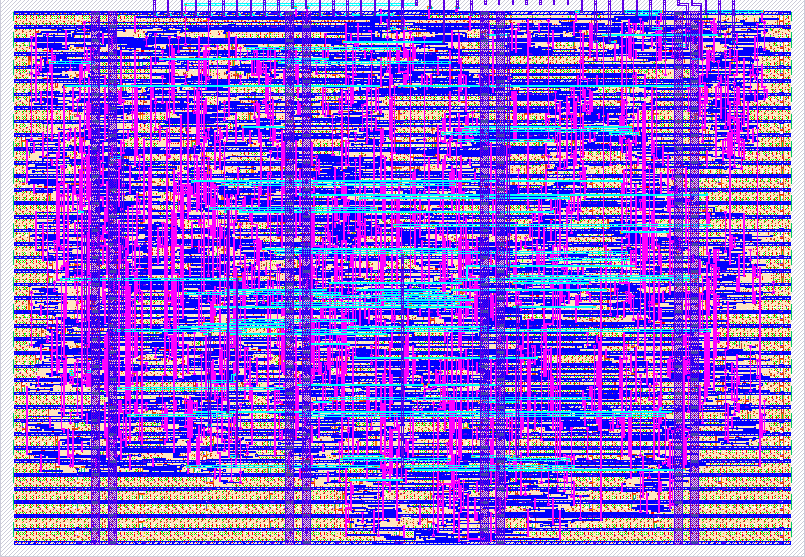
- Author: Mohammed Sharfuddin, Priya Asuti, Shylashree N, RV College of Engineering
- Description: An 8-rule digital fuzzy inference engine with bounded online rule admission and replacement.
- GitHub repository
- Open in 3D viewer
- Open in Tiny Tapeout Explorer
- Clock: 10000000 Hz
Credits
We gratefully acknowledge the Center of Excellence (CoE) in Integrated Circuits and Systems (ICAS) and the Department of Electronics and Communication Engineering (ECE) for providing the necessary resources and guidance. Special thanks to Dr. H V Ravish Aradhya (HoD- ECE), Dr. K R Usha Rani (Associate Dean-PG), Dr. K. S. Geetha (Vice Principal) and Dr. K. N. Subramanya (Principal) for their constant encouragement and support in facilitating this Tiny Tapeout SKY26C submission.
OLAF-8: Bounded-Memory Online Adaptive Fuzzy Inference
Project Overview
OLAF-8 is a compact fully digital fuzzy inference engine designed to demonstrate online-adaptive fuzzy reasoning within a strictly bounded hardware memory.
The architecture processes two 4-bit input values and evaluates them using fuzzy membership functions and an eight-entry rule memory. Unlike a conventional fixed-rule fuzzy inference system, OLAF-8 can dynamically modify its rule memory during operation. When the current input is insufficiently represented by the stored rules, the architecture identifies a low-utility rule and replaces it with a rule derived from the current input.
The design combines:
- 4-bit dual-input fuzzy processing
- LOW, MID and HIGH membership regions
- Eight-entry bounded fuzzy rule memory
- Sequential rule evaluation
- MIN-based rule firing strength
- Weighted fuzzy accumulation
- Iterative digital division for defuzzification
- Maximum firing-strength tracking
- Utility-based rule selection
- Online rule admission and replacement
The key design concept is bounded online adaptation: the system can update its fuzzy knowledge during operation while maintaining a fixed eight-rule hardware memory. This avoids the need for an external processor or complete hardware reconfiguration for adapting the rule set.
OLAF-8 is implemented entirely in the digital domain and is intended as a compact research demonstrator for exploring adaptive fuzzy inference under strict hardware resource constraints suitable for Tiny Tapeout.
How it works
OLAF-8 is a compact fully digital fuzzy inference engine with an 8-rule bounded rule memory and online rule admission.
The design accepts two 4-bit input values, x1 and x2.
For each input transaction:
- The input values are captured.
- Membership degrees for LOW, MID and HIGH fuzzy regions are calculated.
- The eight stored fuzzy rules are evaluated sequentially.
- Each rule firing strength is calculated using the MIN operation.
- The weighted fuzzy output is accumulated.
- The maximum rule firing strength is tracked.
- An iterative divider calculates the defuzzified output.
- If the maximum firing strength is below the admission threshold, the least-utility rule is replaced with a rule derived from the current input.
- Otherwise, the winning rule utility is increased.
The rule memory is permanently bounded to eight entries. This allows online adaptation without requiring an external processor or reconfiguration.
The design is intended as a fully digital Tiny Tapeout research demonstrator.
How to test
The OLAF-8 interface uses the standard Tiny Tapeout pins.
Inputs
ui_in[7:4]- 4-bit inputx1ui_in[3:0]- 4-bit inputx2uio_in[0]- Start signal
Outputs
uo_out[3:0]- 4-bit fuzzy outputuo_out[4]- Done pulseuo_out[5]- Rule admission/replacement indicatoruo_out[6]- Busy indicatoruo_out[7]- Reserved
To execute a transaction:
- Wait until
busyis low. - Apply the desired 4-bit
x1andx2values. - Generate a one-clock pulse on
uio_in[0]. - Wait until
uo_out[4]becomes high. - Read the fuzzy output from
uo_out[3:0]. - Check
uo_out[5]to determine whether online rule admission occurred.
The design uses sequential rule evaluation and iterative arithmetic, so the output is generated after multiple clock cycles rather than immediately.
External hardware
No external hardware is required.
OLAF-8 is a fully digital design and is intended to operate using the standard Tiny Tapeout clock, reset, input and output interfaces.
IO
| # | Input | Output | Bidirectional |
|---|---|---|---|
| 0 | x2[0] | fuzzy_y[0] | start |
| 1 | x2[1] | fuzzy_y[1] | |
| 2 | x2[2] | fuzzy_y[2] | |
| 3 | x2[3] | fuzzy_y[3] | |
| 4 | x1[0] | done | |
| 5 | x1[1] | rule_admitted | |
| 6 | x1[2] | busy | |
| 7 | x1[3] | reserved |