652 4-bit Up/Down Counter
652 : 4-bit Up/Down Counter
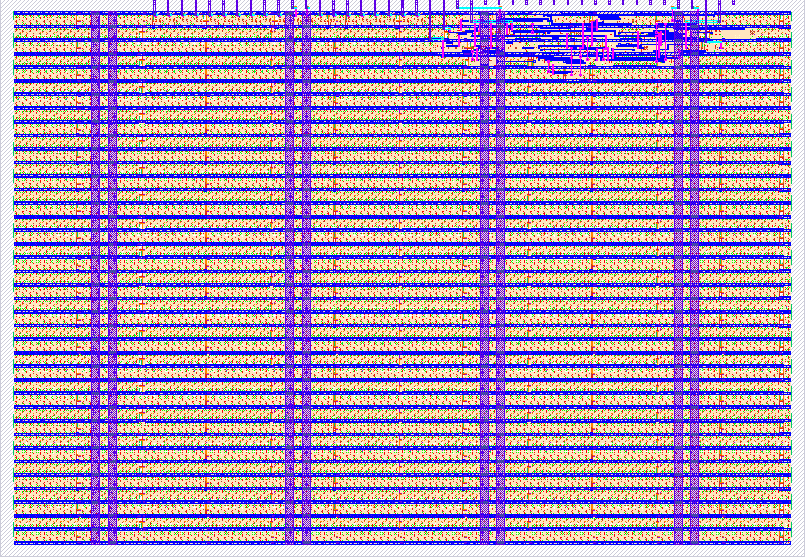
- Author: Abdulla Alaqili
- Description: A synchronous 4-bit up/down counter. ui_in[0] sets direction, ui_in[1] enables counting, rst_n clears the count to zero.
- GitHub repository
- Open in 3D viewer
- Open in Tiny Tapeout Explorer
- Clock: 1000000 Hz
How it works
This is a 4-bit synchronous up/down counter built around a single always block driving a 4-bit register. ui_in[1] is the count enable: when high, the counter advances on every clock edge; when low, the count holds its current value. ui_in[0] sets the direction: high counts up, low counts down. The count wraps at both ends (15 down to 0 wraps to 15, and 15 up wraps to 0, standard unsigned 4-bit rollover). rst_n is an active-low synchronous reset that clears the count to zero on the next clock edge. The 4-bit count value is driven straight out on uo_out[3:0], with uo_out[7:4] tied to zero. This was built as a first Tiny Tapeout submission, keeping the design intentionally simple to maximize the odds of a clean first tapeout.
How to test
Hold rst_n low for a few clock cycles to reset the counter to 0. Set ui_in[1] high to enable counting, and ui_in[0] high to count up or low to count down. Watch uo_out[3:0] increment or decrement by one on every clock cycle. Set ui_in[1] low at any time to freeze the count at its current value, then raise it again to resume from where it left off. A cocotb testbench covering reset, count up, hold, count down, underflow wraparound, and a second reset is included in test/test.py.
External hardware
None required. uo_out[3:0] can optionally be watched on LEDs or a logic analyzer connected to the demo board's output pins.
IO
| # | Input | Output | Bidirectional |
|---|---|---|---|
| 0 | direction (1=up, 0=down) | count[0] | |
| 1 | count_en (1=count, 0=hold) | count[1] | |
| 2 | count[2] | ||
| 3 | count[3] | ||
| 4 | |||
| 5 | |||
| 6 | |||
| 7 |