495 FP4 Sparse Mini-TPU

495 : FP4 Sparse Mini-TPU
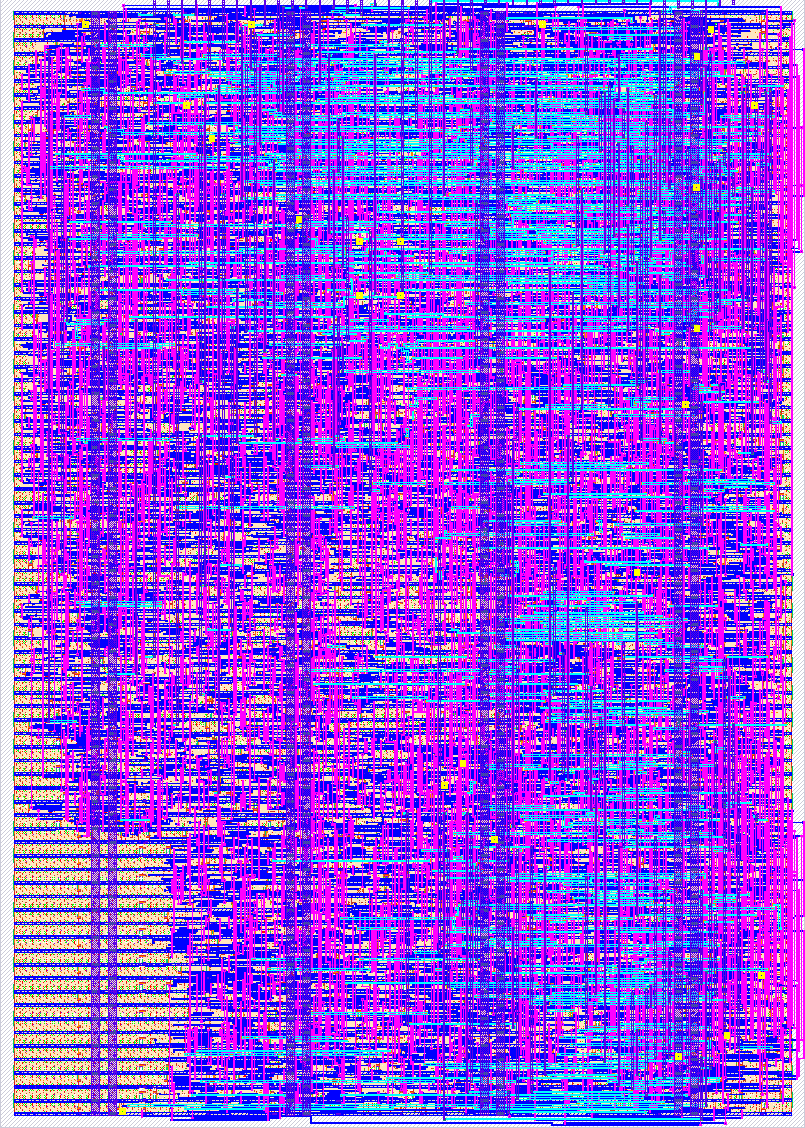
Design render
  • Author: Kashif Rasul
  • Description: One time-multiplexed PE computes a 3x3 output tile with 1:2-sparse E2M1 weights and INT8 activations, without a hardware multiplier. Dense E2M1-weight mode runs at half the sparse contraction rate; NVFP4/MXFP4 weight payloads require host-side activation quantization and scale handling.
  • GitHub repository
  • Open in 3D viewer
  • Open in Tiny Tapeout Explorer
  • Clock: 10000000 Hz

How it works

A mini TPU that computes C = A x W with INT8 activations and 1:2 structurally sparse E2M1 weights — the 4-bit floating-point element type shared by NVFP4 (NVIDIA Blackwell) and MXFP4. It combines the two numerics levers from Roune's AI-chip design argument in one datapath: structured sparsity along the contraction axis and a 4-bit float element — with higher-precision INT8 activations, the side that is hardest to quantize.

The math runs on one time-multiplexed processing element, not a spatial array: a SPI-driven design is completely SPI-bound (the 36 operand instructions require at least 3456 clk cycles at SCLK <= clk/6), so a RUN's compute latency is practically free no matter how many outputs share one PE. The original 3x3 systolic array spent 58% of its flip-flops and most of its combinational logic on 9-way spatial parallelism that bought nothing; serializing to one PE — reused across all 9 outputs, ~45 cycles per RUN, still about 1.3% of the SPI load time — cut chip area ~47% and dropped the design from a 2x2 to a 1x2 tile.

There is no hardware multiplier anywhere: every E2M1 magnitude (0, 1, 2, 3, 4, 6, 8, 12 in the x2 integer domain) is (1 or 3) << shift, so a product is one conditional add (the 3x), one shift, and one conditional negate:

prod = ± (act [+ act << 1]) << shift

The sparse weight format

Each 5-bit weight code {select, e2m1[3:0]} covers two consecutive contraction steps (k = 2j and k = 2j+1): the E2M1 value sits at k = 2j + select, the other position is zero — 1:2 structured sparsity, the 1:2 analog of NVIDIA's 2:4. The select bit muxes which INT8 activation of a pair enters the shift-add, so an 8-bit mux does the work of a second "multiplier" and every cycle advances two contraction steps: an 8-deep dot product in the time a dense array does 4, with weights stored at 2.5 bits per dense position. Two sparse RUNs cover exactly one NVFP4 16-element block (four cover an MXFP4 32-block), so host-side block scaling aligns with no padding.

Results are exact 14-bit signed integers (max |C| = 6144). Block scaling happens on the host during dequantization: scale each block's partial sum before adding it to other blocks, C = sum_b((D_b / 2) * partial_b). This makes the chip element-level format-agnostic: apply E4M3 scales per 16-element block (+ FP32 tensor scale) for NVFP4 semantics, or E8M0 power-of-two scales per 32-element block for MXFP4. The exact accumulators let the host apply per-block scales (including four-over-six adaptive scaling and per-token activation scales) to bit-exact partial sums.

Second mode: dense E2M1 x INT8

The RUN instruction's d flag switches to dense operation: each code's E2M1 nibble is a weight for ONE contraction step (K = 4, half throughput, select bit ignored, only even activation elements participate) — the same trade NVIDIA makes running dense on 2:4-sparse tensor cores. This is plain dense FP4-weight x INT8-activation matmul. E2M1 checkpoint weights can be streamed after the host quantizes activations to INT8 and handles all block and tensor scales; it is not native FP4-activation execution.

SPI protocol follows the proven reference mini-TPU (MILOUDIAS/IEEE_ttsky_mini_tpu_spi), which this chip's original 3x3 array also ported its systolic control from; a (row, col, step) sequencer replaced the skewed wavefront when the array serialized to one PE (see REPORT.md). Both operand streams still change every RUN step (real dot products, not a shortcut). Activation functions are host-side: they are only correct after cross-tile partial-sum accumulation and bias, which happen on the host anyway.

Instruction set (16 bits, sent LSB-first over SPI)

Instruction Format (binary) Description
LOAD A 10 0 rr eee aaaaaaaa INT8 activation byte a into row r (0-2), element e (0-7)
LOAD B 10 1 cc 0jj 000swwww Weight code {select s, E2M1 w} into column c (0-2), pair slot j (0-3)
RUN 01 d 0000000000000 Clear accumulators, run all 9 outputs on one PE (~45 cycles); d=0 sparse (K=8), d=1 dense E2M1 (K=4)
STORE 11 b rr cc 000000000 Drive byte b (0 = acc[7:0], 1 = acc[13:8]) of C[r][c] on uo_out

The system clock is 10 MHz and SCLK must be at most clk/6 (about 1.67 MHz). MOSI, CS, and SCLK pass through synchronizers and the receiver runs entirely in the system-clock domain; raw SCLK is not an internal clock. Keep CS high for at least four system-clock cycles between frames. The ready pin (uio[1]) stays high when a RUN completes and clears when the next RUN is accepted, so a polling host cannot miss it. Instructions received while RUN is busy are ignored. Alternatively, wait ~45+ clock cycles. The SPI is receive-only: all results are read via STORE on uo_out, from a small result memory that holds all 9 outputs until the next RUN overwrites them (the same "any output, any time" contract the old per-PE accumulators offered).

E2M1 weight encoding (element type of NVFP4 and MXFP4)

Code Value x2 integer Code Value x2 integer
0000 +0.0 0 1000 -0.0 0
0001 +0.5 1 1001 -0.5 -1
0010 +1.0 2 1010 -1.0 -2
0011 +1.5 3 1011 -1.5 -3
0100 +2.0 4 1100 -2.0 -4
0101 +3.0 6 1101 -3.0 -6
0110 +4.0 8 1110 -4.0 -8
0111 +6.0 12 1111 -6.0 -12

How to test

Run the cocotb testbench:

cd test
make -B

The suite drives the SPI interface exactly like an external host and checks the full C = A x W result against an independent golden model (E2M1 and sparse-code decode from first principles, then a plain matrix multiply). It includes select-bit routing, both modes with per-RUN mode latching, negative-zero handling, a non-degeneracy test (equal-sum activation matrices must produce different results), exact accumulator limits, accumulator-clear checks, every partial SPI-frame length, reset mid-frame, maximum-rate SPI, sticky ready, and randomized full-coverage trials. An exhaustive PE test covers all 16,384 input/mode combinations. It also checks that partial sums from blocks with different scales are dequantized before being combined.

External hardware

None required. Any SPI-capable host (e.g. the demo board's RP2040) drives MOSI/CS/SCLK and reads result bytes on uo_out. Operand memories do not reset to save area, so the host must load every operand used before the first RUN.

IO

#InputOutputBidirectional
0SPI MOSIresult bit 0
1SPI CS (active low)result bit 1ready (sticky until next RUN)
2SPI SCLKresult bit 2
3result bit 3
4result bit 4
5result bit 5
6result bit 6
7result bit 7

Chip location

Controller Mux Mux Mux Mux Mux Mux Mux Mux Mux Mux Analog Mux Mux Mux Mux Mux Mux Mux Mux Mux Mux Analog Mux Mux Mux Mux Mux Mux Mux Mux Mux Mux tt_um_chip_rom (Chip ROM) tt_um_factory_test (Tiny Tapeout Factory Test) tt_um_teuscher_eml_fabric (EML Fabric — analog exp/ln compute cells) tt_um_wokwi_465656663515438081 (Convert binary to hex on 7 segments) tt_um_nikita_face_detect (FPGA Face Detection) tt_um_obstacle_avoider (Obstacle Avoider State Machine) tt_um_poket_animal (Poket Animal) tt_um_drewbabel_uart (Configurable FIFO-buffered UART with APB CSR) tt_um_wokwi_469163916296039425 (TT Workshop Test) tt_um_jonahsaunders_slsvga (tt_um_jonahsaunders_slsvga) tt_um_fatigue_monitor (Fatigue Monitor (PPG Pulse-Interval Variability)) tt_um_vedam_dual_port_ram (Dual Port RAM) tt_um_wokwi_469739097665887233 (Tiny Tapeout Template Copy) tt_um_spdif_to_i2s_kilpelaj (S/PDIF to I2S receiver) tt_um_morse_converter (ASCII to Morse Code Converter) tt_um_wokwi_469806914724000769 (Spin, Text and VGA) tt_um_wokwi_469701770572338177 (TinyTapeout) tt_um_garnetkoebel_communotron (Communotron) tt_um_wokwi_469449970323169281 (full adder) tt_um_duzabf_2026_ow (A WIP Online Workshop 2026 project) tt_um_wokwi_469807513638180865 (Tiny Tapeout NAK) tt_um_ttsky26c_oguz (ttsky26c-202607-mehmetoguzderin by Oguz) tt_um_kashif_fp4_sparse_tpu (FP4 Sparse Mini-TPU) tt_um_moein_maleki_arm16 (arm16) tt_um_wokwi_469453454643027969 (ON Check System) tt_um_felixcheng_neural_core (Neural Compute Core (V0.15)) tt_um_wokwi_469788774011248641 (Spin Display - select-reset-reverse) tt_um_wokwi_469449443070765057 (Samuel's first chip) tt_um_wokwi_469449007236383745 (testinttrsv01) tt_um_vga_ca (VGA cellular Automaton) tt_um_dosci_500hz (Digital Oscillator 500 Hz) tt_um_wokwi_469747443569078273 (XOR test project - Tiny Tapeout workshop) tt_um_wokwi_469585758593419265 (spinner) tt_um_fp16_mac (FP32 Math Unit) tt_um_1DC_vga_dyoa (VGA Design Your Own ASIC) tt_um_haydenevans_top (Systolic Processing Element) tt_um_wokwi_469806252715961345 (TT_Proj_SA) tt_um_wokwi_469448996577604609 (Tiny Tapeout - Reto) tt_um_ehofmannbr_pmodvga_06 (VGA Color Tiles) tt_um_lfglabs_lsc1u (leanSilicon LSC-1 Micro arithmetic kernel) tt_um_wokwi_469804280240495617 (Zetterling SRAM) tt_um_wokwi_469806066852696065 (TileTestchase) tt_um_wokwi_469449118072978433 (binary_add_v1) tt_um_voltage_amplifier_neuron (Voltage Amplfier Neuron) tt_um_wokwi_469449686545956865 (Tiny Tapeout Template Copy_JinoShiono) tt_um_wokwi_469448887171240961 (Tiny Tapeout - Mini CORDIC) tt_um_wokwi_469809033878555649 (Tiny Tapeout Yummy Chip - bgianfo) tt_um_sirajmuhammad_bpsk_mod (BPSK Baseband Modulator) tt_um_K_coder_9 (TENs device frequency controller) tt_um_wokwi_469758119198926849 (LL_6BitShiftRegister_ToggleEnabledFeedback) tt_um_Asaadkhex_6x6u (6x6 UART Bussbar Switch) tt_um_wokwi_469809198944364545 (tt8-8bit-cpu Copy) tt_um_wokwi_469710279607305217 (Tiny Tapeout Submission KL - SiliDize) tt_um_wokwi_469629799092815873 (2:1 Mux with differential outputs) tt_um_poundbrad_reciprocal_counter (Two-Channel Reciprocal Counter) tt_um_joonatanalanampa_cordic (CORDIC-1) tt_um_x4ntha_nova (Data General Nova 1200 CPU) tt_um_quick_bus (quick_bus) tt_um_wokwi_470058539448408065 (Nigel's Tiny Tapeout Project) tt_um_wokwi_470058244557293569 (Tiny Tapeout Kabisan) tt_um_wokwi_470058241869790209 (Abdi's desgin) tt_um_wokwi_470060107756808193 (Sukhraj Deol's Chip) tt_um_wokwi_470058578588614657 (The Chip of Master George Stead) tt_um_wokwi_470069286344622081 (Tiny Tapeout ISHA) tt_um_ucl_display (Flashing... lights) tt_um_wokwi_470058746279043073 (Arihant's first Wokwi design) tt_um_wokwi_470060103260512257 (Tiny Tapeout Jabriel Copy) tt_um_wokwi_470069460157662209 (haadi's tiny tapeout) tt_um_wokwi_470058418706939905 (Kitty) tt_um_wokwi_470058490118136833 (Iris) tt_um_wokwi_470060098828179457 (Temz_ tiny tapeout) tt_um_wokwi_470058023187099649 (Osman WOKWI project 1) tt_um_wokwi_470057988621827073 (Viraj Tiny Template Full Adder TEST) tt_um_wokwi_470069802034377729 (Tiny Tapeout Template Copy) tt_um_wokwi_470070136685362177 (full adder) tt_um_wokwi_470070449402211329 (Anastasia Copy (2)) tt_um_wokwi_470059864883484673 (Keyaan’s first Wokwi design) tt_um_wokwi_470071200164912129 (full adder tiny tapeout Copy) tt_um_wokwi_470060671178857473 (SBUSixth First Chip Design Mentored by Tiny Tapeout) tt_um_wokwi_470099562753182721 (Isaac Tiny Tapeout) tt_um_wokwi_470120538476737537 (efwz8voices) tt_um_lelo_gr01_analogicus (LELO-GR01) tt_um_lelo_gr04_analogicus (LELO-GR04) tt_um_lelo_gr02_analogicus (LELO-GR02) tt_um_pump_out (60 Hz RMS Pump-Out Controller) tt_um_urish_simon (Simon Says memory game) tt_um_lelo_gr03_analogicus (LELO-GR03) tt_um_wokwi_470299374901578753 (Shrimp) tt_um_vga_clock (VGA clock) tt_um_frequency_counter (Frequency counter) tt_um_z2a_rgb_mixer (RGB Mixer demo) tt_um_mattvenn_r2r_dac_3v3 (Analog 8 bit 3.3v R2R DAC) tt_um_rebeccargb_universal_decoder (Universal Binary to Segment Decoder) tt_um_rebeccargb_hardware_utf8 (Hardware UTF Encoder/Decoder) tt_um_rebeccargb_intercal_alu (INTERCAL ALU) tt_um_rebeccargb_vga_pride (VGA Pride) tt_um_ogggggish_ota_ldo (SSF Capless LDO) tt_um_hariri4534_audioplayback (audioplayback) tt_um_wokwi_470637150792846337 (Joni - Tiny Tapeout Teardown2026 Workshop) tt_um_wokwi_470635013242210305 (Tom's first Wokwi design) tt_um_wokwi_470635780983408641 (Tiny Tapeout-AyeshaTeardown26) tt_um_wokwi_470639152626282497 (KeKoaM Tiny Tapeout) tt_um_wokwi_470637073520124929 (Tiny Tapeout workshop) tt_um_toby43479_iox (IO Expander with PWM) tt_um_wokwi_470635764113915905 (Divider Demo) tt_um_wokwi_470635580461052929 (Mann-teardown-project) tt_um_wokwi_470639672984256513 (KCs 001 TinyTapeout Design) tt_um_wokwi_470635507665754113 (Tiny Tapeout Template Copy) tt_um_wokwi_470637047364443137 (Pixel-Curio-Chip) tt_um_terihear_tinytearout (TinyTearout) tt_um_wokwi_470643025042834433 (TT 2026) tt_um_wokwi_470637360757626881 (Tiny Tapeout Template Copy) tt_um_wokwi_470635627278929921 (Tiny Tapeout Workshop) tt_um_wokwi_474471160110403585 (Cylon-Scanner) tt_um_wokwi_470646659230201857 (bloopbloop) tt_um_pthomas_sigma_delta (Continuous-Time Sigma-Delta ADC (1st order)) tt_um_sky_tpu_3x3 (Sky TPU 3x3) tt_um_tpcannon7_fir (tinyfir) tt_um_bruniliomuy_top (Fir_Filter) tt_um_semiqa_diff_opamp (Diff-In-Diff-Out-OpAmp) tt_um_TinyProcessor_naiyar_ (TinyProcessor) tt_um_CCDmos3D (ADC for CCDmos3D pixel) tt_um_snn_lif_neuron (snn_lif_neurons) tt_um_galaguna_NanoSys_fit (Nano-120_CPU@ler.uam.mx) tt_um_rowles_regime (Single-Bit Macro Regime Classifier) tt_um_rowles_fedmodel (The Fed Model (F1/F2)) tt_um_sky26c (tt_sky26c) tt_um_aka_regfile_ecc (regfile_ecc) tt_um_fwilson12_mac (int8 MAC) tt_um_davidbroughsmyth_ecg_sar12 (heart_monitor_adc_art) tt_um_foxworks_picorv32 (TCD Foxworks PicoRV32) tt_um_saltworks_ndf_c32 (Neural dataflow fabric — bit-serial MAC cells on a self-routing switch) tt_um_yjeum11 (DTMF (Touch-Tone) decoder) tt_um_vedic_mult (4-bit Vedic Multiplier) tt_um_atx_phased_interferometer (Acoustic Interferometer) tt_um_tilesos_dual_adc (Dual-Path Noise-Shaping ADC) tt_um_darga_cirom (Darga CiROM digital read + ternary MAC) tt_um_azara_cirom (Azara CiROM ternary read) tt_um_spi_reg_bank (8-bit Modified RISC-V) tt_um_aialaqili_updown_counter (4-bit Up/Down Counter) tt_um_noahzperez29_riscv_core (Noah RISC-V Core) tt_um_fp8_fpu (FP8 (E4M3) Floating-Point Unit) tt_um_costinemanuelv_gps_daily_trigger (GPS Daily Trigger) tt_um_ja_achtung_1x1 (JA Achtung Compact) tt_um_ja_achtung_1x2 (JA Achtung Full) tt_um_pwm_spice (spice-pwm-tapeout) tt_um_wecallemjazzyfact_bgr_ldo (BGR + LDO 3.3V/1.8V Integrated IP) tt_um_lelo_temp_wulffern (LELO-TEMP) tt_um_wokwi_472389622799861761 (3-Bit 101 Pattern Detector) tt_um_LnL_SoC (Lab and Lectures SoC) tt_um_dash_lucas_risc (risc_processor) tt_um_serdes_ephotonics (UCIe-style SERDES with analog TX driver & RX slicer) tt_um_joram200 (Kalman Filter Hardware Accelerator) tt_um_colbywonn_poly_synth (Poly Synth v1.0) tt_um_nobleg30_uart_vga_scroller (UART VGA Text Scroller) tt_um_multi_precision_mult (Multi-Precision Multiplier) tt_um_pratibha_munnangi_qkt_mac (QKT MAC Accelerator) tt_um_akankaan_bf16_fma (BF16 Fused Multiply-Add (FMA)) tt_um_rtfce (RTFCE - Reconfigurable Temporal Fault/Constraint Engine) tt_um_hdc_classifier (HDC Classifier) tt_um_preethi8a_adaptive_lfsr_prng (Self-Seeding Adaptive 16-bit Galois LFSR PRNG) tt_um_dilip951_cpu_systolic_array (Reconfigurable mixed-precision 2x2 systolic MAC array) tt_um_pqc_ntt_bfly (Crypto-Agile NTT Butterfly (ML-KEM / ML-DSA / FN-DSA)) tt_um_mlkem_coefficient_integrity (Fault-Aware Constant-Time FO Backend for ML-KEM) tt_um_vital_ap (VITAL-AP: Adaptive Pixel Register) tt_um_olaf8 (OLAF-8: Bounded-Memory Online Adaptive Fuzzy Inference) tt_um_Median_MAD (Streaming Median-MAD Estimator) tt_um_tnt_mosbius (tnt's variant of SKY130 mini-MOSbius) tt_um_undip_ann_q610 (UNDIP ANN Accelerator (SPI + bring-up self-test)) tt_um_cpu8 (CPU8) tt_um_vaishnavipatil5_configurable_cam (Configurable CAM with Masked Pattern Matching and Priority Resolution) tt_um_gina_env_monitor (Environmental Mapping Processor) tt_um_manasvibhat_bloom_filter (Bloom Filter Membership Tester) tt_um_amazing_sage_snn (LIF Neuron SNN) tt_um_nkanderson_lut_snn (LUT Spiking Network Classifier) tt_um_bigmanraffa_clm (Clementine: 4-lane int8 SIMT GPU) tt_um_adityarprasad_fft (Adaptive-Precision FFT) tt_um_oscillating_bones (Oscillating Bones) tt_um_silicon_edge_ns_sar_adc (NS SAR ADC) tt_um_sishi888_tinymind (TinyMind SoC) tt_um_afra_123_ecc_memory (Runtime-Reconfigurable ECC Memory) tt_um_kenchangh_mnist (MNIST Digit Recognition) tt_um_ece298a_8_bit_cpu_top (8-Bit CPU) tt_um_libormiller_SIMON_V2 (SIMON V2) tt_um_WaiMingLee888_nanov_1tile (NanoV RV32E one-tile RISC-V processor) tt_um_four_bit_nn_accel (4-bit Neural Network Accelerator) tt_um_rsa_simple (RSA Simple Encryptor) tt_um_synapticrw_lif_neuron (LIF Neuron (SynapticRW Teardown 2026)) tt_um_smunigan_ipv4_filter (IPv4 Header Filter) tt_um_jjy_spi_watchdog (SPI-Configurable Watchdog Timer) tt_um_osian_beam_controller (Programmable Metasurface Beam Controller) tt_um_namramazhar_popcnt_shiftreg (17-bit Wallace-tree POPCNT with shift-register input) tt_um_obookstay_puf (An arbiter PUF) tt_um_arminkardovic_montenegro_securekey (Montenegro SecureKey) tt_um_rcyaon_droop (All-Digital Supply Droop Detector) tt_um_ctw_spms (CTW-SPMS — Programmable Smart Power Management & Supervisor) tt_um_taiwoopesade_tempo_detector_sky26c (Hardware Audio Tempo Detector) tt_um_wokwi_470059878406973441 (Ehan's first TinyTapeout Project) tt_um_wokwi_470637170309995521 (My First Wokwi Thing!) tt_um_wokwi_470637401137246209 (Teardown Tiny Tapeout) tt_um_wokwi_469443433165025281 (Tiny Tapeout First Design Beth Plummer) tt_um_wokwi_472423526521678849 (4-bit to 5x7 Matrix Decoder for Tiny Tapeout) tt_um_wokwi_470057961258181633 (Tiny Tapeout Template Kavana) tt_um_wokwi_470057993933917185 (ivane- Tiny Tapeout (full adder)) tt_um_wokwi_470088776251343873 (training_project_kaylem) tt_um_neuropong (NeuroPong) tt_um_tamagotchi (TamaGotThis) tt_um_group02_seethebeat (SeeTheBeat) tt_um_kul_chromechain (Chrome Chain) tt_um_baked_weights (Baked-Weights Shakespeare GPT) tt_um_gilangfajrul_sar_adc (sar-adc) tt_um_Logy_FMAC (FMAC) tt_um_porkfreezer_rrio_opamp (RRIO Op-amp) tt_um_diff_engine (DSLX finite_difference) tt_um_dragonochi (WISH) tt_um_siliconsonics (ultrasonic sonar: range and bearing) tt_um_kul_conway (Interactive Conway's Game of Life) tt_um_algofoogle_ttsky26c_analog (Assorted analog in 1 tile) tt_um_mariavictoriaalm_qubit_sim ( tt-2qubit-sim) tt_um_andre_dpe (Dot product engine) tt_um_rmranjitkarNULL_pong_top (last_minute_Pong) tt_um_SAR_ADC (CTW LDO and Dynamic Comparator) tt_um_fabulous_sky_26c (Tiny FABulous FPGA) tt_um_tomvdsch_tiny32_soc (Tiny32 RV32IMA Zephyr-target SoC) tt_um_np523_pong (Pong) tt_um_usfq_adc_procmon (USFQ 8-bit Tracking ADC and Process Variation Monitor) tt_um_rangfuu_alu (Tiny ALU PD) tt_um_wokwi_473800139156677633 (Tiny Snake with PRISM 8) tt_um_mini_nn (Four-MAC Core Neural Network Inference Engine) tt_um_kianv_rv32_regfile (KianV uLinux RISC-V regfile edition) tt_um_2048_vga_game (2048 sliding tile puzzle game (VGA)) tt_um_urish_rings (VGA Rings) tt_um_silicon_art_vga_screensaver (VGA Screensaver with Silicon Art ROM) tt_um_rom_vga_screensaver (VGA Screensaver with embedded bitmap ROM) tt_um_krisjdev_manchester_baby (Manchester Baby) tt_um_urish_sic1 (SIC-1 8-bit SUBLEQ Single Instruction Computer) tt_um_ThomasCowieEngineering_LMC (Little Man Computer CPU) tt_um_pranavUl_ascon_aead128 (Ascon bit-serial permutation engine) tt_um_orca (ORCA — Online Reconfigurable Circuit with Adaptation) tt_um_krisjdev_artwork (Silicon Artwork) tt_um_htfab_caterpillar (Simon's Caterpillar) tt_um_htfab_vga_tester (Video mode tester) Available Available Available Available Available Available Available Available Available Available